

Korea's growing migrant-background population helps offset the country's demographic decline
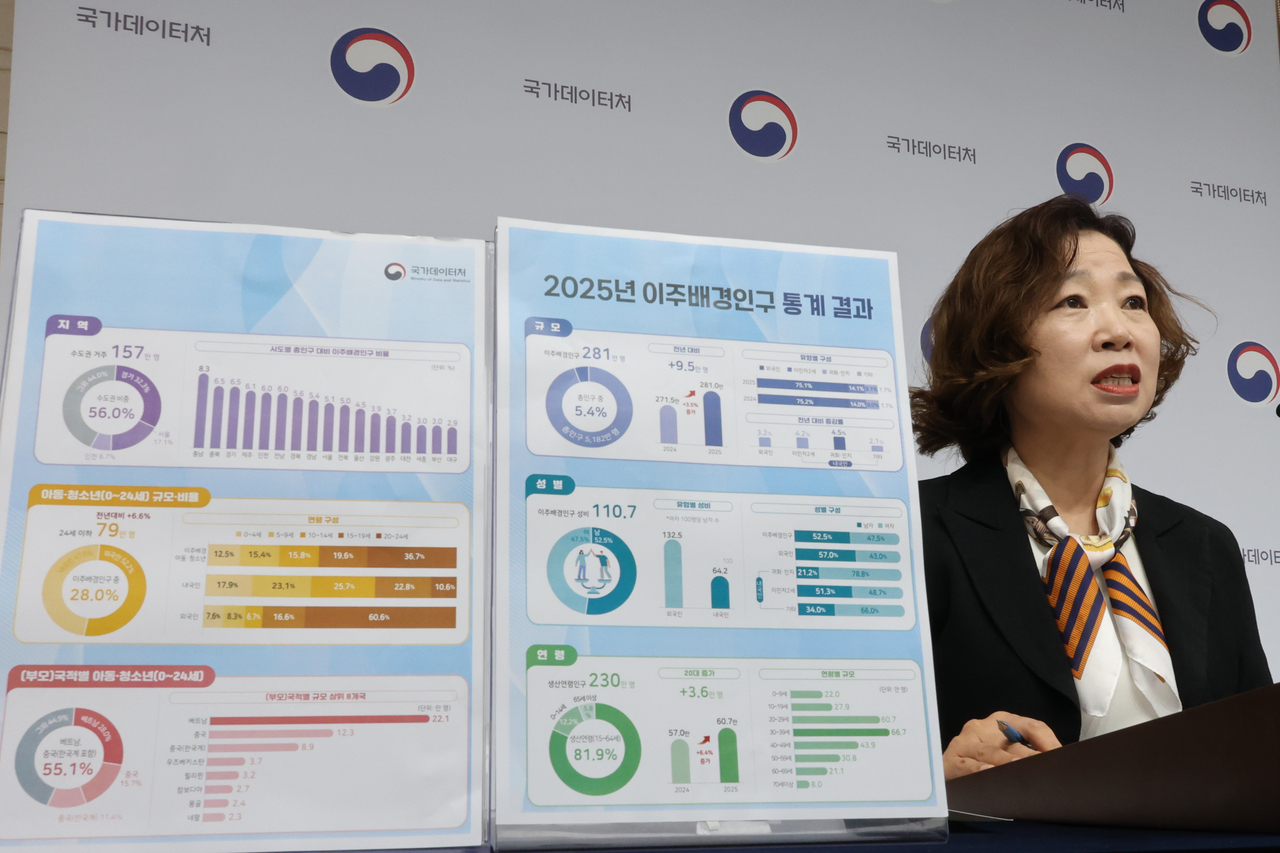
Nearly one in three residents aged 24 or younger in Goseong, Gangwon Province, had a migrant background last year, the highest share nationwide and more than four times the national average, government data showed Monday.
According to the Ministry of Data and Statistics’ 2025 report on the migrant-background population, 1,402 of Goseong County’s 4,429 residents in that age group had migrant backgrounds as of Nov. 1, 2025. They accounted for 31.7 percent, compared with 7.7 percent nationwide.
Of those in Goseong, 1,204 were foreign nationals, while 198 held Korean citizenship.
The ministry said foreign nationals in areas such as Goseong, Eumseong in North Chungcheong Province and Busan’s Jung-gu were mainly international students and foreign workers. In other counties, including Yeongam and Jindo, naturalized marriage migrants and their children were more prominent.
The statistics cover people who had lived in Korea for at least three months.
The migrant-background category includes foreign nationals, naturalized citizens, Korean-born children of foreign or naturalized parents, North Korean defectors and their children, and certain other citizenship categories.
Rural counties lead in share
Goseong was followed by Yeongam at 28.8 percent, Eumseong at 26.9 percent and Busan’s Jung-gu at 23.3 percent.
Nine cities, counties and districts recorded shares of at least 20 percent. The areas with the highest proportions were largely rural counties with relatively small populations of children and young adults.
In absolute numbers, however, cities in Gyeonggi Province had the largest migrant-background populations aged 24 or younger. Ansan led with 24,986, followed by Suwon with 19,057, Hwaseong with 18,974, Siheung with 16,647 and Bucheon with 15,340.
Nationwide, the number of children and young adults with migrant backgrounds reached 787,000 last year, up 6.6 percent from a year earlier. Foreign nationals accounted for 52.2 percent, while Korean citizens made up 47.8 percent.
Their share of the population aged 24 or younger rose from 6.3 percent in 2023 to 7.7 percent in 2025.
The trend contrasts with a shrinking youth population overall. Between 2023 and 2025, Korea’s population aged 24 or younger fell from 10.83 million to 10.18 million, while those with migrant backgrounds increased from 684,000 to 787,000.
Vietnam was the most common national background among these children and young adults, accounting for 28.0 percent, followed by China at 15.7 percent and ethnic Koreans from China at 11.4 percent.
For foreign nationals, the classification reflects their current nationality. For Korean citizens, it reflects their own former nationality or a parent’s foreign nationality.
Growth offsets population decline
The growth extended beyond younger age groups.
Korea’s total migrant-background population reached 2.81 million in 2025, an increase of 95,000, or 3.5 percent, from the previous year. They accounted for 5.4 percent of the country’s population of 51.82 million.
That growth more than offset a decline of 83,000 among Korean citizens classified as having no migrant background, leaving the total population up by 12,000.
The migrant-background population was also considerably younger than the overall population.
People aged 15 to 64 accounted for 81.9 percent of the migrant-background population, compared with 69.2 percent nationwide. Those aged 65 or older made up 5.8 percent, compared with 20.7 percent overall.
One in 10 residents in their 20s had a migrant background, as did 9.5 percent of those in their 30s.
Kyung Eun-sook, head of the ministry’s population census division, attributed the relatively high shares among younger adults to arrivals for study, training and employment.
“Among people in their 20s and 30s, studying and training are major reasons for migration,” Kyung said. “Many younger migrants are also entering the manufacturing and construction sectors through the Employment Permit System and other nonprofessional employment programs.”
seungku99@heraldcorp.com