“I want our nation to become the most beautiful nation in the world... I do not want our nation to become the richest and powerful nation in the world. Because I have felt the pain of being invaded by another nation. I do not want my nation to invade others. It is sufficient that our wealth is such that it makes our lives abundant and our military strength such that it is able to repel others' invasion. The only thing that I desire in infinite quantity is the power of a highly-developed culture. This is because the power of culture both makes ourselves happy and gives happiness to others. …
I do not desire that our nation become a nation that imitates others. Rather, I desire that it become a nation that becomes the origin, the goal, and the model of this highly-developed and novel culture. I desire that a true world peace is fulfilled in, and because of, our nation.”
(Excerpt from “My Wish,” under the title “My Desire,” on the Kim Koo Museum & Library website)
The name Kim Koo burst into the international limelight when RM of BTS rapped, “Pardon me, Kim Koo seonsaengnim, tell me how you feel” in the song “Aliens” released in March.
Who was Kim Koo and why did RM invoke him?
Kim was born Kim Chang-am in 1876 in Haeju, located in today’s North Korea, during a turbulent time in Korean history. His life was panoramic.
He took on new names at various turning points in his life. He went by a total of nine different names, including the final name Kim Koo, which he took in 1912, and a Chinese alias he used while on the run from the Japanese authorities.
His penname, Baekbeom, which he took while in prison in the 1910s, expressed his goal: to be "the companion of the lowest and most ordinary Koreans" in the struggle for independence.
Kim had a voracious appetite for knowledge, and studied both the Chinese classics and Western ideas, which he quickly adopted.
He practiced different religions in sequence: steeped in Donghak (Eastern) learning in his teenage years, joining the Buddhist priesthood for a year and converting to Christianity in 1903.
Kim was not only a capable military leader, as demonstrated by his success in the Donghak Peasant Army, but was also dedicated to education and rural enlightenment.
As a key leader of the Provisional Government of the Republic of Korea, or KPG (he served as the “juseok,” or president, of KPG from 1940-1945), Kim pursued diplomacy, raised funds, masterminded armed attacks against Japanese officials and organized the Korean Independence Army.
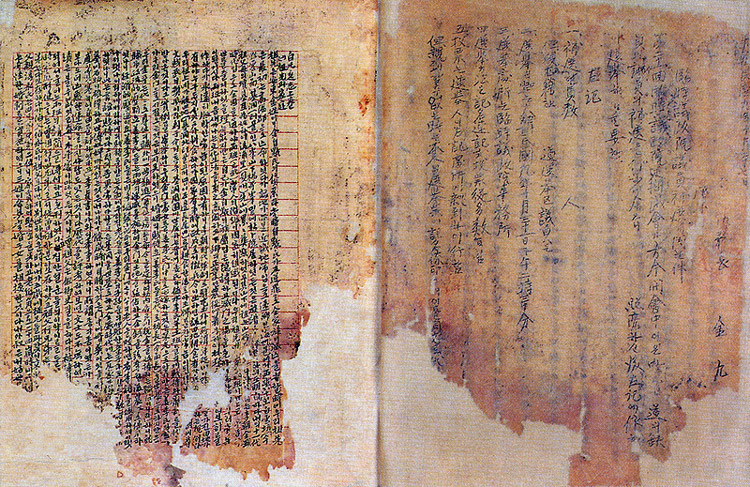
“Baekbeom Ilji,” or "The Diary of Kim Koo," a two-volume autobiography written in 1929 and 1943, details his life and gives first-hand accounts of KPG activities and his vision for the Korean nation.
“‘My Wish,’ an essay appended to the 1947 edition of the autobiography, is celebrated today for its prescient observation that culture leads to world peace.
The authorship of “My Wish,” however, is under debate, with many scholars attributing it to Lee Kwang-soo, a famous writer initially close to Kim who later became a pro-Japanese traitor.
The argument is based on the highly polished style of the essay compared to the original two volumes of the diary and its deviation from Kim’s emphasis on military strength found elsewhere in the autobiography.
In a book on the thoughts of Kim Koo and Lyuh Woon-hyung published by Changbi Publishers in February, historian Do Jin-soon, a foremost scholar on Kim Koo’s autobiography, notes that there has long been an argument that “My Wish” is Lee’s work. He proposes that Lee may have written the draft of the essay, adding that it was common practice to have someone else write a top leader’s speech or declaration.
“I think ‘My Wish’ was 100 percent written by Lee Kwang-soo,” Lee Sin-cheol, secretary general of Korea-Japan Peace Forum, told The Korea Herald on Oct. 6. “However, did he write it all on his own? It would be difficult to say that.”
Lee said that Kim Koo had thoughts about the importance of culture. “Also, the concept of national self-reliance in the essay aligns with Kim Koo’s philosophy,” he added. “Its emphasis on liberalism also does not deviate largely from Kim Koo’s thoughts.”
Jongsoo Lee, whose first-ever English translation of Kim Koo’s autobiography, “Paekpom Ilchi: The Autobiography of Kim Ku,” was published in 2000, characterized Kim as “first and foremost a Korean nationalist.”
“When I first read ‘My Wish’ in the early 1990s, I could not conceive of how Korea would one day become a global cultural powerhouse,” Lee said in an e-mail interview with The Korea Herald.
“Reading his writings makes one realize that he was not a radical terrorist but, rather, a man of peace who understood ‘soft power.’”
cap:
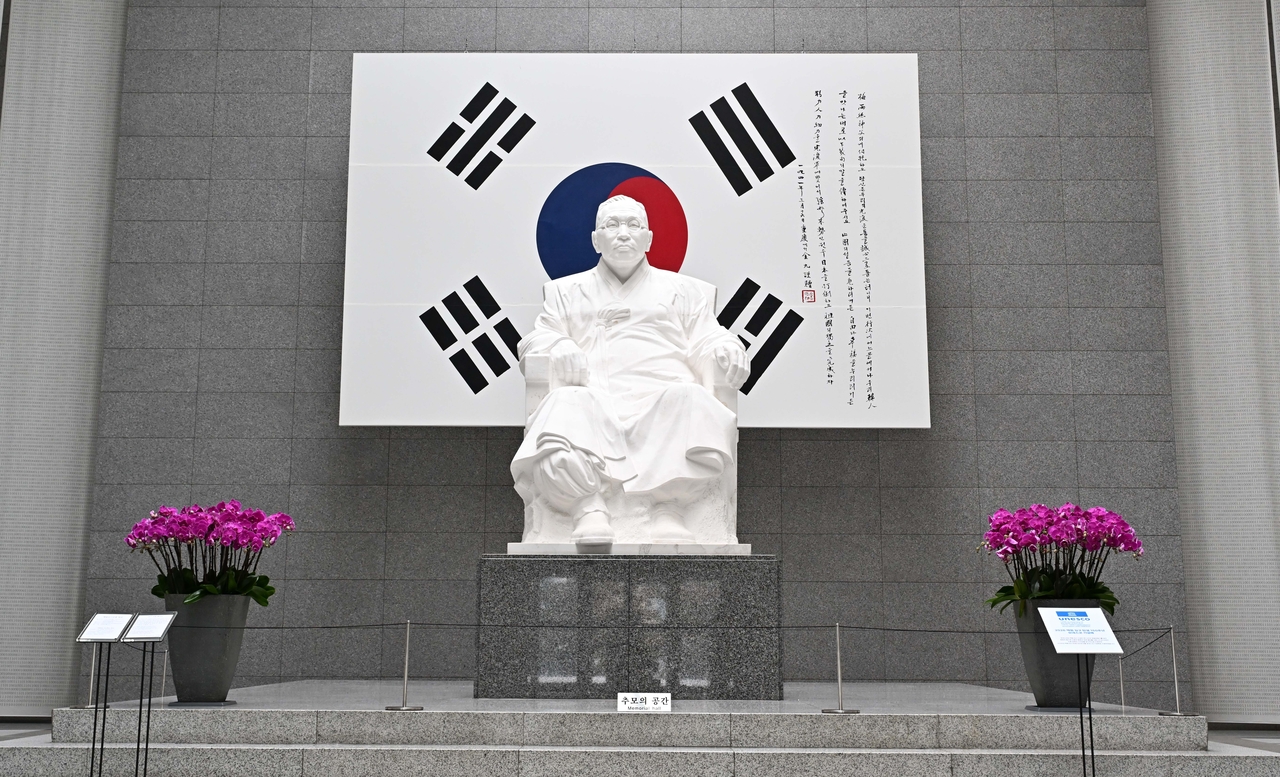
Statue of Kim Koo at Kim Koo Museum & Library in Seoul (Lee Chang-sub/The Korea Herald)