DP Rep. Kim Yong-man, Kim Koo's great-grandson, warns against historical distortion
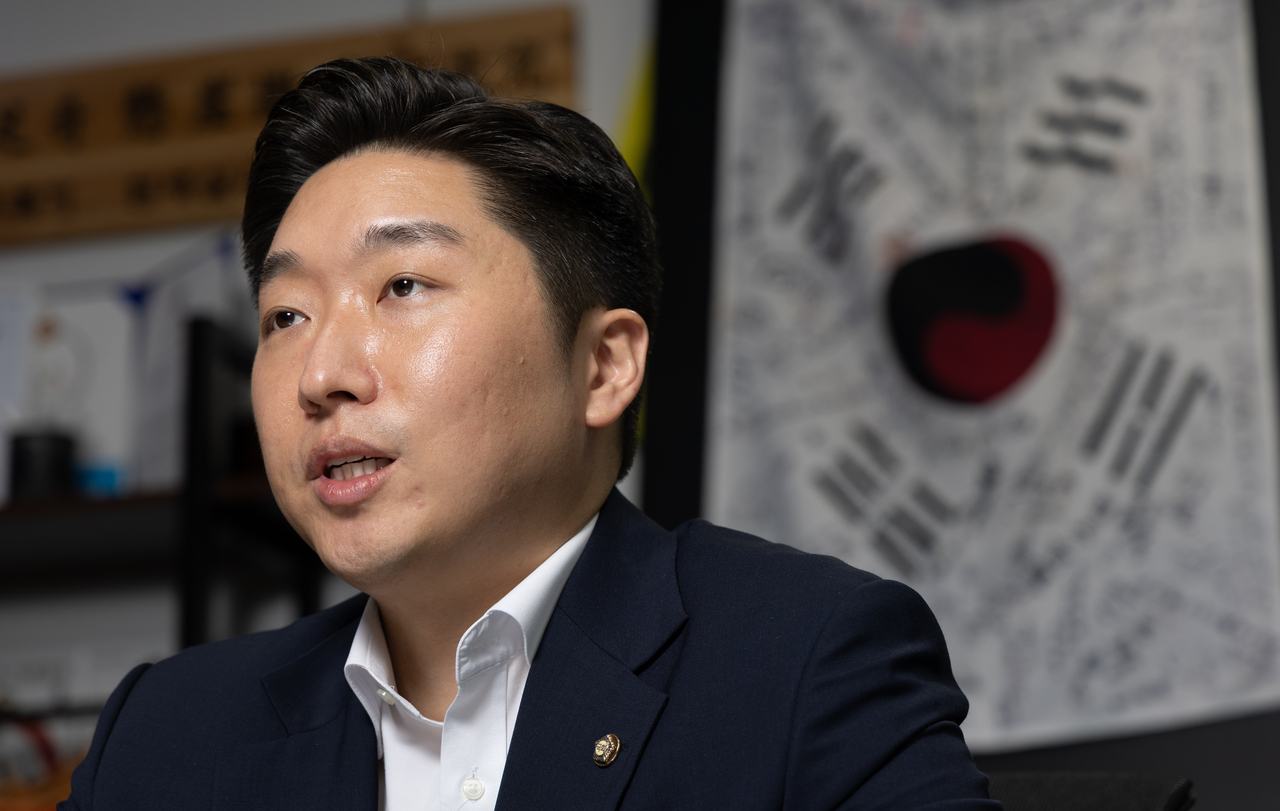
Democratic Party of Korea Rep. Kim Yong-man’s office is filled with memorabilia related to independence activist Kim Koo.
The first-term legislator, who represents Hanam-eul, Gyeonggi Province, occupies room No. 815 of the National Assembly Members’ Office Building. The number evokes Korea’s Liberation Day, Aug. 15.
The references to Kim Koo and Korean independence are only natural: Kim Yong-man, 40, is a great-grandson of Kim Koo. There is even a slight physical resemblance between the two.
“I can talk about him through the stories told by my grandfather Kim Shin, Kim Koo’s younger son and former chief of staff of the Republic of Korea Air Force,” Kim Yong-man said during an interview with The Korea Herald at his office on Sept. 1, when asked how Kim Koo is remembered in the family.
“In Kim Shin’s stories, Kim Koo is a cool-headed family member rather than a benevolent or patriotic figure,” he continued.
Growing up in China, Kim Shin was often left at orphanages, as it became difficult for Kim Koo, constantly on the move as an independence movement leader, to raise him, according to Kim Yong-man.
“Kim Koo’s mother, Kwak Nak-won, would bring her grandson back from the orphanages. This happened several times. Understandably, Kim Shin was hurt,” he said.
“Later, when Kim Shin realized the importance of the independence movement, he accepted that the decision (to send him to orphanages) had been made for the sake of his work to save the country,” Kim Yong-man said.
“Ultimately, Kim Koo was a figure dedicated to the country, not a person who took care of his family.”
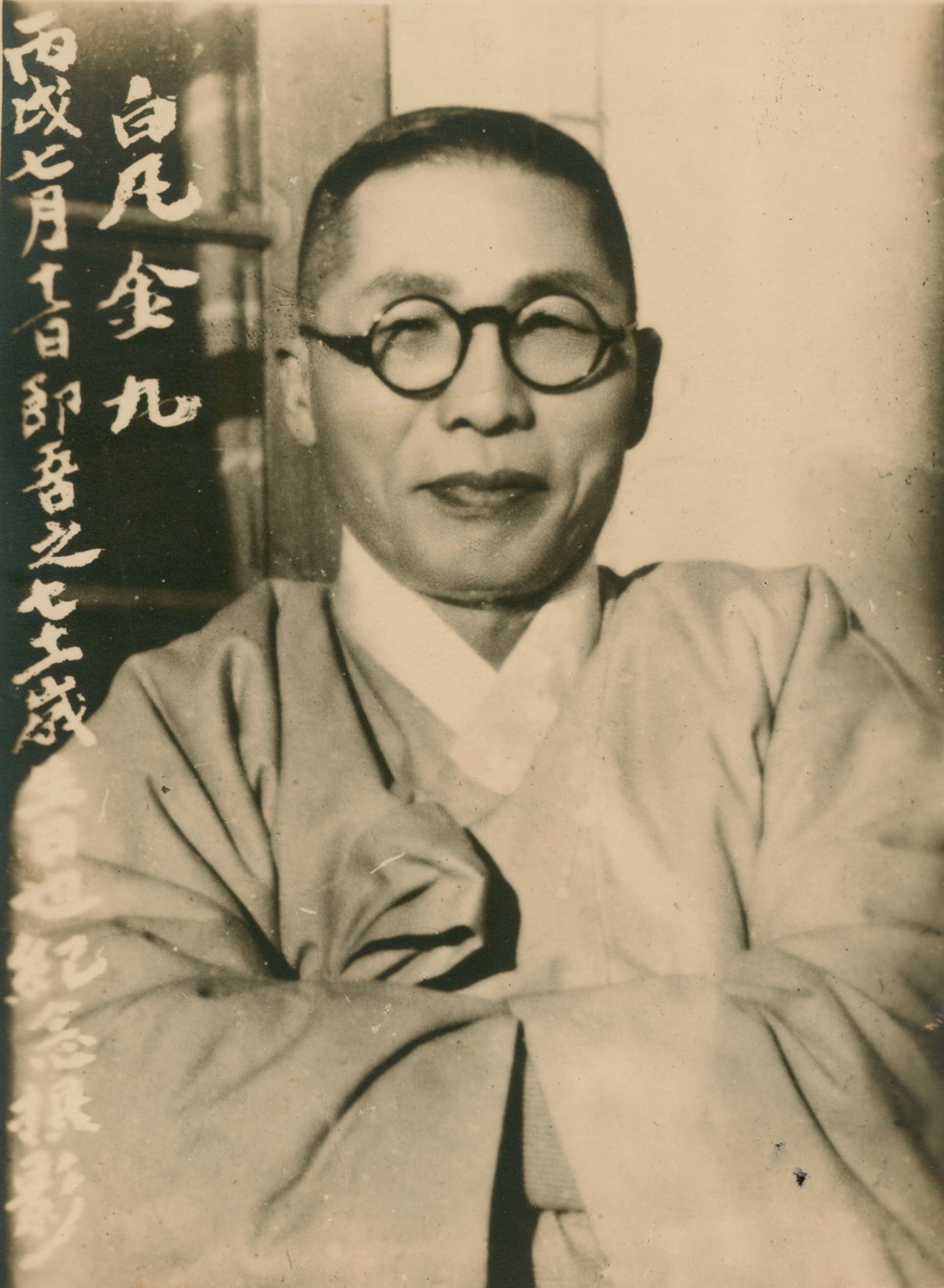
Kim Koo, the visionary
“When we talk about Kim Koo, we typically talk about the independence activist Baekbeom, (the first president) of the Provisional Government of the Republic of Korea. However, the independence movement was not considered in designating the UNESCO celebration year,” said Kim Yong-man.
He was referring to this year’s commemoration of the 150th anniversary of Kim Koo's birth, celebrated in association with UNESCO under the theme, “My Wish, Culture of Peace.”
“There is a misunderstanding that UNESCO designated the commemorative year for the independence activist Kim Koo. This isn’t the case,” he said.
What the UNESCO-associated anniversary celebrates is Kim Koo, who, in 1947, dreamed of peace achieved through the power of culture, Kim Yong-man pointed out.
As Kim explained, Kim Koo’s vision mirrors the goals of UNESCO and the UNESCO World Conference on Cultural Policies and Sustainable Development (MONDIACULT), which, in 2025, declared culture as a "mediator in conflict resolution" and a cornerstone of peacebuilding.
“So, I wish that, at least this year, Kim Koo would be remembered as someone who harbored a vision of world peace achieved through the power of culture, rather than as the independence activist Kim Koo,” said Kim Yong-man.
What would Kim Koo say if he could see the global popularity of Korean culture and Korea’s growing soft power?
“In the past, there was a ‘Korea discount’ deriving from Korea’s status as a country in a state of armistice," Kim Yong-man said, referring to the truce in place since the 1950-53 Korean War ended without a peace treaty.
"As we have come to be recognized internationally for our culture, anything with a 'K,' be it K-cinema, K-food or K-beauty, now commands a premium. I think we are close to becoming the nation of advanced culture that Baekbeom dreamed of,” he said.
While there are many events celebrating the special Kim Koo year, there have also been attempts to distort or denigrate his achievements.
When Seoul Dairy Co-op released a limited-edition milk package featuring a portrait of Kim Koo and an excerpt from his famous 1947 essay “My Wish,” some far-rightists took to social media, attacking Kim Koo as a “commie” and calling for the boycott of the brand.
The smear campaign backfired when consumers, upset by the blatant distortion, fought back online and the sales of Seoul Dairy Co-op products rose.
Kim Yong-man pointed to the failure to hold pro-Japanese collaborators accountable following Korea’s liberation as a reason for the continued controversy over Kim Koo's legacy.
“When the Syngman Rhee regime came to power, pro-Japanese collaborators joined the government in droves. The Special Investigation Committee of Anti-National Activities was dissolved midway,” he said. Established in 1948 to purge pro-Japanese collaborators, the committee was disbanded less than a year later without significant achievements.
“And then the Korean War broke out, followed by the division of the peninsula. Ultimately, I think the pro-Japanese collaborators’ influence remains to date,” the lawmaker said.
This year, another attempt will be made to settle past history.
“There was an attempt to recover pro-Japanese collaborators’ assets in 2006 and there is another effort underway in 2026,” he said, referring to the first presidential Investigative Commission on Pro-Japanese Collaborators’ Property, active from 2006 to 2010, and the second commission, to be inaugurated in December with a mandate of a maximum of five years.
The first commission recovered land worth 237.3 billion won from 168 people; the second commission expects to recover 32.5 billion won.
Fighting historical distortion
Kim Yong-man suspects that organized groups related to pro-Japanese collaborators are behind the attempts to distort history.
“They do not want to lose their power, so they try to interpret history the way they wish to. I think there are attempts at historical revisionism,” he said.
“Such efforts continue in Korea in 2026,” he said, citing the example of the criminally indicted Kim Byeong-heon, a far-right figure who claims that Korean women forced into Japanese military sexual slavery during the Japanese colonial period were voluntary prostitutes. Investigations have shown that he received 76 million won in funding from right-wing organizations in Japan over a period of five years.
Kim Byeong-heon’s incendiary speech and actions against the victims of Japanese military sexual slavery led to the speedy passage of a revision to the Act on Protection, Support and Commemorative Projects for Victims of Japanese Military Sexual Slavery Under Japanese Colonial Rule, also known as the Comfort Women Victims Act, in February.
“The fact that a law is needed to protect them (the victims), when they should be taken care of even without legislation, is deeply regrettable,” said Kim Yong-man, who played a key role in the passage of the revised law.
To counter those who seek to distort history to advance their own interests, Kim Yong-man emphasized that the government and civil society must strive to remember history and be on the alert for hate speech masquerading as freedom of expression.
“We will then be able to protect historical justice."