

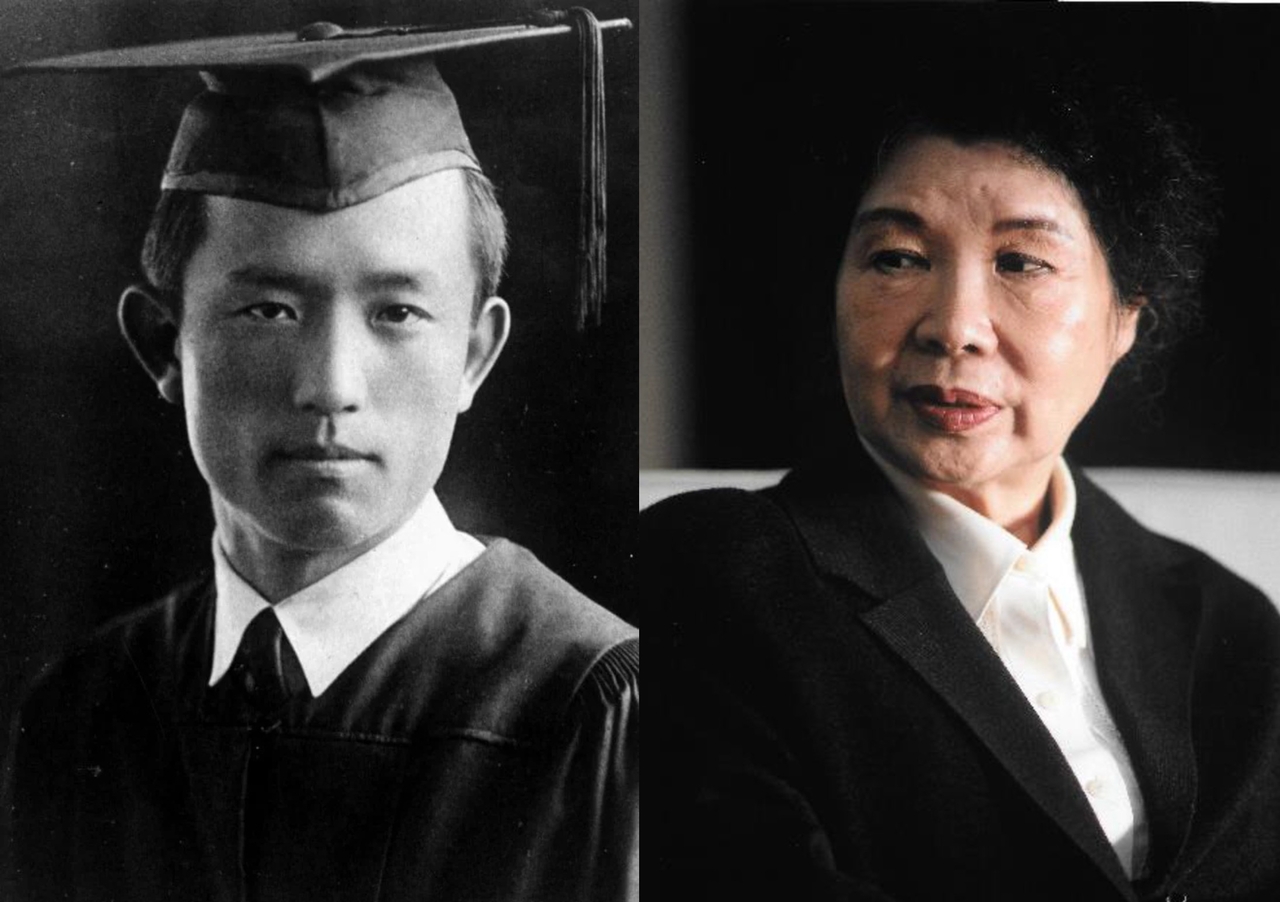
Yoon Dong-ju, one of Korea’s most beloved poets, whose introspective Korean-language poetry captured the pain of life under Japanese colonial rule, and Kim Nam-jo, one of the most prominent female poets of postwar Korea, were posthumously awarded the Geumgwan Order of Cultural Merit, the country’s highest cultural honor, on Monday.
Born in 1917 in Longjing, in what is now China’s Jilin province, Yoon graduated from Yonhi College, now Yonsei University, in 1941 and went to study in Japan, first at Rikkyo University in Tokyo and then at Doshisha University in Kyoto. In 1943, Japanese police arrested him on suspicion of anti-Japanese activity. He died in Fukuoka Prison on Feb. 16, 1945, at the age of 27.
His work was not published as a book during his lifetime. “Sky, Wind, Star and Poem,” his posthumous collection of 31 poems, came out in 1948 with an introduction by poet Chong Ji-yong. Its poems, including “Prologue” and “A Night I Count the Stars,” are among the most widely read in modern Korean literature. In 1990, Yoon was posthumously awarded the Order of Merit for National Foundation for his part in the independence movement. Monday’s medal recognizes him as a literary figure, 81 years after his death.
Kim, often called "the poet of love," wrote more than 1,000 poems over seven decades before she died in 2023 at 96 years old. According to the ministry, she published 19 poetry collections during her literary career and worked to bring Korean poetry to readers at home and abroad.
Born in Daegu in 1927, Kim debuted in 1950 and published her first collection, “Life,” in 1953. She is best known for “Winter Sea.” She taught at Sookmyung Women’s University for decades, led the Society of Korean Poets and put out her last collection at 93.
In all, 17 people received Orders of Cultural Merit this year.
The Eungwan Order, the second-highest grade, went to cartoonist Lee Hyun-se, poet Yu An-jin, actors Jeon Moo-song and Park Jung-ja, and the late painter Chung Sang-hwa, a leading figure in "dansaekhwa," Korean monochrome painting.
Novelist Kim Ae-ran and art director Jung Ku-ho were among six winners of the Korea Culture and Arts Award, which comes with a presidential citation and 10 million won ($7,600). Eight people received the Young Artist Award. They include craft artist Park Jong-jin, this year’s winner of the Loewe Foundation Craft Prize.
“Today’s K-culture stands on the dedication and sacrifice of those honored here,” Culture Minister Chae Hwi-young said. “The ministry will do its best so that artists of the present and future can work in better conditions than they do now.”
gypark@heraldcorp.com