
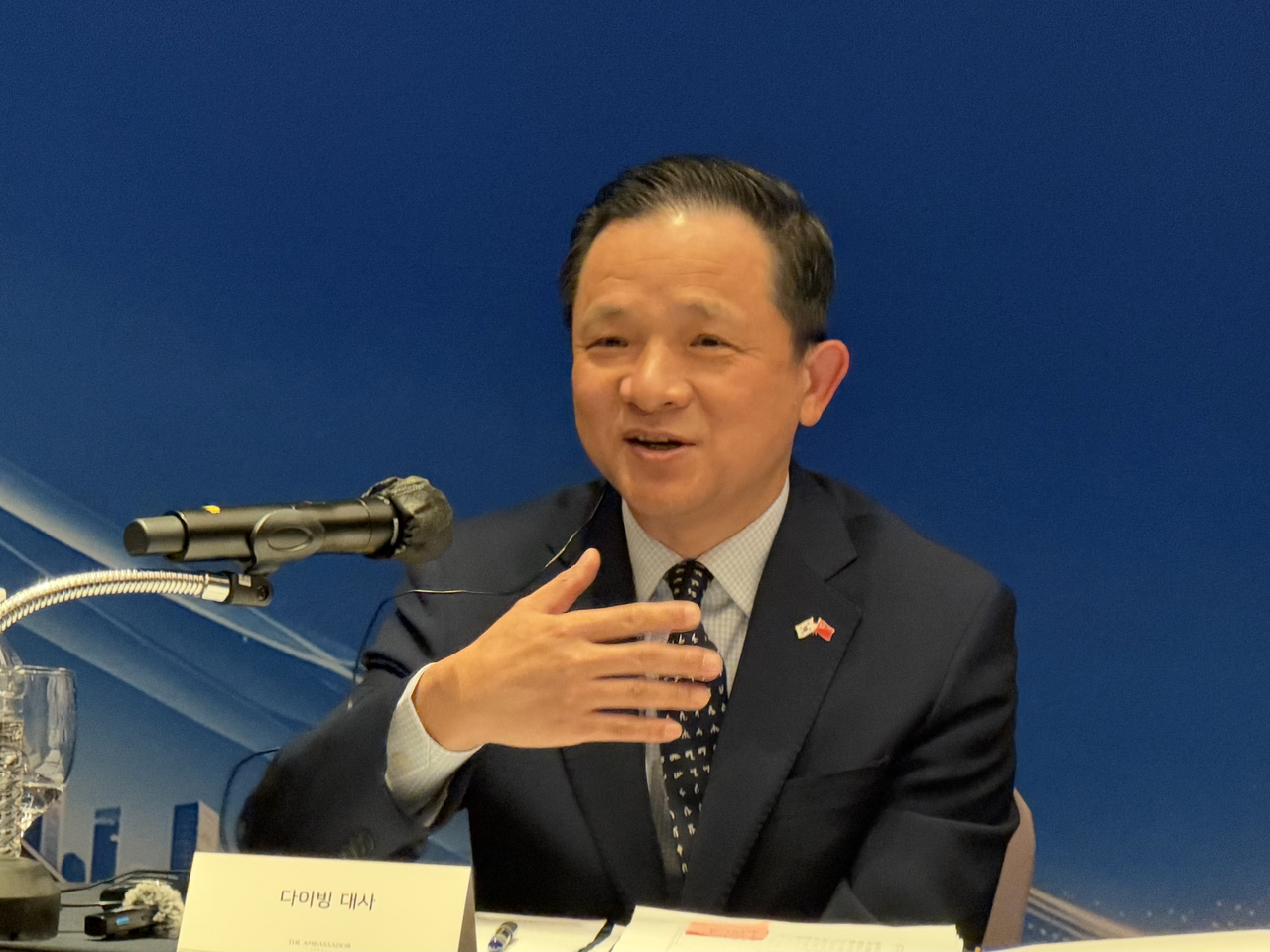
Dai Bing voices concerns over alliance modernization, eyes stronger Seoul-Beijing ties ahead of 35th anniversary of diplomatic relations
Chinese Ambassador to South Korea Dai Bing said Thursday that the South Korea-US alliance should not be used to counter China.
Expressing concerns over ongoing discussions on alliance modernization and strategic flexibility, he called on Seoul to maintain its strategic autonomy.
Beijing seeks to build on recent momentum in South Korea-China relations after President Lee Jae Myung met Chinese President Xi Jinping on the sidelines of the Asia-Pacific Economic Cooperation summit in Shenzhen last week. The two countries are also set to mark the 35th anniversary of diplomatic relations next year.
"Expressions such as the so-called modernization of the South Korea-US alliance and strategic flexibility are concerning," Dai said during a press conference in central Seoul.
"Judging from recent remarks by serving US officials, China's concerns are not unfounded."
Alliance modernization has emerged as a key agenda item between Seoul and Washington since last year, amid discussions about expanding the alliance's role in addressing regional security challenges beyond the Korean Peninsula.
While acknowledging the historical background of the alliance, Dai made clear Beijing's opposition to any shift in its strategic orientation toward countering China.
"China has never asked South Korea to choose between the United States and China," Dai said. "Nor do we want the South Korea-US alliance to become a factor constraining the development of South Korea-China relations."
He expressed the hope that Seoul would maintain its strategic autonomy while managing its relations with both Washington and Beijing.
On North Korea's advancing nuclear capabilities, however, Dai reiterated Beijing's longstanding position on nuclear nonproliferation without outlining specific measures to address Pyongyang's growing nuclear threats.
Describing the nuclear issue as one of the key factors that have complicated the situation on the Korean Peninsula for decades, Dai said China's commitment to upholding the authority of the Treaty on the Non-Proliferation of Nuclear Weapons, or NPT, remained unchanged.
Dai said Lee and Xi exchanged views on Korean Peninsula issues during their recent bilateral meeting in Shenzhen, with Xi explaining developments in China-North Korea relations and reaffirming the continuity and stability of Beijing's policy toward the peninsula.
He stressed that maintaining stability on the Korean Peninsula was in the common interests of Seoul and Beijing.
Beijing rejects 'Yalta 2.0' comparisons
Dai also dismissed concerns that the recent trilateral summit between the US, China and Russia in Shenzhen represented a modern-day Yalta Conference, amid speculation that major powers could seek to reshape the international order without adequately consulting smaller countries.
"At the Yalta Conference more than 80 years ago, a handful of major powers simply drew lines on a world map with a red pen," Dai said.
"The latest meeting, by contrast, should be understood as an effort to put the brakes on an increasingly unstable international situation."
The remarks came amid concerns in South Korea that discussions among major powers could have implications for the security landscape on the Korean Peninsula.
Building momentum in Seoul-Beijing ties
Despite differences over regional security issues, Dai expressed optimism about bilateral relations ahead of the 35th anniversary of diplomatic ties in 2027.
He said the substantial conclusion of second-phase negotiations on the South Korea-China free trade agreement would elevate bilateral economic cooperation, while highlighting growing exchanges between the two countries.
As an indication of improving relations, Dai noted that the recent meeting between Lee and Xi in Shenzhen lasted 36 minutes, exceeding the originally scheduled 25 minutes.
He also recalled Lee taking a selfie with Xi and their spouses during his visit to China in January, describing it as a memorable moment.
"Spending the weekend in Shanghai or Seoul has become a trend among young people in both countries," Dai said, projecting that cross-border visits between the two countries would exceed 10 million this year.
Following Seoul's recent decision to extend visa-free entry for Chinese group tourists, Dai said Beijing was reviewing an extension of its own visa-free entry policy, including for South Korean nationals.
The ambassador also expressed concern over lingering anti-China sentiment in South Korea, arguing that closer bilateral cooperation would serve the interests of both countries.
"An open and stable China is not a threat to South Korea, but its greatest opportunity," Dai said, citing a survey conducted by the Chinese Embassy in cooperation with Gallup Korea that he said showed more than 80 percent of respondents supported bilateral cooperation.
Dai added that the two leaders had reached a consensus on holding major commemorative events next year, with both countries exploring various initiatives, including high-level engagements.
Asked whether Beijing would lift its unofficial restrictions on South Korean cultural content, including K-pop performances, Dai stopped short of offering a definitive answer.
Instead, he emphasized the leaders' agreement to promote "gradual, healthy and beneficial cultural exchanges," suggesting that Beijing would favor a phased expansion of cultural engagement.
Taiwan controversy affects panda diplomacy
Dai also revealed that a Taiwan-related controversy in South Korea had affected discussions on sending additional giant pandas to the country.
Lee had requested a pair of giant pandas during his visit to China in January, but no decision on their transfer has been made.
Dai attributed the delay in part to a Taiwan-related controversy in Gwangju in August, which he said had prompted strong public reactions in China.
"Given public sentiment in China, the conditions are not yet in place for pandas to be sent to Gwangju," he said.
According to Dai, South Korea is currently home to five of the approximately 40 giant pandas living outside China, the second-largest number after the US.
The ambassador expressed regret over the situation, while calling on Seoul to uphold Beijing's one-China principle.
"The Taiwan issue concerns China's core interests and is a red line that must not be crossed," he said.
Meanwhile, addressing Washington's latest tariffs on Chinese goods, Dai said Beijing remained open to dialogue but was prepared to take countermeasures if necessary, stressing that there would be no winners in a tariff war.
He also indicated that Xi was likely to attend the Group of 20 summit in the US next month.
Asked about recent allegations surrounding South Korean Ambassador to China Roh Jae-heon, Dai declined to comment, describing the matter as South Korea's domestic affair.
Referring to the role of Roh's father, former President Roh Tae-woo, in establishing diplomatic relations between Seoul and Beijing, Dai cited a Chinese proverb: "When drinking water, never forget those who dug the well."
mkjung@heraldcorp.com