Pyongyang's elite flaunt Western luxury brands as Russia-fueled growth masks deepening inflation and widening inequality, analysts say
From Dior handbags and Cartier watches to luxury yachts and high-end smartphones, North Korea's ruling elite appear to be enjoying increasingly lavish lifestyles, even as ordinary citizens grapple with soaring food prices and a weakening currency.
The growing visibility of luxury consumption in Pyongyang has fueled perceptions that North Korea is experiencing an economic revival, buoyed by its expanding military and economic cooperation with Russia.
But analysts warn that the apparent prosperity masks a far more troubling reality: a recovery concentrated among the political elite and military-industrial sector, with limited benefits for the broader population.
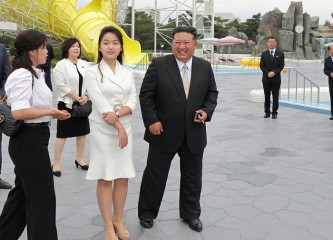
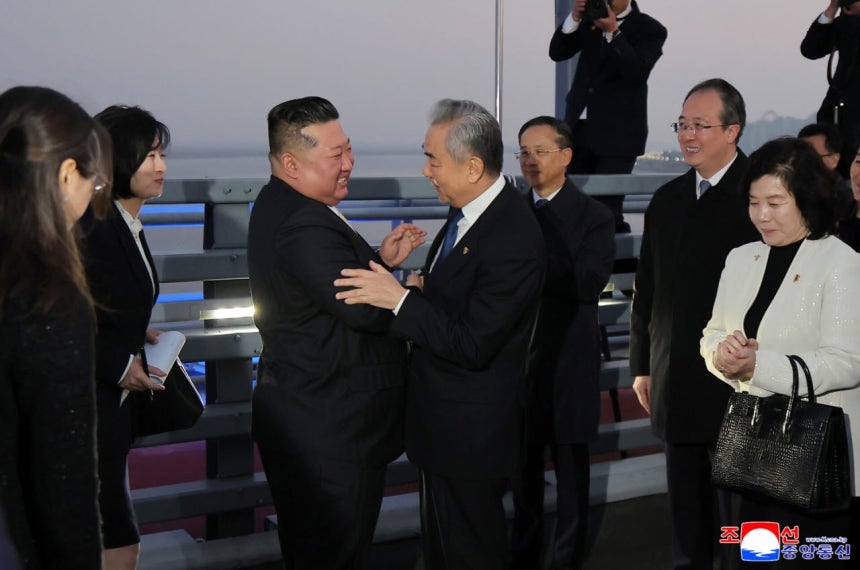
The contrast was on display during North Korean leader Kim Jong-un's visit to Dandong, China, on Oct. 24, when his younger sister Kim Yo-jong and Foreign Minister Choe Son-hui were photographed carrying what appeared to be designer handbags.
According to an Oct. 26 report by US-based North Korea-focused outlet NK News, Choe was seen carrying a Saint Laurent leather handbag listed on the brand's website for approximately $3,500. She had been spotted with the same bag during a 2024 visit to Moscow.
Kim Yo-jong, meanwhile, appeared to be carrying a Dior handbag. She had previously been photographed with what was believed to be a Lady Dior bag in 2023 during Kim Jong-un's visit to a fighter jet manufacturing facility in Russia. The handbag was reportedly priced at more than $6,000 at the time.
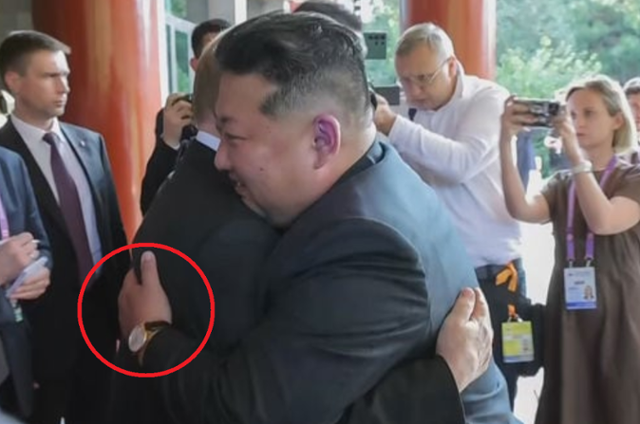
Kim Jong-un himself has also displayed a taste for expensive Swiss watches. The leader was photographed wearing what appeared to be an IWC Schaffhausen Portofino Automatic watch, valued at $14,100, while embracing Russian President Vladimir Putin during a military parade in Beijing marking the 80th anniversary of the end of World War II in September last year.
Kim, who attended school in Switzerland, was seen wearing the same watch at several public appearances in recent years, including during his 2023 visit to Russia.
The penchant for luxury goods extends across the ruling family.
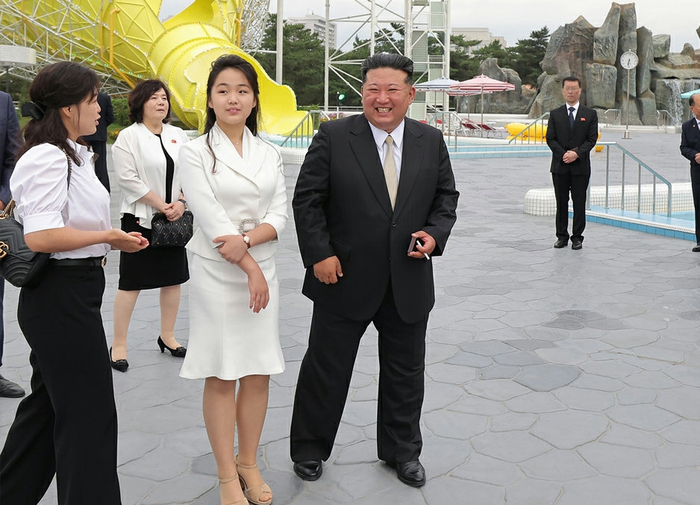
Kim's wife, Ri Sol-ju, has been photographed carrying handbags believed to be from Dior, Chanel and Gucci at official events. His daughter, Kim Ju-ae, has appeared in expensive designer clothing and accessories, including a Dior coat reportedly worth around $2,800 and a watch believed to be a Cartier model valued at approximately 30 million won ($21,000).
The display of wealth has also extended beyond fashion accessories.
The BBC reported in October that satellite imagery captured an approximately 80-meter luxury yacht repeatedly appearing in waters off Wonsan between July and mid-October. The vessel appeared to feature a large swimming pool and waterslide facilities, with comparable superyachts costing tens of millions of dollars.
Such displays have renewed questions about how luxury goods continue to reach North Korea despite United Nations Security Council sanctions imposed following Pyongyang's first nuclear test in 2006. Resolution 1718 prohibits the supply of luxury goods to the country, although the precise scope of prohibited products depends on how the restrictions are implemented.
The contrast is particularly striking given the regime's long-standing emphasis on self-reliance and criticism of Western consumer culture.
In a photograph published in the April edition of North Korea's state-run monthly pictorial Choson, Foreign Minister Choe was seen wearing what appeared to be a jacket from Canadian luxury outerwear brand Moose Knuckles while attending a tree-planting event with Kim Jong-un in Pyongyang.
The event, held in March, was promoted as a demonstration of patriotism and dedication to the people.
Yet luxury consumption is no longer confined to the ruling family and senior officials.
It is also becoming increasingly visible in Pyongyang's upscale retail establishments. At Daesong Department Store, a multistory shopping complex in the capital's Taedonggang District that reopened after extensive renovations in 2019, imported luxury watches, cosmetics and electronics are displayed alongside domestic consumer goods.
The store, which also houses restaurants and recreational facilities, has long catered to Pyongyang's more affluent shoppers. According to a recent Financial Times report, products from international luxury brands including Omega and Chanel are available at the department store, reportedly entering North Korea through parallel import channels involving China despite international sanctions.
The capital has also witnessed the emergence of smartphone-based taxi-hailing services, QR-code payment systems and premium mobile phones costing as much as $500.
The transformation has coincided with an influx of resources from Russia, which has deepened military and economic cooperation with Pyongyang since the outbreak of the war in Ukraine.
South Korea's Institute for National Security Strategy estimated that the economic value of North Korean military supplies and personnel provided to Russia reached approximately $11 billion by the end of 2025. Assuming similar levels of cooperation this year, the cumulative value could reach roughly $16 billion by the end of 2026.
North Korea's economy has also recorded three consecutive years of growth, according to Bank of Korea estimates, expanding 3.1 percent in 2023, 3.7 percent in 2024 and 3.5 percent in 2025.
But the figures tell only part of the story.
A boom for the regime, not the people
Lim Soo-ho, a researcher at the Institute for National Security Strategy, cautioned in a report published last month against interpreting North Korea's visible economic transformation as evidence of a broad-based recovery.
He argued that the country's recent growth has been driven largely by military production and state-directed construction projects, while ordinary citizens face a severe deterioration in purchasing power.
According to figures Lim cited, the North Korean won has plummeted against the US dollar and Chinese yuan. North Korea's official rate is pegged at 130 won to the dollar, but in practice, the amount of won each currency could buy surged by 646.5 percent and 697.2 percent, respectively, between the first quarter of 2024 and the third quarter of 2026.
Over the same period, rice prices rose 599.4 percent, corn prices climbed 447 percent, and pork prices increased 368.3 percent. Gasoline and diesel prices surged 527 percent and 669.8 percent, respectively.
The figures suggest that the apparent economic revival has coincided with a dramatic erosion of household purchasing power, particularly among North Koreans who depend on informal marketplaces, known as "jangmadang," for daily necessities.
Lim characterized the current situation as a temporary expansion of regime finances fueled by wartime demand and inflation, rather than a genuine improvement in the national economy.
"What North Korea is experiencing is not a boom in the national economy, but a temporary boom in regime finances built on wartime windfalls and inflation-driven revenue extraction," Lim wrote.
He described the phenomenon as a form of "predatory growth," arguing that the visible prosperity of Pyongyang's privileged class should not be mistaken for a recovery in the country's underlying economic strength.
The distinction is rooted in North Korea's unusual economic structure.
Since the 1970s, the country's military economy, often referred to as the "second economy," has operated largely separately from the civilian economy administered by the Cabinet.
According to Lim, profits generated by the military generally remain within that sector, while resources from the civilian economy can be redirected toward military priorities.
This structure means that even substantial revenue from arms exports to Russia may do little to improve living standards for ordinary citizens.
The economic disparity is compounded by the concentration of resources in Pyongyang, where showcase construction projects and luxury commercial establishments have become increasingly visible and conditions in provincial areas remain difficult to assess.
Peter Ward, a North Korean economy specialist at the Sejong Institute, has similarly cautioned against interpreting the capital's transformation as evidence of nationwide prosperity, describing the current expansion as more of a "project boom" driven by leadership priorities than a broad-based economic recovery.
The sustainability of North Korea's recent growth also remains uncertain.
Lim warned that the country's growing dependence on Russia's wartime demand for weapons and ammunition could leave it vulnerable to a sharp economic reversal if the war in Ukraine ends or Moscow significantly reduces its purchases.
A sudden decline in military exports, combined with persistent inflation and excess liquidity, could destabilize both state-run distribution networks and informal markets, he argued.
For now, the contrast between Pyongyang's designer boutiques and the soaring cost of necessities illustrates the uneven nature of North Korea's economic recovery.
While the ruling elite enjoy imported luxury goods and the capital undergoes a visible transformation, the broader population remains exposed to inflation, economic uncertainty, and a system that prioritizes military production and political prestige over household welfare.
mkjung@heraldcorp.com