The United States on Wednesday abstained from a United Nations resolution condemning North Korea's human rights abuses for the first time since the annual measure was introduced in 2005.
The unprecedented departure from Washington's longstanding position has fueled speculation over whether US President Donald Trump seeks to pave the way for renewed dialogue with North Korean leader Kim Jong-un.
Trump is currently in China for the Asia-Pacific Economic Cooperation summit, and has continued to signal his willingness to meet Kim. Some believe Washington's decision was intended to create a more favorable diplomatic atmosphere for a potential encounter.
While the Trump administration attributed its abstention to objections over references to the International Criminal Court in the resolution, some North Korean experts interpreted the decision as part of a broader effort to ease tensions with Pyongyang, which has long condemned international criticism of its human rights record as interference in its internal affairs.
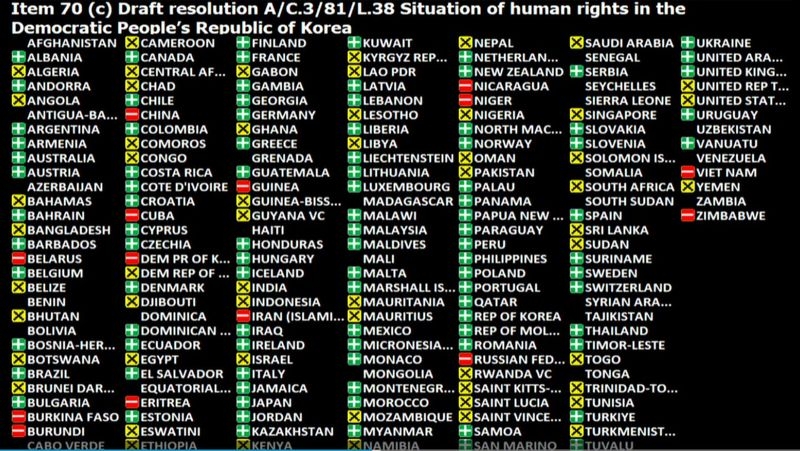
The UN General Assembly's Third Committee, which handles human rights and social affairs, adopted the resolution at UN headquarters in New York with 95 countries voting in favor, 14 against and 58 abstaining.
South Korea, Japan, Britain, France and Canada were among those supporting the resolution, while China, Russia, Iran and Cuba voted against it. The United States, traditionally one of the resolution's leading supporters and co-sponsors, abstained.
The decision was particularly striking because Washington had supported the annual measure throughout its history, while the resolution itself had been adopted by consensus without a formal vote since 2016.
This year, however, the United States declined to join the list of co-sponsors and requested a recorded vote, breaking with a decade of consensus-based adoption.
The unexpected development apparently caught North Korean representatives by surprise. North Korean Ambassador to the UN Kim Song took the floor to ask which country had requested the vote.
Before the vote, Kim had denounced the annual resolution as a "politically motivated provocation" intended to tarnish North Korea's international image and undermine its political system.
Washington insisted that its abstention did not represent a retreat from its commitment to addressing human rights abuses in North Korea.
US Ambassador to the UN Economic and Social Council Dan Negrea attributed Washington's abstention to objections over ICC-related language, stressing that the decision was "not a reflection on the situation" in North Korea.
"We have supported this resolution since 2004, and we have co-sponsored it in every UN General Assembly session for the past 22 years," he said, adding that Washington's commitment to North Korean human rights and accountability remained "unwavering."
The disputed language concerns a recommendation that the UN Security Council consider referring the situation in North Korea to the ICC to hold those responsible for serious human rights violations accountable.
Washington's objection centered on language calling on the UN Security Council to consider referring North Korea's human rights situation to the International Criminal Court to hold perpetrators accountable.
The Trump administration has challenged the ICC's jurisdiction and imposed sanctions on court officials following its issuance of arrest warrants for Israeli Prime Minister Benjamin Netanyahu and others. The US also abstained from a separate resolution on Myanmar's human rights situation, citing objections to ICC-related language.
Yang Moo-jin, distinguished professor at the University of North Korean Studies, said Washington's abstention should be viewed as part of a broader strategy to create a favorable atmosphere for renewed dialogue with Pyongyang, rather than merely an objection to ICC-related language.
"Although the US cited objections to the ICC-related language, the decision is actually part of a strategic approach aimed at creating an atmosphere conducive to US-North Korea dialogue," Yang said.
He highlighted what he described as Washington's implicit recognition of North Korea's nuclear-armed status, possible adjustments to joint military exercises, consideration of sanctions relief and the absence of a special envoy for North Korean human rights as signs of a broader diplomatic overture.
Yang also noted the contrast with South Korea, which supported and co-sponsored the resolution, urging Seoul to reassess the effectiveness of its approach to North Korean human rights and denuclearization.
He called on the government to clarify whether Washington had consulted Seoul before the vote, warning that an excessive emphasis on symbolic commitments to human rights and denuclearization could prioritize pressure over dialogue and ultimately worsen tensions.
South Korea, meanwhile, maintained its support for the resolution, which was adopted by the Third Committee for the 22nd consecutive year.
The resolution reiterated concerns over North Korea's "systematic, widespread and gross" human rights violations "that may amount to crimes against humanity," citing a September 2025 UN assessment that found conditions had largely stagnated or deteriorated over the past decade. It also highlighted growing concerns over digital surveillance and technology-enabled repression.
At Seoul's proposal, the text emphasized dialogue with Pyongyang, including inter-Korean engagement, and called for progress on humanitarian issues involving abductees, detainees, South Korean prisoners of war and families separated by the Korean War. It also encouraged North Korea to engage with UN human rights mechanisms.
South Korea's Foreign Ministry said the government would continue working with the international community to achieve tangible improvements in the human rights situation of North Korean people.
The resolution is expected to be submitted to the full UN General Assembly for final approval in December.
mkjung@heraldcorp.com