Court finds ban unconstitutional, gives lawmakers until 2028 to revise law
Can foreign residents in South Korea speak out against discrimination or call for policy changes without violating immigration law?
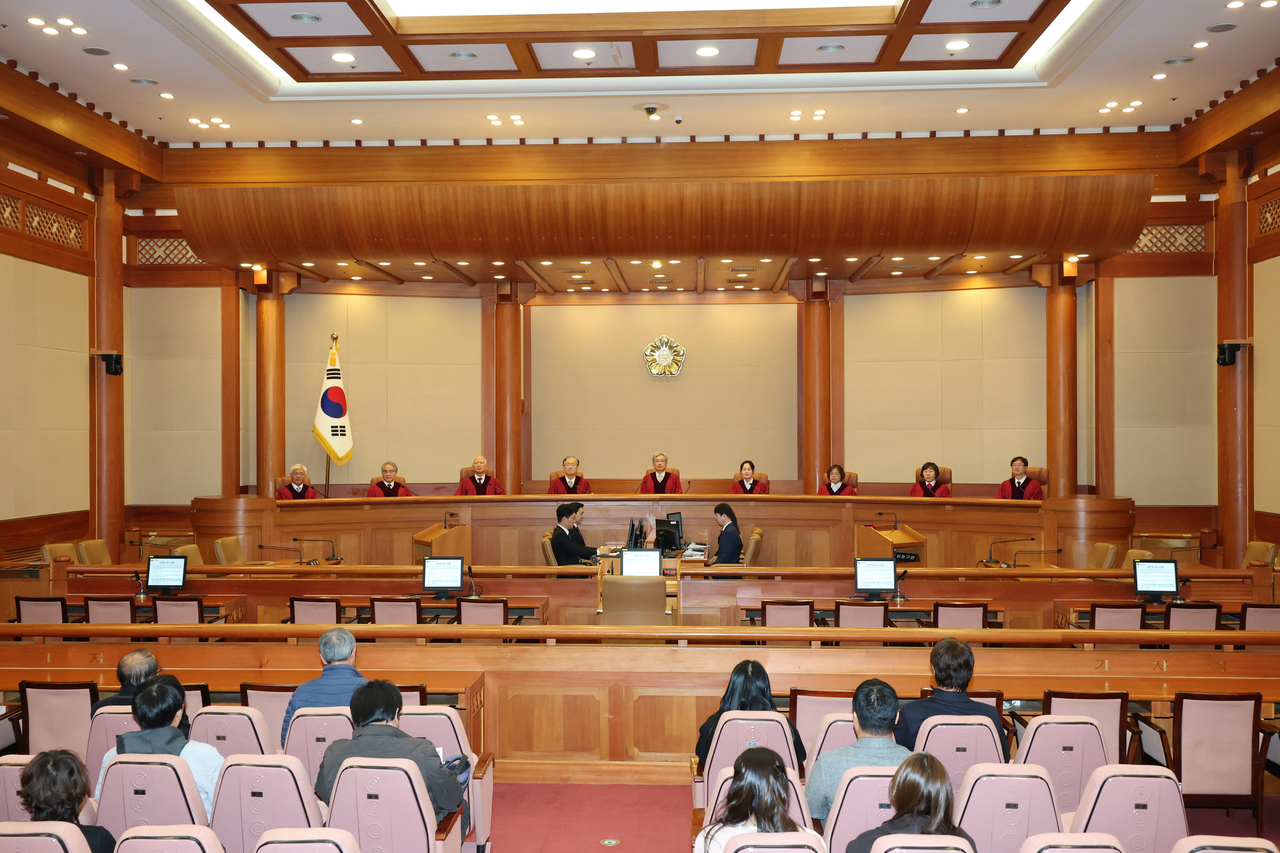
A landmark Constitutional Court ruling Thursday has brought them a step closer to doing so.
In a 6-3 decision, the court ruled that Article 17, Paragraph 2 of the Immigration Act, which imposes a blanket ban on political activities by foreign nationals, is incompatible with the Constitution, finding that it excessively restricts their freedom of expression.
Here is what the ruling means for foreign residents.
Why did the court find the ban unconstitutional?
While acknowledging the need to protect Korean citizens' sovereign decision-making, national security and public order, the court found that the blanket ban also restricts activities that pose no threat to those interests.
The provision has discouraged foreign residents from speaking out on issues directly affecting their lives, including discrimination and unfair treatment.
“Prohibiting political activities altogether is excessively broad," Kim Seon-taek, a law professor at Korea University, told The Korea Herald. "The boundaries of what is permitted or prohibited need to be clearly defined."
The court suggested following Germany's approach, which permits political activities by foreign nationals in principle while explicitly defining prohibited activities.
Does the ruling immediately lift the ban?
No. Under the decision of constitutional nonconformity, the provision will remain in effect pending legislative amendments.
Lawmakers have until Dec. 31, 2028, to revise the law, after which the provision will lose its legal effect if no amendments are made.
Separate restrictions on election campaigning, political party activities and political donations remain unaffected by the ruling.
What prompted the legal challenge?
The case stems from a constitutional complaint filed in July 2021 by two Mongolian students.
They had planned to urge prospective candidates in the 2022 presidential election to adopt policies addressing discrimination against foreign residents, only to learn that such advocacy could violate immigration law.
They argued that the provision's vague and sweeping wording discouraged foreign residents from exercising their freedom of expression.
Is Korea an outlier?
While many democracies restrict foreigners' electoral participation, Korea's blanket ban on political activities goes further.
Germany permits foreigners' political activities in principle, subject to specific restrictions, while the US distinguishes political expression from electoral participation.
International human rights law likewise guarantees freedom of expression to everyone while reserving certain electoral rights for citizens.
shwang9@heraldcorp.com