New agricultural committee taps international technology network to advance low-carbon, AI-powered farming
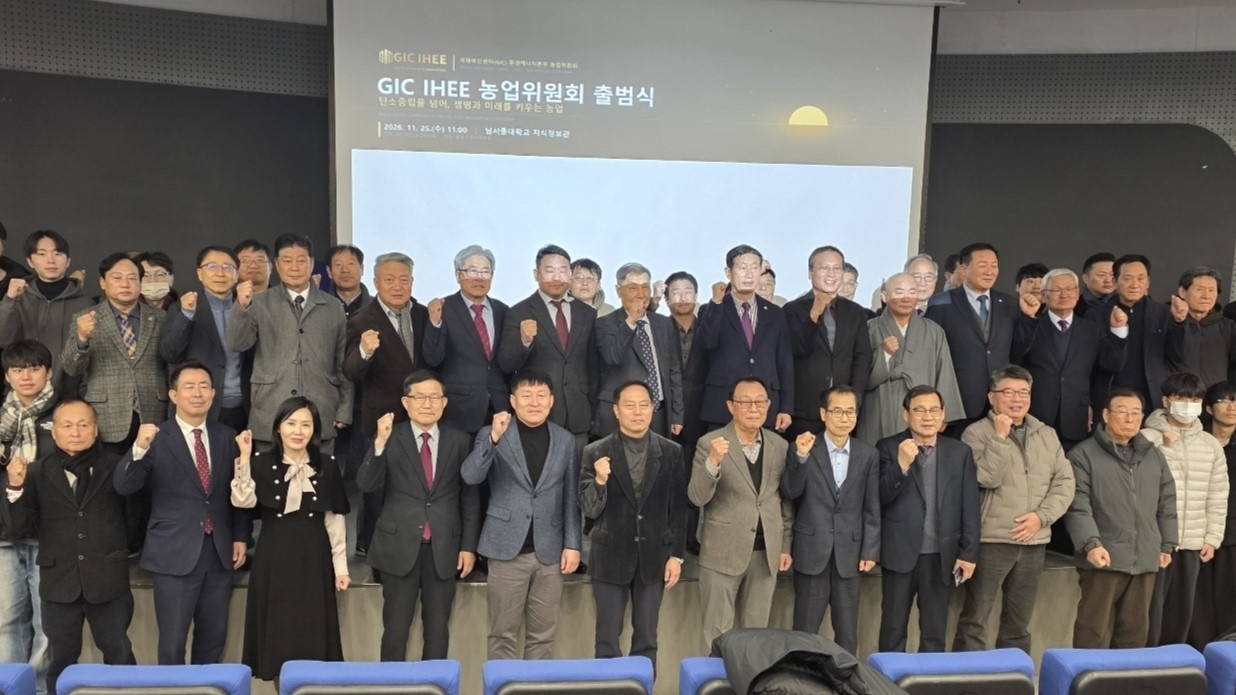
The Global Innovation Center, an international science and technology cooperation body, has launched an agricultural committee in South Korea, seeking to turn carbon reduction into a new income source for farmers while addressing climate change and food security concerns.
The committee, established under the GIC's Environment and Energy Division, held its inaugural ceremony Wednesday at Namseoul University in Cheonan, South Chungcheong Province, bringing together government officials, researchers, business representatives and farmers. The university will serve as the committee's secretariat.
Drawing on the GIC's international network spanning 56 countries and some 30,000 companies, the committee aims to accelerate the adoption of low-carbon technologies and artificial intelligence in agriculture and develop commercially viable farming models.
“Today's launch does not simply mean that one more organization has been created. It is a starting point for action — to find new solutions by connecting the challenges of agriculture and the environment, climate and food, energy and the local economy,” committee Chairman Choi Kyung-eun said in his opening remarks.
Choi outlined five strategic priorities: carbon-neutral farming, agricultural biotechnology, AI-powered smart farming, blue carbon initiatives and international cooperation.
Among its flagship initiatives is a carbon-neutral smart livestock platform designed to integrate data across the entire agricultural value chain, from feeding and livestock management to manure treatment, energy consumption, carbon emissions and distribution.
By using AI to analyze farm productivity, operating costs and environmental performance, the platform aims to help farmers reduce emissions while potentially generating additional revenue through tradable carbon credits.
The committee also plans to promote the use of biotechnology to improve soil and livestock health, convert agricultural byproducts into resources and restore marine ecosystems, including tidal flats and seagrass meadows, to enhance carbon absorption.
On the international front, Choi said the committee would begin with an agricultural development project in Russia's Primorsky Krai before expanding its initiatives to Southeast Asia, South America and the Middle East.
“The future of agriculture we pursue is not about building one more smart farm or introducing another new technology,” Choi said. “What we want to create is one connected ecosystem.”
Namseoul University President Yoon Seung-yong pledged to support the initiative by translating the university's expertise in smart farming education and research into practical applications.
GIC Secretary-General Zhao Gang also pledged to mobilize the organization's international network to facilitate technology sharing and cross-border agricultural cooperation.
The committee plans to establish a permanent operating structure within 30 days of its launch, designate its first smart livestock pilot farm within 60 days and begin its first demonstration project within 100 days.
“With this ceremony we have fastened the first button,” said Kim Young-hwa, the committee's secretary-general and a professor of smart farming at Namseoul University. “We will deliver, one by one, results that farmers and companies can actually feel.”
jylee@heraldcorp.com