
With five titles out this year, prolific actor plays stranger who may or may not be killer in 'White Blast'

For most stars, overexposure is a real fear. Show up too often and viewers start to see the actor and not the part — before long a name that once felt fresh becomes all too familiar, then boring.
Every now and then, though, someone comes along who never seems to wear out their welcome. This year, that someone was Koo Kyo-hwan.
"White Blast," which opened Wednesday, is Koo’s fifth title of the year, after three movies and a TV series that ran the gamut from weepy romance to zombie blockbuster. Last month, he was all over the tabloids after it came out that he had married director Lee Ok-seop, his longtime partner, back in 2022. (“That’s just how the two of us are,” he said of keeping it to themselves.)
“How did I end up here?” Koo wondered out loud at a cafe in central Seoul on Wednesday. “It feels surreal, in a good way.” As a film student, he watched screen veteran Kim Yoon-seok in the hit gambling caper “Tazza” (2006), marveling at his chops. Now he gets to share nearly every frame of “White Blast” with Kim.
At 43, Koo has an unmistakably boyish air about him. His voice, reedy and nasal, is like no other on Korean screens, and it comes through even more in person as he talks in quick, wry bursts.

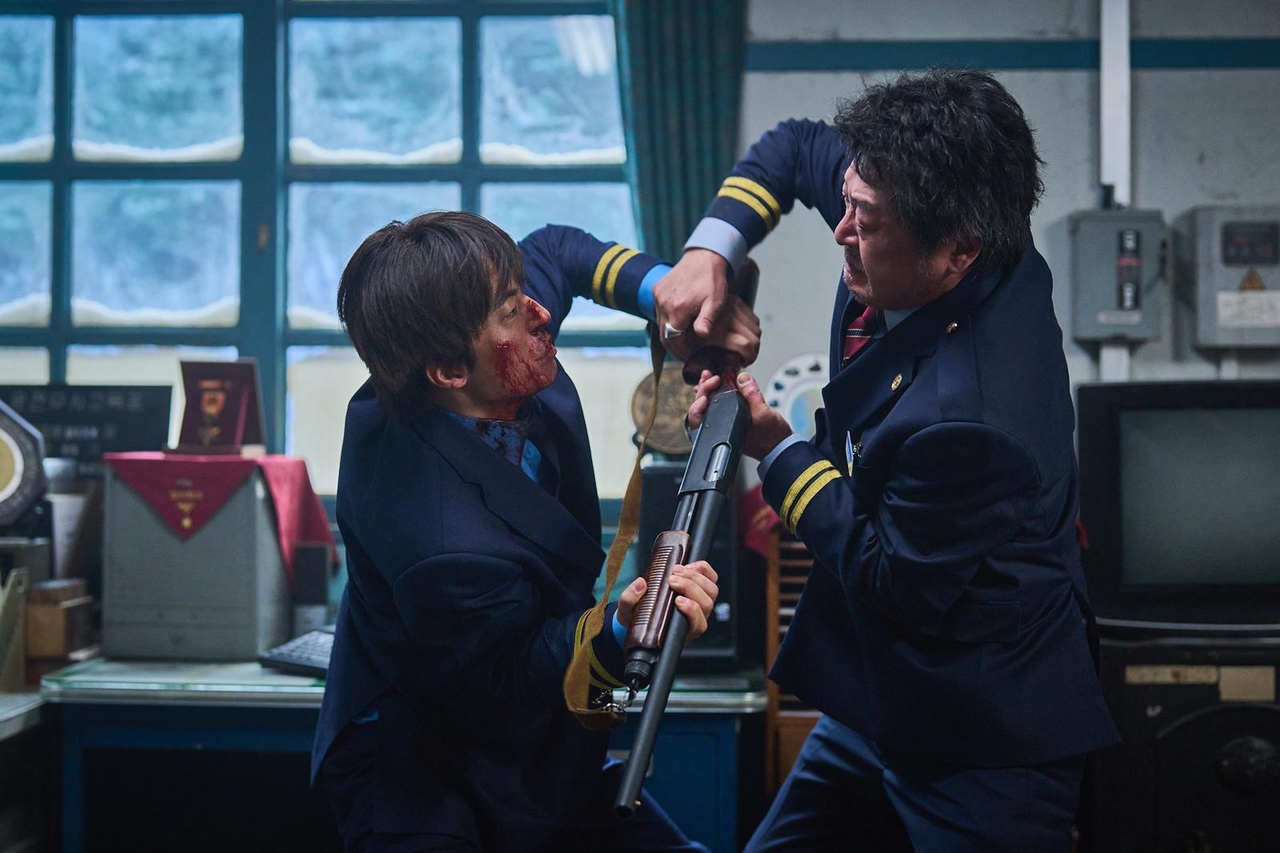
“White Blast” follows Gap-soo (Kim), a stationmaster at a remote, snowbound rail stop in Gangwon Province, on his last day on the job. A prison bus has crashed nearby and the inmates are on the loose. So when his replacement, Hyun-taek (Koo), shows up late in a blizzard, Gap-soo has reason to wonder who he has let in. Adapted from a stage play, it is impossible to forget where it came from throughout its brisk 89-minute runtime, right down to the mannered back-and-forth.
The question that keeps the whole thing going: Is Hyun-taek an escaped convict, or a confused young man caught up in another man’s paranoia? One minute he is soft-spoken if a little unnerving; the next, beaten bloody, he comes off as such a sorry figure that you can’t help but root for him. Koo deserves credit for making both versions believable.
For all the guesswork, Koo said he never went searching for ambiguity. “If I’d gone in with a fixed game plan, people wouldn’t feel confused enough,” he said. “So when Hyun-taek feels he is wronged, he really means it. When he’s scared of getting caught, he’s actually scared. I tried to play every scene straight.”
The shoot was rehearsed down to the last step — “It felt like we’d put on a good stage show,” Koo said. In flashbacks, director Hong Eui-jeong has the two leading men stay in the frame and tell the story to each other as it unfolds. “It never felt like pressure. I was psyched, like, ‘Oh, so this is how she wants to do it,’” Koo said. “It made me go for it even harder.”
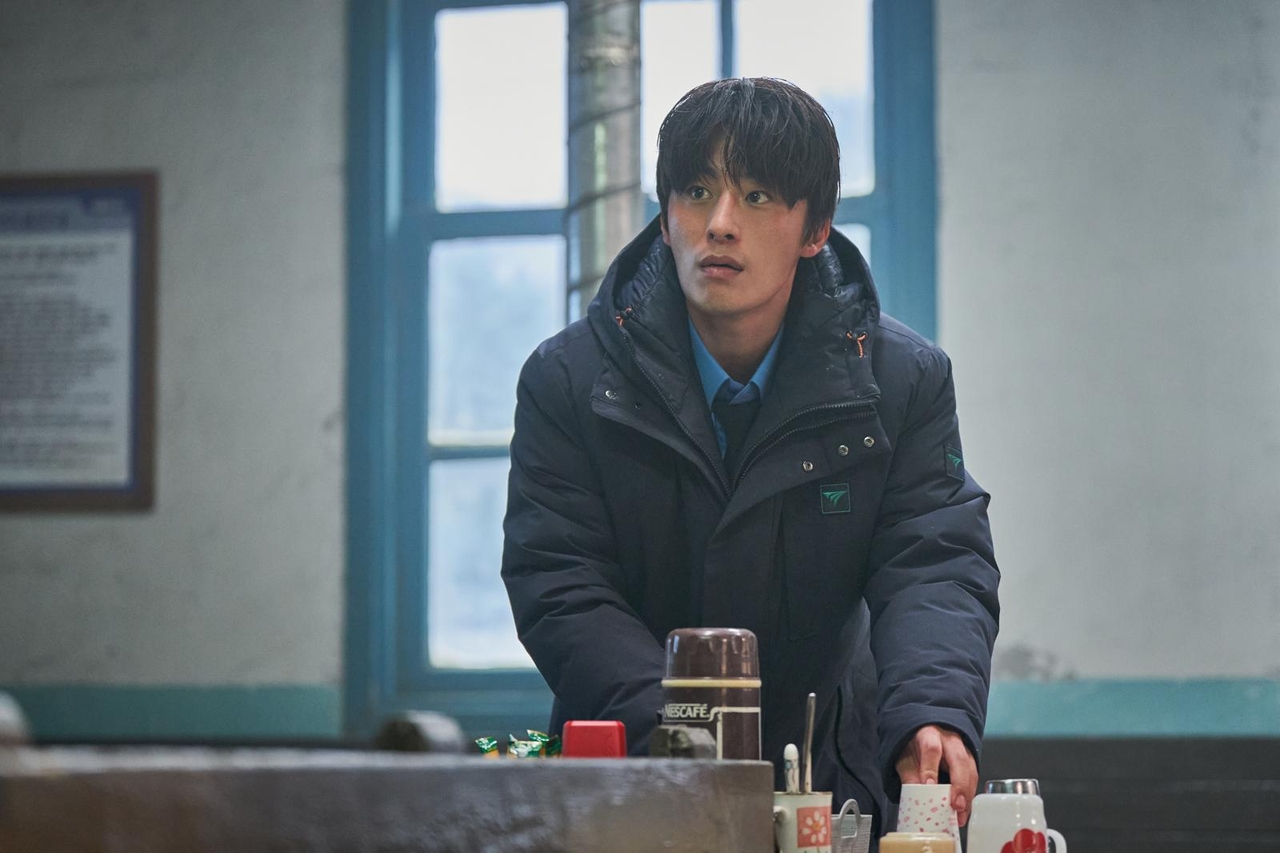
At the end of the day, what the film leaves open is why any of this should happen. What makes two men go from suspicion to bloodshed, almost out of nowhere, over a job at a remote train station? At a press conference last week, Kim described the standoff as a parable of sorts about two generations at odds, perhaps even a father and a son. The director, for her part, has said that she left their motives vague on purpose, cutting out scenes that explained too much.
Koo doesn’t seem too concerned with the subtext, allegorical or otherwise. “You can’t really tell how old Hyun-taek is,” he said. “He could very well be 40.” For him, Hyun-taek is someone who loves the station — and his job — so much that he wants to become one with it. “I saw it as a love triangle between Gap-soo, Hyun-taek and the station,” he said. “So it’s a romance in a sense.”
As for his chemistry with Kim, 14 years his senior, there was no rivalry to speak of. “I had no reason to try to outdo him. I respect him way too much,” he said. “It’s like playing a sport with the team captain on your side. He really loves his job, and he never lets himself get comfortable. Every take, he tries something new. He’s the kind of actor that I want to be going forward.”
Both men also happen to be filmmakers in their own right. Kim made his directing debut with “Another Child” in 2019. Koo studied film in college and came up through the indie circuit, often teaming up with his wife Lee Ok-seop. The two are now co-directing a feature.
Asked whether his time behind the camera shapes his acting, Koo was quick to draw a line. “I don’t think one carries over into the other,” he said. “When I’m acting, I just stick to being an actor and try to immerse myself in that world. It’s not like we’re following a template.”
Now that the film is in theaters, the rest is out of the actor’s hands. Koo knows better than most that these things can go either way; this year alone, he got a taste of both.
His summer release, “Colony,” from “Train to Busan” director Yeon Sang-ho, sold 5.9 million tickets and became the season’s biggest domestic hit. That is short of 10 million, the industry’s gold standard for a smash hit, but a solid showing for a tentpole nonetheless.
Four months later came his first film as a true leading man, “Reawaken Man: The Red” — and it was a disaster. The scattershot superhero romp burned through a budget of 20 billion won ($15 million), a sizable sum for a Korean film, only to limp to an embarrassing 334,607 tickets sold.
As a man who is now expected to carry a film on his own, Koo simply can’t pretend that the numbers don’t matter, especially at a time when investments are drying up and many Korean films fail to turn a profit. “It’d be a lie to say I don’t get anxious,” he said. “I just hope it doesn’t run too deep. You need some nerves, in any kind of work and in life.”
But Koo has never forgotten his scrappier days. “Jane,” in which he played a transgender singer, sold around 20,000 tickets; “Maggie,” a freewheeling oddity that he co-wrote with Lee, drew about 40,000. He still remembers one screening of “Maggie” where only two people showed up for the Q&A afterward. “I wasn’t let down at all,” he said. “If anything, it was a better time.”
“Those are the films that people bring up the most when they tell me they enjoyed my work,” he said. “Box office numbers might matter commercially, but they don’t affect the work, or me.
“To me, every film is a 10 million seller.”
“White Blast” is now playing in Korean theaters.
moonkihoon@heraldcorp.com