
French museum’s Seoul venue explores the great colorist in its second exhibition
Marc Chagall’s history with Korea goes back further than most people realize. In 1971, when Korea was still a poor country less than two decades out of war, Chagall had his first solo show in Seoul, at what was then the National Museum of Modern Art at Gyeongbokgung.
Details about the show are scarce; among the few surviving records is a copy of its catalog, kept in the MMCA archive, which lists the eight works that were on display. First among them is “The War” (1943), a stark canvas Chagall painted in New York, where he had lived in exile after fleeing Nazi-occupied France in 1941. The artist reportedly chose it for the exhibition himself, citing parallels with the Korean War.
What followed over the next half century was one of the greatest economic success stories of the postwar era, as Korea pulled itself up from the ruins of war. Along the way, Chagall became perhaps the best-loved Western painter in the country, with major surveys of his work coming around decade after decade.
That lasting popularity might have something to do with the artist's biography: a life shaped by loss and upheaval is what many Koreans can relate to through their own history.
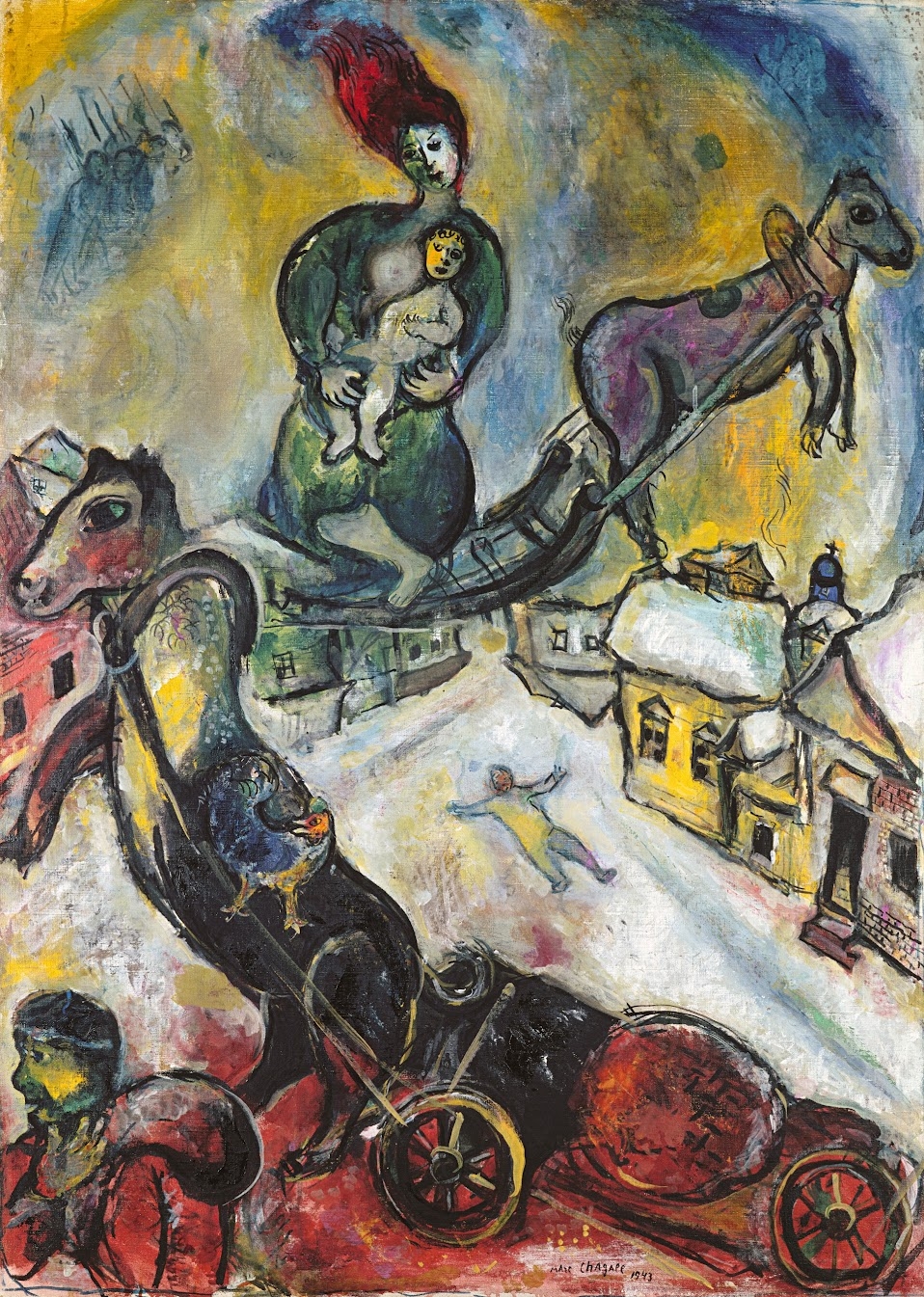
Now the painting that led off Chagall’s first Korean show is back in Seoul, 55 years later, as part of “Chagall, Ever Crossing,” a 65-work exhibition that opens Nov. 24 at Centre Pompidou Hanwha. It is the second show at the Pompidou’s first outpost in Korea, which opened in May at the 63 Building in Yeouido in partnership with the conglomerate Hanwha Group.
At 65 works, the exhibition is smaller in scale than several the country has seen before; just last year, a show at the Seoul Arts Center featured some 170. What it lacks in numbers, it makes up for in range. Sixty-one of the works are on view in Korea for the first time, and the show is the first here to cover Chagall’s practice beyond painting, from ceramics to sculpture, according to organizers. It also offers a rare chance to see the Pompidou’s Chagall collection, which is usually scattered across France, all at once — “Even Parisians have never been able to see them in one place,” said Xavier Rey, director of the Musee National d’Art Moderne, at a press conference Tuesday.
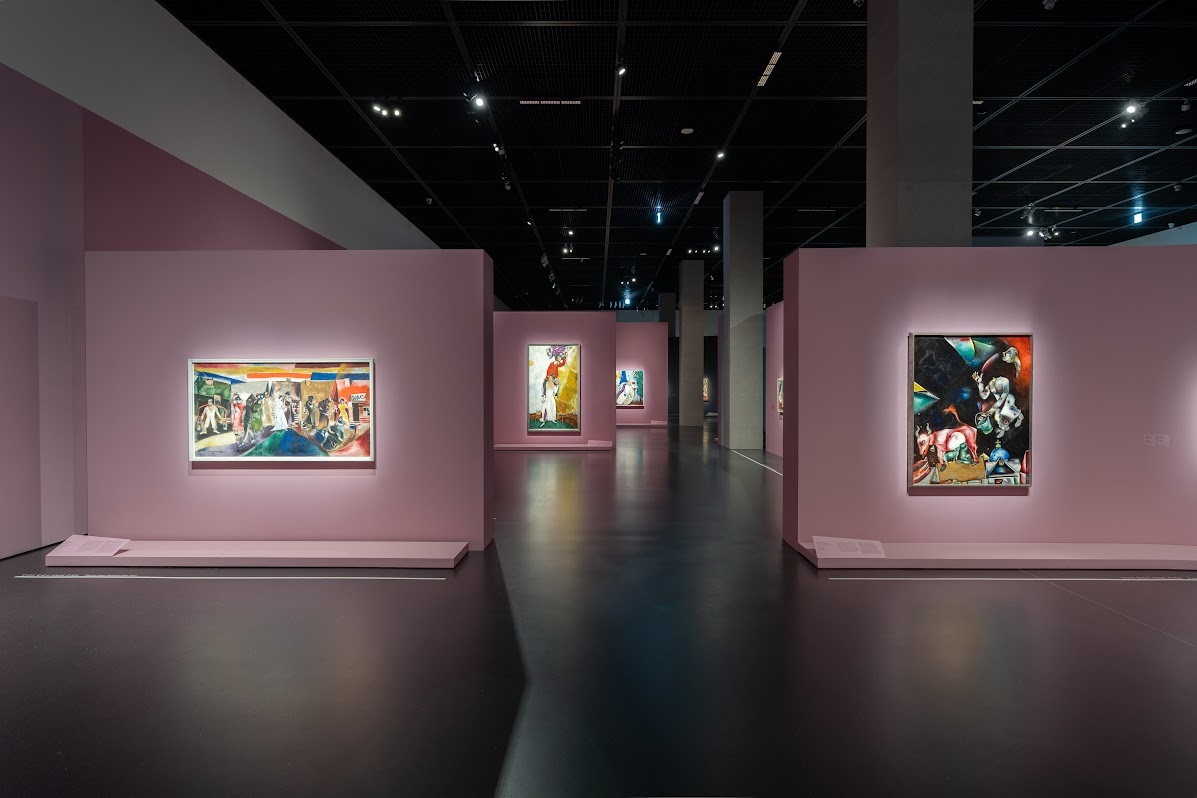
The opening section, “Entangled Sources,” follows Chagall from his native Vitebsk to the Paris of the 1910s, then the center of the avant-garde, where he plunged into the new art of the day. Out of those years came works like “To Russia, Asses and Others” (1911) and “The Wedding” (c. 1911-1912), which blend the folk memory of his Jewish childhood with Fauvist hues and the interlocking planes of Cubism.
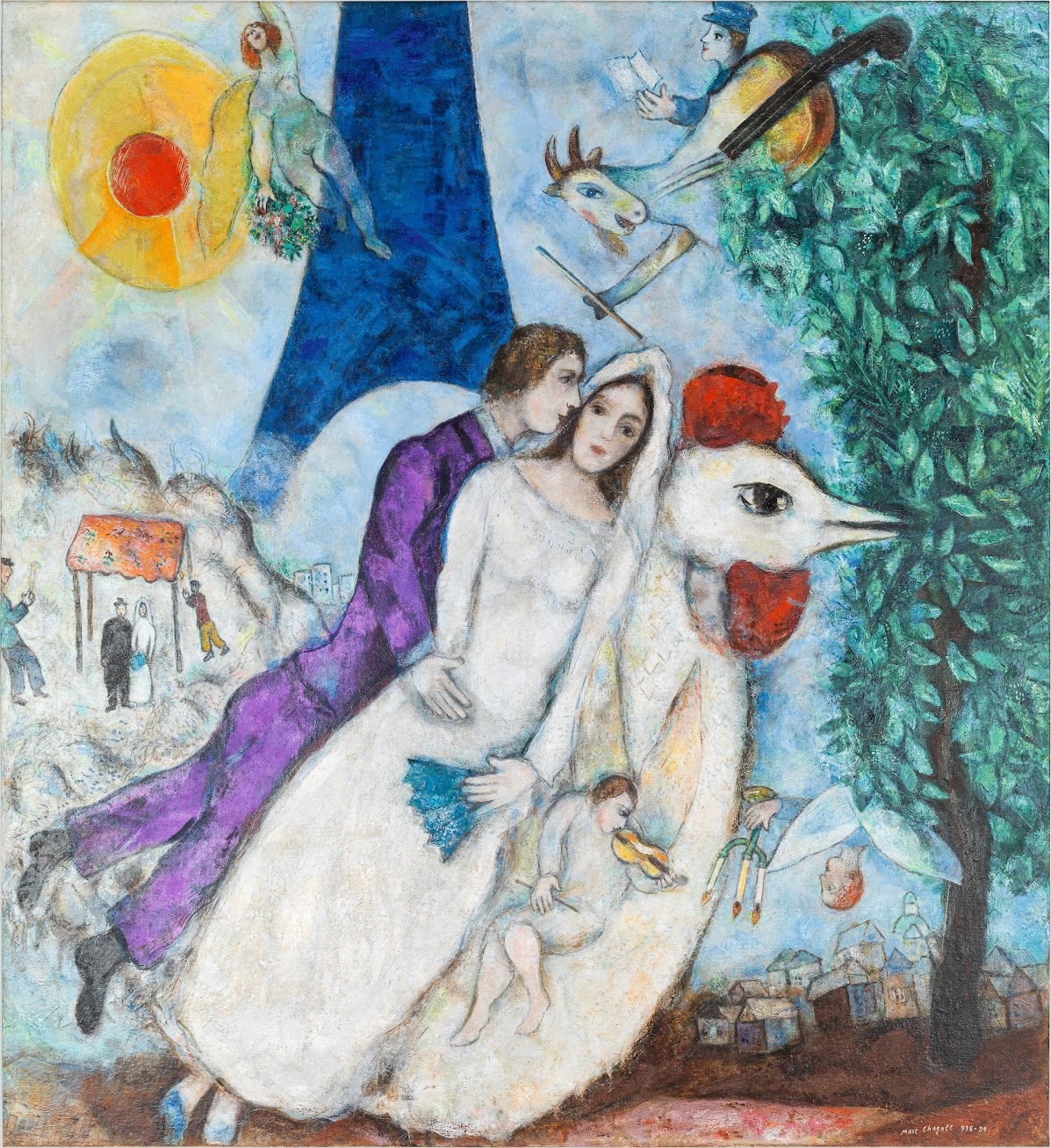
Chagall married Bella Rosenfeld in his hometown in 1915 and settled back in Paris in 1923; by the 1930s, with fascism on the rise across Europe, his canvases had grown more somber and political. In “Bride and Groom with Eiffel Tower” (1938-1939), an angel tumbles toward a Jewish town with a lit candle in hand, as if the artist had sensed what lay ahead. While in exile in New York, Chagall portrayed Christ as a Jewish martyr wearing phylacteries in “Yellow Crucifixion” — a fraught image he would return to again and again.
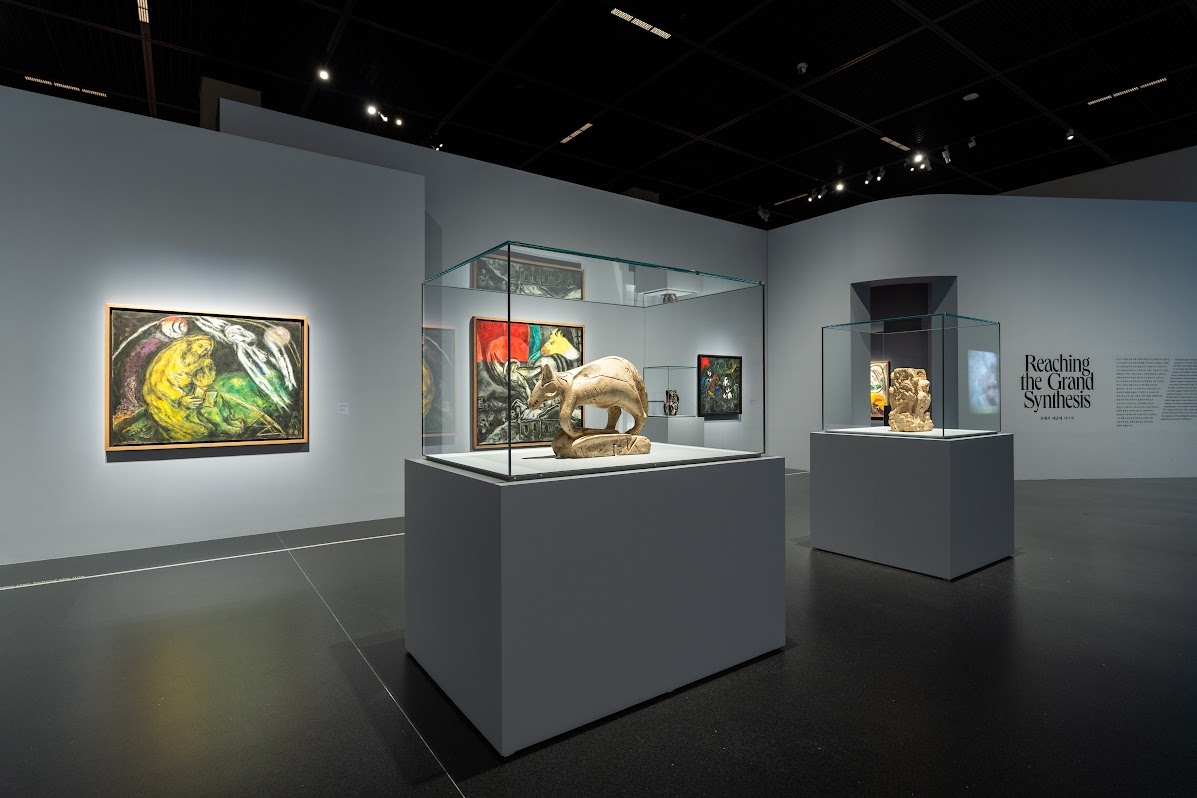
The show’s later rooms find Chagall back in France after the war, settled in Vence, where the Mediterranean light had visibly loosened and brightened his palette. In “Sunday” (1952-1954), he and his second wife, Vava, float above Paris as a double star, rendered in broad planes of color. It was also around this time that Chagall took up marble and ceramics, the latter in Vallauris, where his friend Picasso happened to be working. Eight of his sculptures are on view, many of which pick up motifs from the paintings that hang nearby, whether they be the lovers and animals of “Two Nudes” (1953) or the dark ground of “Black Vase” (c. 1955).
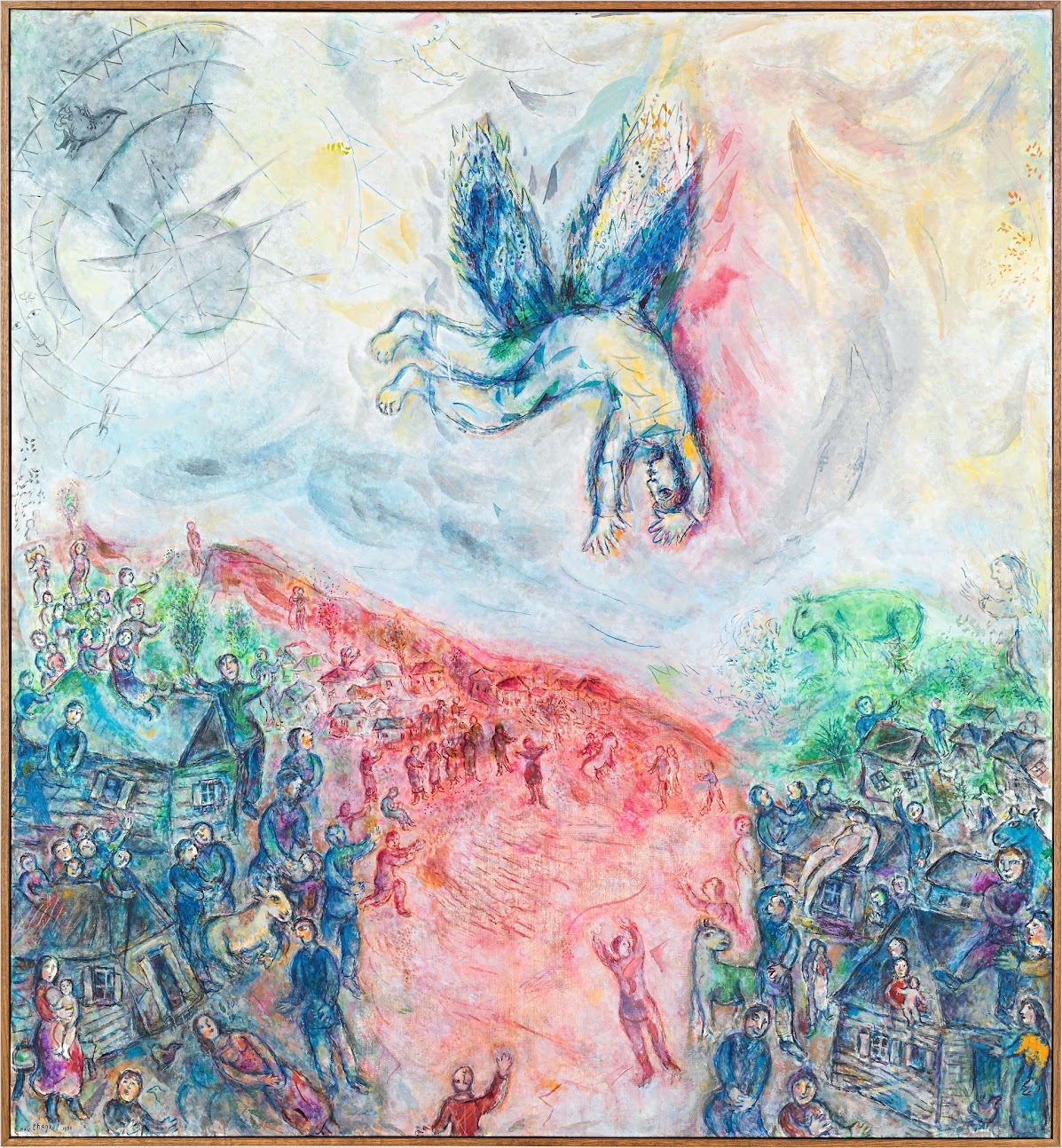
The show closes with “The Fall of Icarus” (1974/1977), an imposing 2-meter-tall canvas in which the figure from Greek myth plunges headlong toward a crowded village square reminiscent of Chagall’s early work. Painted in the pale, luminous hues of stained glass, it is a poignant look back on a life of constant change and reinvention, completed when the artist was nearly 90. Nearby are glass replicas of his stained glass windows for the Metz Cathedral, and an immersive video of the ceiling that he painted for the Paris Opera, projected onto a round floor 8 meters wide.
“Chagall, Ever Crossing” is at Centre Pompidou Hanwha in Yeouido, western Seoul, from Nov. 24 through March 28. Admission is 25,000 won.
moonkihoon@heraldcorp.com