
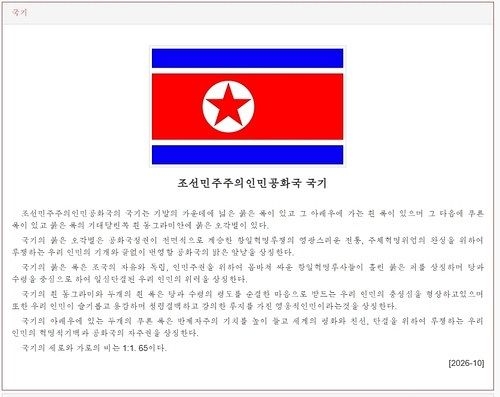
North Korea has revised the official proportions of its national flag for the first time since the regime's establishment in 1948, in what analysts see as another step by leader Kim Jong-un to forge a distinct national identity under his "two hostile states" doctrine.
According to Article 166 of the revised constitution published Friday on Naenara, a North Korean external propaganda website, the height-to-width ratio of the national flag has been changed from 1:2 to 1:1.65, effectively shortening its width while preserving its basic design.
The revision marks the first change to the flag's proportions in 78 years, although its central red field, white and blue stripes and red five-pointed star remain unchanged.
In a separate section of the website, Pyongyang explained that the flag's central red field symbolizes the blood shed by anti-Japanese revolutionary fighters, while the white circle and stripes represent loyalty to the ruling Workers' Party and the country's leader. The blue stripes symbolize anti-imperialist independence, world peace and friendship, as well as national sovereignty.
The change is seen as part of Kim's broader campaign to redefine North Korea's national identity and distinguish his leadership from that of his predecessors, particularly as Pyongyang moves to institutionalize its increasingly hostile stance toward South Korea.
In 2024, North Korea revised the lyrics of its national anthem, replacing "samcholli," literally meaning "3,000 ri," a traditional Korean expression referring to the entire Korean Peninsula, with "i sesang," meaning "this world."
The term samcholli refers to the traditional geographical extent of Korea, with ri being a traditional unit of distance. It has long symbolized the Korean homeland as a whole, encompassing both North and South Korea.
The change was widely interpreted as part of Kim's efforts to move away from the concept of a unified Korean nation and to reinforce North Korea's identity as a separate state.
The regime also removed reunification-related provisions from its constitution earlier this year, reinforcing Kim's declaration that North and South Korea are two separate, hostile states rather than partners pursuing eventual reunification.
Lim Eul-chul, a professor at Kyungnam University's Institute for Far Eastern Studies, said the flag revision reflects an effort to balance continuity with the legacy of previous North Korean leaders and the establishment of a distinct political identity under Kim.
"Changing the flag's proportions while maintaining its basic design is an attempt to preserve the legacy of previous leaders while imprinting a distinct national identity associated with the Kim Jong-un era," Lim said.
"The revision also carries significance in institutionalizing the 'two hostile states' doctrine at the constitutional level and through national symbols."
mkjung@heraldcorp.com