South Korea held a separate memorial ceremony in Japan on Friday to honor Korean victims of forced labor at the Sado mines during Japan's colonial rule, marking the third consecutive year that Seoul has boycotted a Japanese-organized event.
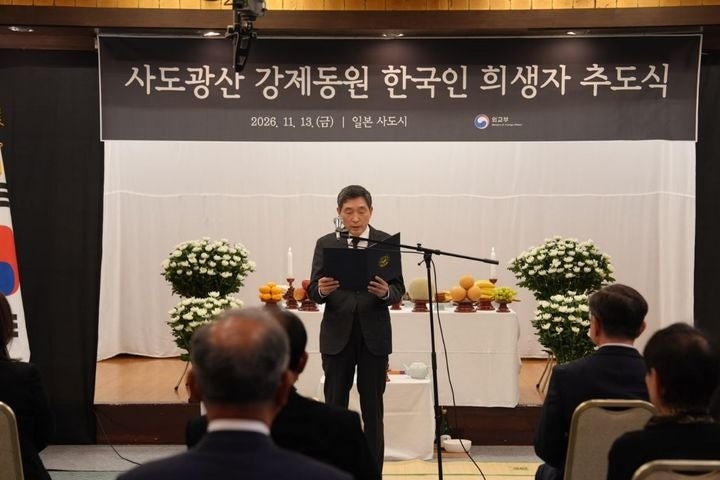
The ceremony, held at 10 a.m. in Sado, Niigata Prefecture, was attended by South Korean Ambassador to Japan Lee Hyuk, other government officials and nine bereaved family members, according to Seoul's Foreign Ministry.
In his commemorative address, Lee emphasized the suffering endured by Korean laborers who were forcibly mobilized to the mines during Japan's 1910-45 colonial rule of the Korean Peninsula.
"Here on Sado Island, many Korean workers were brought against their will during Japan's colonial rule and forced to perform labor," Lee said, according to the ministry.
He noted that Korean workers were assigned particularly dangerous and demanding tasks, enduring constant fear of injury, isolation from the outside world and uncertainty about their futures.
Such suffering, he said, had left lasting wounds not only on the workers themselves but also on their families across generations.
Lee expressed his condolences to the victims and their families, stressing the importance of confronting the painful history of the mines.
"Remembering the pain of the past and sharing our respects here today will deepen our sense of empathy and healing, while providing an opportunity for everyone to fully understand the entire history of the Sado mines as a World Heritage site," he said.
He also expressed hope that South Korea and Japan would continue to remember their shared painful history while moving toward a future of cooperation and solidarity.
Choi Jae-sik, a representative of the bereaved families of Korean forced labor victims, expressed hope in his commemorative address that his late father could finally rest in peace, free from the resentment and suffering of the past.
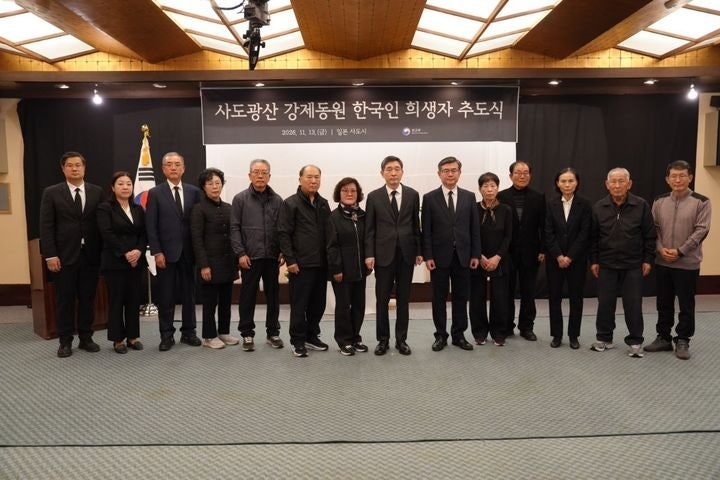
Choi also paid tribute to all Korean workers who endured hardship in a foreign land.
Following the ceremony, family members visited the former site of a dormitory where Korean laborers had lived, laid flowers and toured other locations associated with Korean workers to commemorate the victims.
Friday's ceremony came two months after Japan held its own memorial event on Sept. 12, organized by a local committee in Sado.
Yukiya Hamamoto, director-general for cultural affairs at Japan's foreign ministry, attended as Tokyo's representative and acknowledged in his commemorative remarks that workers from the Korean Peninsula had labored under dangerous and harsh conditions.
However, his remarks made no explicit reference to the forced nature of their labor, a longstanding point of contention between the two governments.
Seoul declined to participate in the Japanese-organized ceremony after the two sides failed to narrow their differences over how the historical circumstances of Korean workers should be reflected in the commemorative address.
The dispute dates back to July 2024, when the Sado mines were inscribed on UNESCO's World Heritage List with South Korea's consent.
The mines, located on Sado Island off Japan's western coast, were once among the country's most important gold and silver production sites. During Japan's colonial rule, approximately 1,500 Koreans were mobilized to work at the mines under harsh conditions.
As part of efforts to secure Seoul's support for the UNESCO designation, Tokyo pledged to reflect the site's full history and hold an annual memorial ceremony honoring all workers, with representatives of the Japanese central government in attendance.
However, disagreements over the ceremony's official name and the wording of commemorative remarks emerged ahead of the inaugural event in 2024, prompting Seoul to withdraw from the Japanese-organized ceremony and hold its own memorial.
The dispute continued in 2025, when the two governments again failed to agree on language explicitly acknowledging forced labor. South Korea subsequently held a separate ceremony on Nov. 21, attended by Ambassador Lee and 11 bereaved family members.
The continued division over the memorial ceremonies underscores the unresolved historical sensitivities surrounding the UNESCO-listed site, despite the two countries' broader efforts to strengthen bilateral cooperation.
Three years after Japan's commitment to commemorate the workers, Seoul and Tokyo have yet to agree on a joint ceremony that addresses South Korea's concerns over the acknowledgment of forced labor.
mkjung@heraldcorp.com