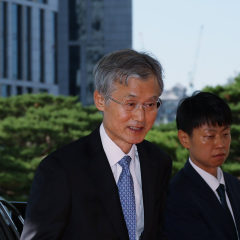
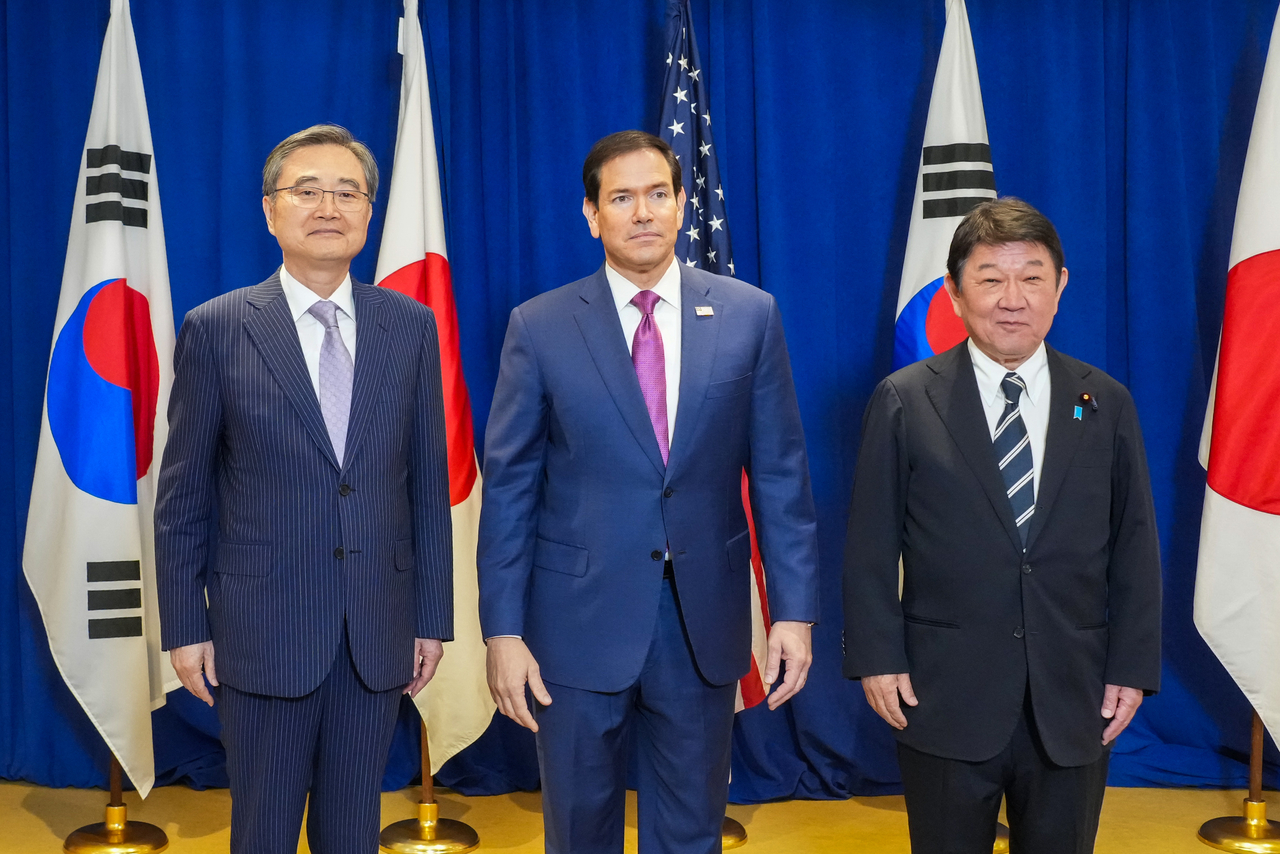
The top diplomats of South Korea, the United States and Japan reaffirmed the three countries' commitment to the complete denuclearization of North Korea, calling on Pyongyang to return to dialogue during trilateral talks in New York on Monday.
South Korean Foreign Minister Cho Hyun, US Secretary of State Marco Rubio and Japanese Foreign Minister Toshimitsu Motegi met on the sidelines of the UN General Assembly High-Level Week, where they discussed North Korea as well as security and economic challenges in the Indo-Pacific.
In a joint statement, the three reiterated their “resolute commitment” to the complete denuclearization of North Korea and to preventing revenue generation that supports Pyongyang's nuclear and ballistic missile programs in accordance with UN Security Council resolutions.
At the same time, they stressed that “the path to dialogue remains open” and urged North Korea to resume talks, while pledging continued efforts to promote peace and stability on the Korean Peninsula.
The US also reaffirmed its “ironclad” defense commitments to South Korea and Japan, backed by American military capabilities, including its nuclear forces.
The three diplomats welcomed efforts by the Multilateral Sanctions Monitoring Team, established in 2024, to track North Korean sanctions violations and evasions. They also highlighted cooperation against North Korea's illicit IT-worker activities and cyberthreats.
Beyond the Korean Peninsula, Cho, Rubio and Motegi emphasized the importance of maintaining peace and stability across the Taiwan Strait. They opposed unilateral attempts to change the status quo and called for the peaceful resolution of cross-strait issues.
They also reiterated support for freedom of navigation and overflight and lawful commerce in the Indo-Pacific in accordance with international law.
The discussions came days before US President Donald Trump and Chinese President Xi Jinping are set to meet in Washington on Thursday.
Economic security was another focus of Monday's meeting, with the three countries pledging to strengthen critical supply chains and their trilateral early warning system. They also opposed economic coercion and market-distorting practices, including arbitrary export restrictions.
The diplomats agreed to bolster energy security cooperation and move forward with a July agreement aimed at accelerating the deployment of small modular reactors in third countries under nuclear safety, security and nonproliferation standards.
They also pledged closer cooperation in emerging technologies, including artificial intelligence, quantum technology, digital infrastructure and biotechnology.
According to Seoul's Foreign Ministry, the three sides agreed to maintain close communication and coordination amid growing uncertainty in the international security environment.
Monday's talks followed trilateral meetings held on the sidelines of the NATO summit in Turkey on July 7 and an Association of Southeast Asian Nations-related gathering in the Philippines on July 22.
mkjung@heraldcorp.com