Countertenor Iestyn Davies, who asks composers to treat his voice as 'normal,' says Shin’s song cycle never uses it as an effect

When countertenor Iestyn Davies sings Shin Donghoon's “Sonnets to Orpheus” in Seoul on Nov. 28, the audience will hear a work its composer considers unfinished.
Right after the world premiere at the Istanbul Music Festival in June, Shin told Davies and the Berlin Philharmonic players in the string quartet that something was missing.
“For the music to be complete, I felt it needed one more movement, a very short, final one,” Shin said at an online press conference Thursday. He has not written it yet, so Seoul will hear the five existing movements, and he expects the finale to be ready by the time the work reaches New York.
Davies, who sang the premiere, expects to approach the work differently this time. “I believe the composer wants us to take it off the page and give it life,” he said. “The second time I come to sing a piece which is new, I automatically feel more free.”
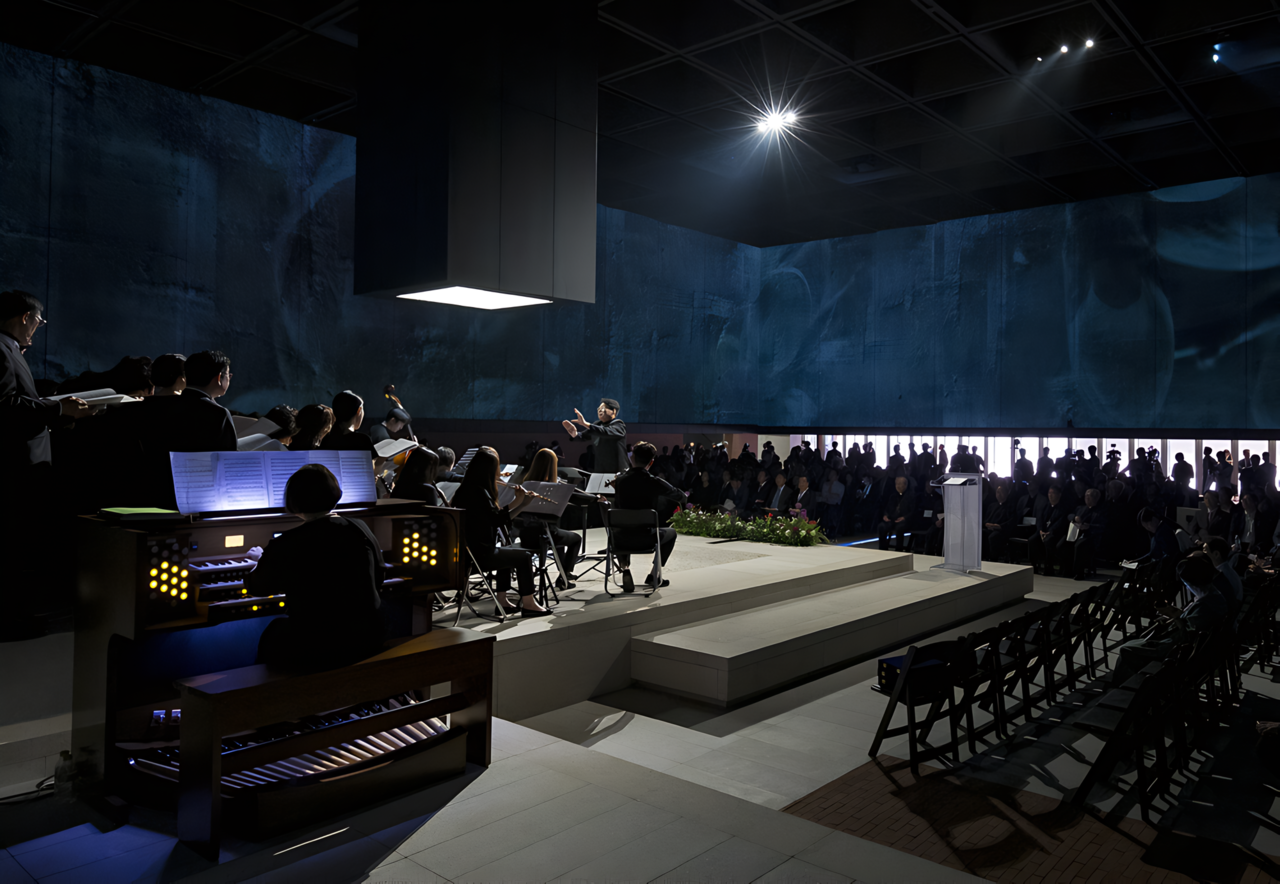
The Seoul concert by Sejong Soloists at the Seosomun Shrine History Museum’s Consolation Hall gives the Asian premiere of the work. The same program has the Asian premiere of Shin’s “Winter Sonata,” played by violinist Chee-Yun and pianist Cho Jun-young. According to Sejong artistic director Kang Kyung-won, a new version for countertenor and Sejong’s string orchestra will premiere at Carnegie Hall on May 17, and a recording is in preparation.
The piece began as two separate projects. About five years ago, Shin told his publisher, Boosey & Hawkes, that he wanted to write a song cycle for Davies. Around the same time, Berlin Philharmonic players asked him for a string quartet, and Shin decided to combine the two.
Davies suggested Rilke’s “Sonnets to Orpheus,” which the poet wrote in about three weeks while mourning the young dancer Wera Ouckama Knoop. Shin set five of the sonnets, tracing a path from grief and anger through resignation and reconciliation with death to transcendence. The venue, an underground hall on what was once an execution ground, echoes Orpheus’ descent into the underworld.
“I’m often at great pains to say, make this normal, don’t make it extraordinary, because I think it’s important to constantly reestablish the countertenor voice as a serious voice alongside the tenor, the baritone, the bass and the soprano,” Davies said. “The danger is that composers use it as an effect, and I don’t think Donghoon has done that at all. I think he really embraces the sort of masculine quality of the sound.”
Because the countertenor developed for centuries mainly in church choirs, Davies said, new music is “pushing new countertenors to investigate where their voice can go.”
Kang said that about five years ago he asked composer Chin Unsuk which young composer Sejong should commission, and she named Shin, then far less known internationally. Shin has since become the first Asian composer to win the Claudio Abbado Composition Prize from the Berlin Philharmonic’s Karajan Academy. He proposed a co-commission, and Wigmore Hall in London, the Istanbul Music Festival and Chamber Music Northwest in the US joined.
Shin, who is based in Berlin, said Western interest in Korea has clearly risen, driven by K-pop, novelists winning major prizes and Korean films. “Composition seems to be an art where the boom always comes late,” he said. “Personally, I hope that interest carries over to Korean composers.”
As the Seoul Philharmonic Orchestra’s Artist in Focus for 2027 and 2028, Shin will see pianist Cho Seong-jin give the Asian premiere of his piano concerto with music director Jaap van Zweden on June 24 and 25 next year. He is also writing a violin concerto for an unnamed soloist, and his first opera.
gypark@heraldcorp.com