
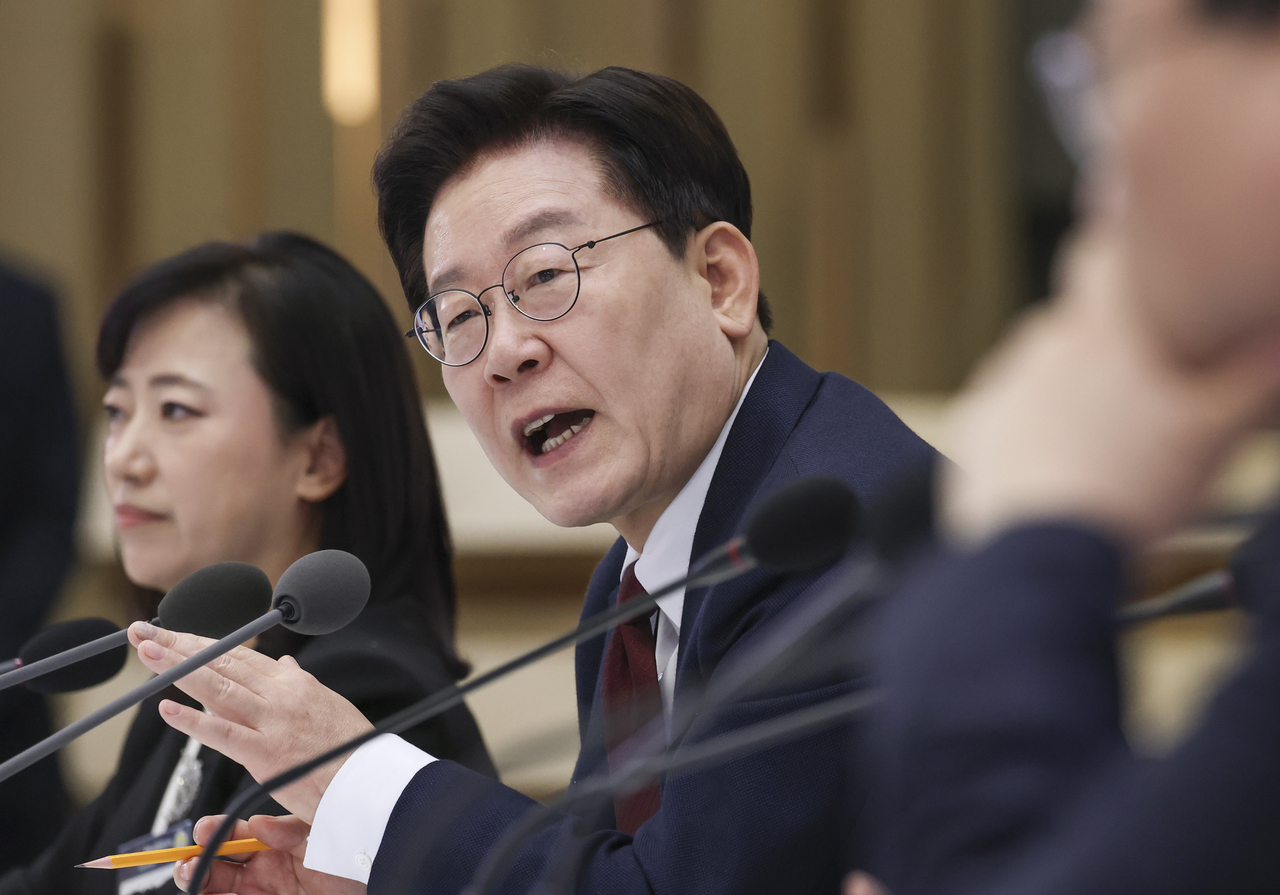
President Lee Jae Myung said Friday that hostile mergers and acquisitions are "the most important mechanism for normalizing the market," urging officials to examine what could help tackle the country's persistently undervalued stocks.
"From the government's standpoint, we need to revitalize M&A. We need to make M&A easier and more frequent for the market to normalize," Lee said during a two-and-a-half-hour capital market policy meeting at the Korea Exchange in Seoul.
Lee argued that South Korea needed to significantly increase takeover activity to address unusually low stock valuations, saying more deals could expand the overall benefits available to investors.
"To address the problem of abnormal undervaluation, as seen in South Korea, we need to revitalize M&A on a large scale so that the overall pie grows," he said.
Lee called for a comprehensive review of barriers to hostile takeovers and suggested examining whether companies that effectively run like private businesses because of concentrated ownership should remain listed.
"We should conduct a comprehensive review to see whether there are various mechanisms blocking hostile M&A," he said, urging officials to find concrete ways to encourage such transactions while cautioning against excessive activity.
The discussion followed concerns that some Korean companies trade below their book value but remain largely insulated from takeover attempts because controlling shareholders hold majority stakes, limiting outside investors' ability to challenge management.
Explaining his reasoning, Lee said, "When share prices are abnormally undervalued, someone could acquire the company and either sell it at a normal price or operate it themselves. That is the most important mechanism for normalizing the market."
Hostile takeovers are legal in South Korea, but concentrated ownership can make them difficult without the consent of controlling shareholders.
Lee questioned whether negative attitudes toward hostile acquisitions influenced government policy, suggesting policymakers might have implicitly favored protecting incumbent management against unwanted takeovers.
He also questioned whether companies should continue enjoying the benefits of stock market listings while effectively operating under the exclusive control of dominant shareholders.
"The purpose of the stock market is to allow many participants to trade and receive fair prices, and that's why business owners are given various benefits," he said. "Shouldn't we consider ways to delist companies that are effectively operated like private companies?"
Lee cited companies where controlling shareholders hold more than half, or even 70 percent to 80 percent, of outstanding shares. He said he was uncertain whether a 50 percent ownership threshold would be appropriate and asked officials to examine the matter further.
The meeting also addressed proposed mandatory tender offer rules, which would require acquirers to offer to buy shares from minority shareholders when corporate control changes hands, allowing them to share in takeover premiums.
The ruling and opposition parties have agreed to introduce the system by revising the Capital Markets Act during the current National Assembly session.
However, domestic and foreign asset managers have opposed a proposal that would require acquirers to purchase at least 50 percent plus one share while allowing controlling shareholders to sell their stakes first. Critics argue the arrangement would fail to guarantee minority shareholders an equal opportunity to sell their shares.
Lee held an impromptu show-of-hands vote among participants on whether acquisitions should involve offers for all outstanding shares or be limited to 50 percent plus one share, as well as how selling opportunities should be allocated.
The president questioned whether full tender offers might increase acquisition costs enough to discourage deals while seeking empirical evidence on their impact. Lee described the choice as a policy judgment involving competing interests between controlling and minority shareholders, saying neither approach could be considered absolutely right.
Lee nevertheless indicated that he leaned toward encouraging M&A activity to expand the overall market.
"Even if it means facing criticism, I lean toward expanding the pie — that is, revitalizing M&A so that the market as a whole can be normalized and all shareholders can benefit," Lee said.
Lee added that the decision was not his alone and called for further discussions, expressing hope that the process would not be delayed too long.
He also called for the prompt delisting of financially unsound and underperforming companies from the Kosdaq market, while stressing the need to protect firms with technological capabilities and growth potential.
Returning to the broader problem of undervaluation, Lee said the immediate priority should be to encourage hostile takeovers to help correct what he described as an abnormal market structure.
"Right now, more important than establishing a highly rational and ideal system is focusing on revitalizing hostile M&A to break this abnormal structure," Lee said.
dagyumji@heraldcorp.com