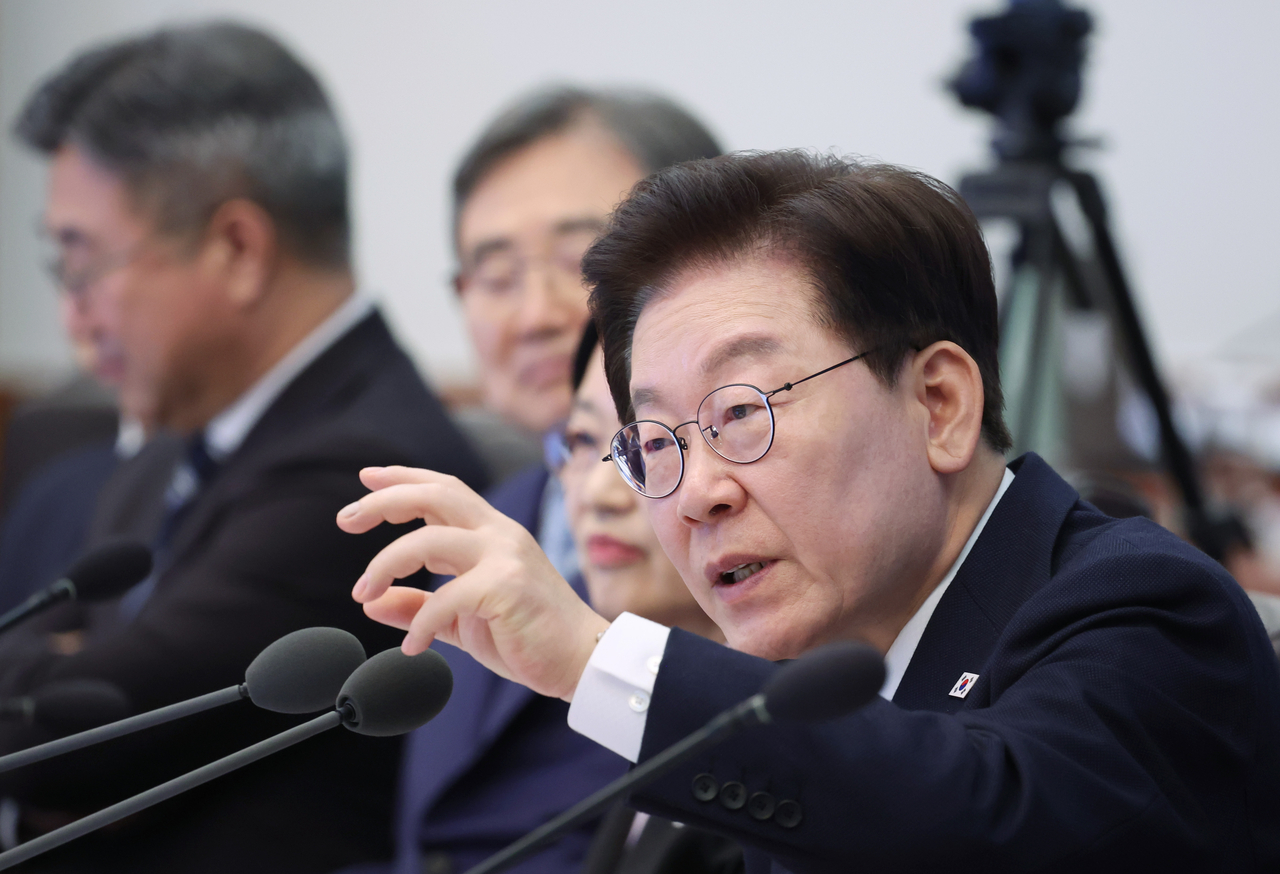
President Lee Jae Myung on Tuesday stressed fairness in government support programs amid growing criticism over his recent remarks questioning preferential benefits for multicultural families in some public services.
“The state has a responsibility to look after the difficulties faced by socially and economically vulnerable people and carefully devise measures to support them,” Lee said during a Cabinet meeting at Cheong Wa Dae.
“But in that process, the principles of fairness and reasonableness must also be considered.”
Lee warned that even seemingly small benefits provided without a reasonable basis could erode public trust, weaken support for welfare policies and give ammunition to those seeking to stir up hostility toward vulnerable groups.
His remarks came after he recently questioned whether multicultural families should automatically receive preferential treatment in some public services regardless of their individual circumstances, prompting criticism that such an approach could undermine support for socially vulnerable groups.
The government defines multicultural families as households formed by a Korean national and a person from a different cultural background.
Lee instructed ministries and agencies to review eligibility standards and the implementation of public services closely tied to people’s daily lives and correct practices the public could view as unreasonable or unfair.
Beyond the fairness issue, Lee also discussed a broad range of policy priorities, including next year’s budget, cybersecurity and public confidence in the country’s investigative system.
Referring to his budget speech at the National Assembly on Monday, Lee said the 2027 budget would serve as a foundation for “greater growth, warmer livelihoods and a stronger South Korea.”
He called for bipartisan cooperation, saying the next one to two years would be critical as the global political, economic, industrial and security order undergoes rapid change.
“Politics may have different camps, but there can be no ruling and opposition parties when it comes to people’s lives and the country’s future,” Lee said.
Lee also urged ministries to follow up on issues raised during this year’s parliamentary audits, saying valid criticism should be promptly reflected in policy, particularly on matters directly affecting people’s livelihoods.
Cybersecurity overhaul
On cybersecurity, Lee called for a fundamental overhaul of the country’s security system, warning that increasingly sophisticated hacking attacks were posing growing risks to people’s daily lives, the economy and national security.
He proposed considering a government-wide “cybersecurity czar” body capable of coordinating security functions across the public and private sectors.
The remarks came a day after controversy erupted over the online exposure of personal information belonging to Lee, first lady Kim Hea Kyung, Cabinet members and presidential staff, including passport information contained in a passenger list from an overseas presidential trip.
The presidential office and relevant authorities have said they are investigating how the information was exposed and taking follow-up measures for those affected.
Lee called for stronger action against the organized spread of false information, saying fake news was increasingly being used for financial gain or political purposes and contributing to social polarization.
He said the social damage caused by such practices had grown beyond the level of ordinary individual defamation cases and warranted a stronger government response.
flylikekite@heraldcorp.com