
South Korea’s military may be ill-equipped to defend against swarms of low-cost attack drones designed to exhaust conventional air defenses, a state-run defense research institute said Tuesday.
The Korea Research Institute for Defense Technology Planning and Advancement said existing counter-drone systems have clear limitations against large numbers of medium-sized attack drones, particularly if cheap uncrewed aircraft force defenders to expend far more costly interceptors.
“Existing fielded systems have limitations in intercepting swarms of medium-sized attack drones of the kind demonstrated in the US-Iran war,” the report said.
The report was authored by Jung Yoon-sik, Kim Ji-hoon and Kim Tae-won, researchers at the institute.
The core problem, the report said, is not a lack of weapons capable of shooting down drones, but the cost and sustainability of doing so.
Citing an analysis by the US-based Center for Strategic and International Studies, the report said US stocks of Patriot interceptors had fallen by about 65 percent as of late July from prewar levels in February, while Terminal High Altitude Area Defense interceptor inventories were estimated to have dropped by 40 to 50 percent.
The report noted that such an imbalance could favor the attacker even when incoming drones are successfully intercepted, as repeated launches of inexpensive drones could steadily deplete stocks of costly interceptor missiles.
It also assessed that South Korea’s existing counter-drone systems have technological weaknesses against emerging threats.
Counter-drone systems protecting key facilities and portable systems for small drones rely largely on electronic jamming, the report said, limiting their effectiveness against autonomous drones able to navigate without external communications or satellite signals.
Laser weapons offer a cheaper alternative because they can be fired repeatedly without conventional interceptor missiles.
But the report said their performance can be affected by weather and atmospheric conditions, while each target must be illuminated for a certain period before it can be destroyed, making simultaneous attacks by multiple drones more difficult to counter.
Those limitations were evident during the Armed Forces Day ceremony on Oct. 1, when the Cheongwang Block-I laser air defense system, jointly developed by the Agency for Defense Development and Hanwha Aerospace, shot down two of four target drones.
The remaining two were not properly engaged after strong winds damaged optical fiber equipment and pushed targets outside a designated safety zone.
By contrast, Cheongwang and a vehicle-mounted laser weapon destroyed all three drones during an Army exercise on Oct. 14, showing how operational conditions can affect performance.
The report identified high-power microwave weapons as another promising option, saying they could disable the electronics of multiple drones at relatively low cost. Most domestic HPM technologies, however, remain under development.
It therefore called for a layered defense combining electronic warfare, interceptor drones, lasers and HPM systems rather than relying on a single solution.
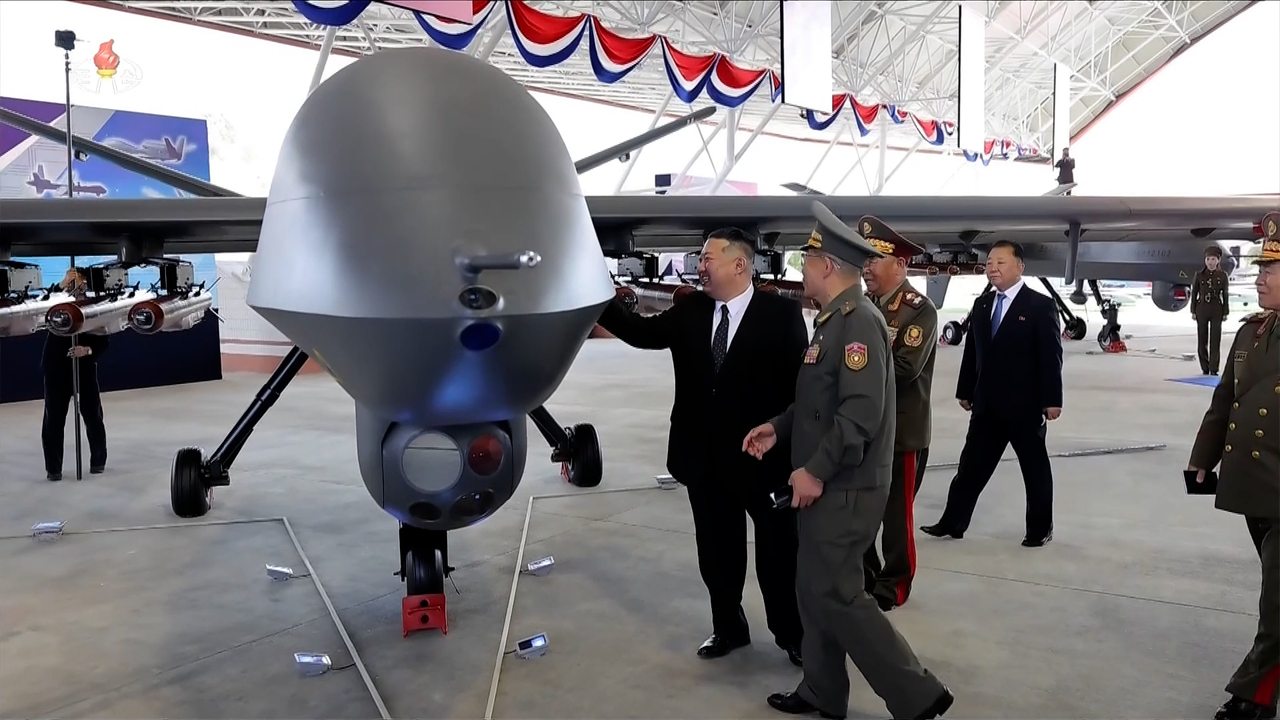
The report also warned that deepening military cooperation between North Korea and Russia could accelerate Pyongyang’s acquisition of technologies used in medium-sized attack drones such as Iran’s Shahed series.
Lee Jun-gon, a professor at Konkuk University’s Department of Defense Acquisition, also pointed to South Korea’s particular vulnerability to drone attacks, as it has more critical assets to protect while its counter-drone preparations still appear to lag behind.
“As we increase the role of drones in our forces, preparations for fighting against drones have to advance at the same pace,” Lee said. “At the moment, our focus appears to be weighted more toward acquiring and operating drones than toward defeating large numbers of inexpensive enemy drones.”
“If an adversary can send dozens or hundreds of cheap drones while we respond with expensive interceptors one by one, that is not a sustainable defense,” he added.
flylikekite@heraldcorp.com