

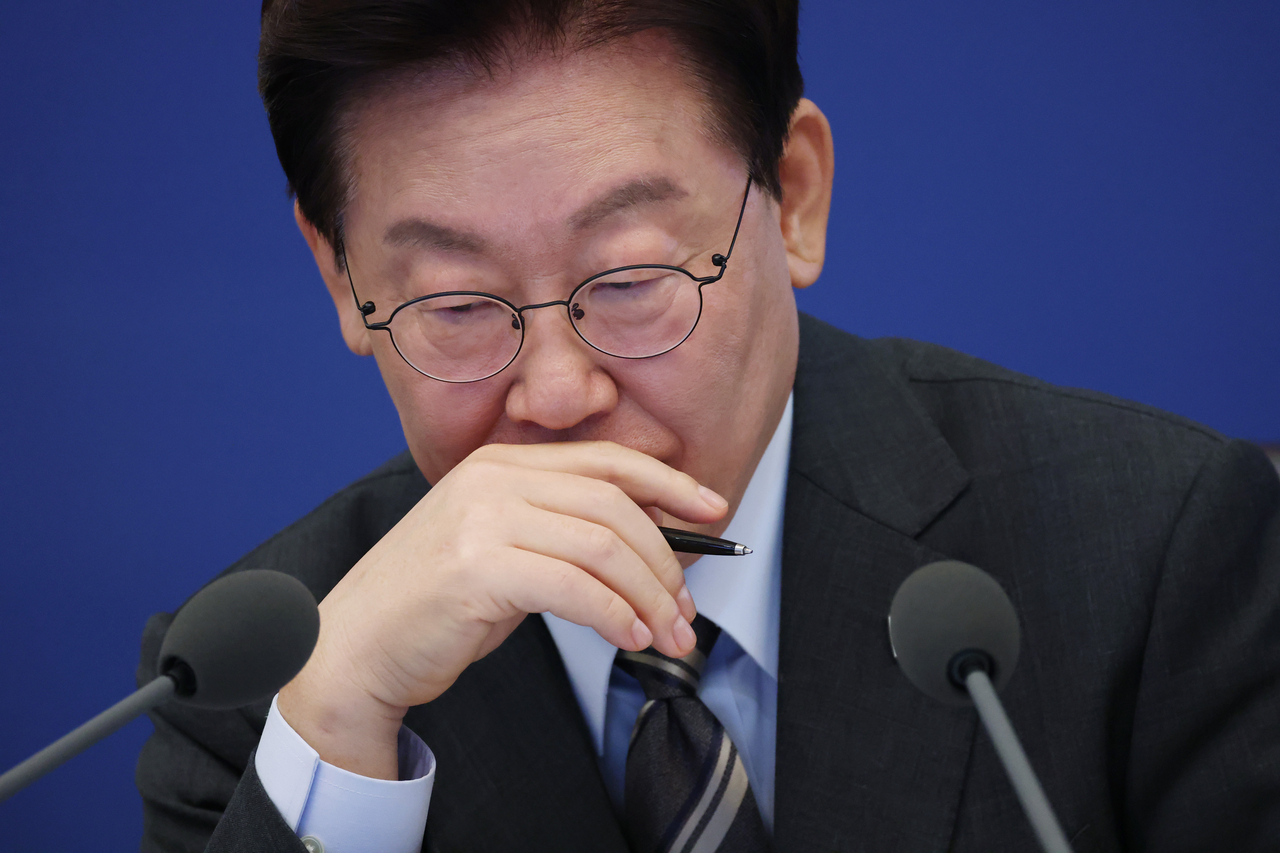
President Lee Jae Myung on Tuesday suggested exploring alternatives to lengthy legislative procedures as his administration moves toward a decision on the extent and scope of lowering the age of criminal responsibility.
Lee made the suggestion during a closed-door session of a weekly Cabinet meeting, where the Justice Ministry presented its review of public opinion survey results on lowering the age threshold, according to senior presidential spokesperson Kang Yu-jung.
The proposal revisits a longstanding debate in South Korea, where the minimum age of criminal responsibility has remained unchanged at 14 since the Criminal Act became law in 1953, despite repeated attempts by successive governments and lawmakers to lower it.
"After receiving the report, President Lee instructed officials to thoroughly review the matter before reaching a final decision," Kang said in a press statement.
Lowering the age threshold would require amendments to existing laws.
The latest survey reportedly found greater support for lowering the threshold across the board than for limiting the change to certain offenses. Lowering the age to 12 also drew more support than reducing it to 13.
"President Lee noted that amending the legislation would involve significant delays and suggested exploring more effective ways to address the issue without necessarily resorting to legislation," Kang said.
The presidential office did not elaborate on what those alternatives might entail.
Under South Korea's Criminal Act, children younger than 14 cannot be criminally punished. Those aged 10 to 13 can instead face protective measures under the Juvenile Act, including placement in juvenile correctional institutions for up to two years.
The renewed debate comes amid an increase in juvenile offenders referred to the justice system. According to police data, the number rose 81 percent, from 11,677 in 2021 to 21,095 in 2025. Of the 89,674 juveniles referred between 2021 and 2025, 13-year-olds accounted for 45,447, or 50.6 percent.
The age of criminal responsibility has not changed since 1953. Will it now?
Lee has repeatedly indicated support for lowering the threshold but questioned how far the government should go.
In July, Gender Equality and Family Minister Won Min-kyung presented the results of a public consultation involving government agencies, experts and citizen deliberation panels. The deliberation process favored lowering the threshold from 14 to 13 for serious, violent or repeat offenses rather than applying the change across the board.
Lee, however, questioned whether the proposal went far enough.
"The Gender Equality and Family Ministry's position is not to lower it across the board, but to lower it by just one year for specific crimes," Lee said at the July 14 Cabinet meeting. "But I wonder whether that is too limited. Quite a few countries set the threshold at age 12, don't they?"
Lee subsequently called for further public consultations on whether the change should apply to all offenses or only certain crimes, and whether the threshold should be lowered by one or two years. The Justice Ministry took charge of the additional consultation process.
Previous attempts to lower the threshold have failed to produce legislative changes.
Lawmakers introduced proposals in 2017 and 2018, while the Justice Ministry pursued a similar change in 2018. None became law.
In 2022, under former President Yoon Suk Yeol, the Justice Ministry again proposed lowering the threshold from 14 to 13, arguing that the justice system needed to respond more effectively to crimes committed by younger teenagers.
The ministry pre-announced amendments to the Criminal Act and Juvenile Act, and later submitted the bills to the National Assembly, but they were never enacted
Supporters of lowering the age argue that the current system is inadequate for dealing with serious crimes committed by younger adolescents. Critics warn that exposing children to criminal prosecution could undermine their rehabilitation and increase the risk of repeat offending.
dagyumji@heraldcorp.com