North Korea appears to have tested an upgraded hypersonic ballistic missile capable of evading interception and conducting precision strikes across the Korean Peninsula, experts said Tuesday.
North Korean state media Korean Central News Agency reported Tuesday that the country's Missile Administration had successfully tested a “new-type weapon” Sunday under the supervision of leader Kim Jong-un, calling it a significant step in the technological development of its weapons systems.
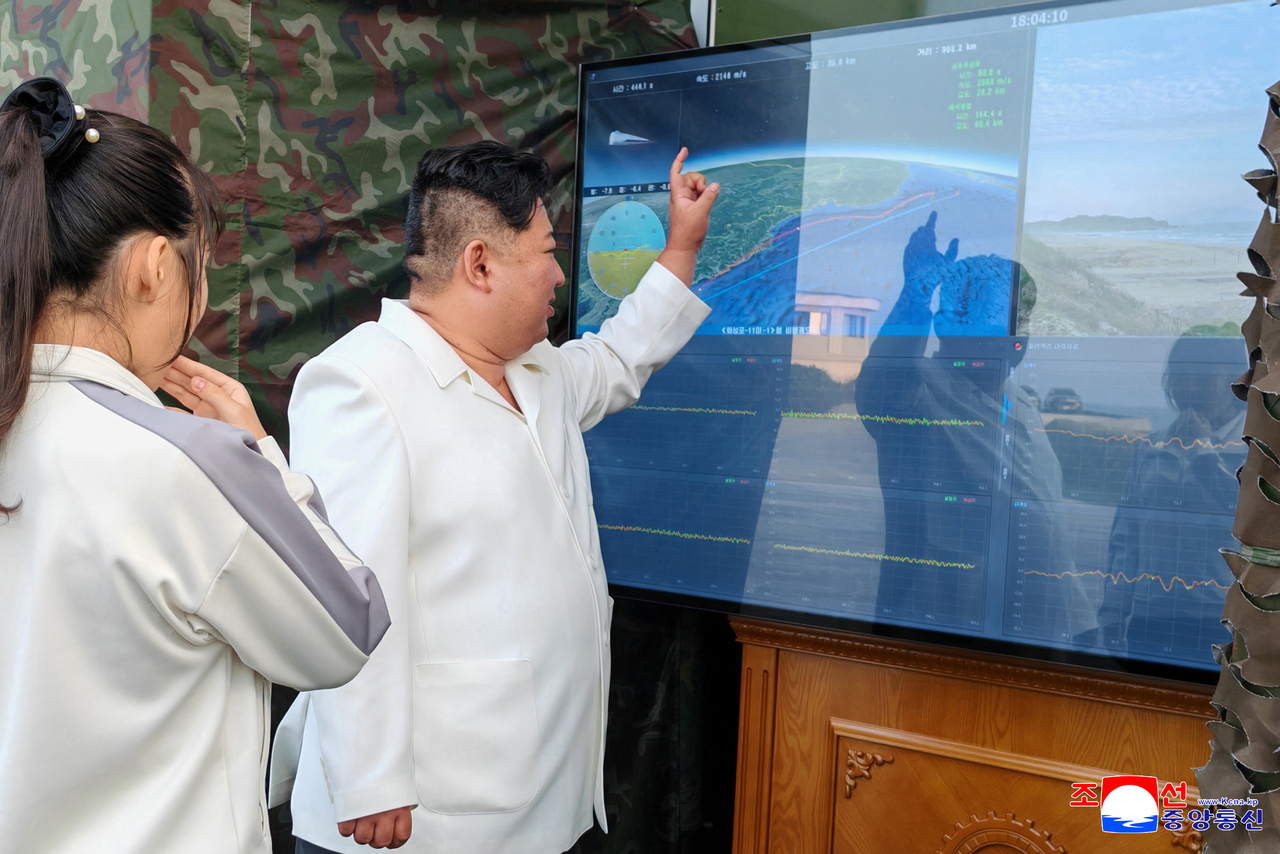
While Pyongyang did not officially identify the weapon, a monitor visible in photos released by state media displayed the words “Hwasongpho-11Ma-1 flight trajectory,” pointing to what experts assessed to be an upgraded version of the Hwasong-11Ma hypersonic missile system.
Hong Min, a senior research fellow at the Korea Institute for National Unification, identified the weapon as the Hwasong-11Ma-1, an improved version of the Hwasong-11Ma first unveiled at North Korea's Defence Development-2025 exhibition in October.
The system combines a KN-23, or Hwasong-11Ga, missile body with a hypersonic glide vehicle-type terminal section, according to Hong.
He characterized it as a long-range precision-strike weapon designed to penetrate missile defenses through maneuverability while striking targets several hundred kilometers away.
North Korea previously described the weapon system during a military parade marking the 80th anniversary of the Workers' Party in October 2025 as capable of conducting “ultraprecision” strikes against targets hundreds of kilometers away with high defense-penetration capability and destructive power.
The latest test also appears to be part of a continuing development program rather than an entirely new weapons project, Hong said. North Korea has been upgrading the system since its initial test in October, with Sunday's launch likely intended to verify the latest Hwasong-11Ma-1 variant.
The test was first detected Sunday by South Korea's Joint Chiefs of Staff, which said North Korea had launched two short-range ballistic missiles from the Wonsan area toward the East Sea.
The JCS assessed the two missiles as having traveled approximately 450 kilometers and 600 kilometers, respectively.
But a monitor shown in the photos released by North Korea two days later indicated a flight distance of 908.2 kilometers, creating a substantial discrepancy with Seoul's initial assessment.
Hong said the decision to expose the figure may have been deliberate.
By releasing the image after South Korea and its partners had already made their assessments public, Pyongyang may have sought to highlight what it portrayed as limitations in their ability to track the missile, he said.
Kim's own remarks appeared to reinforce that message.
“The enemy will know better what such progress means without any explanation in the aspect of military technology,” Kim was quoted as saying by the Korean Central News Agency.
Hong said the two-day delay in announcing the test could also have allowed Pyongyang to observe how South Korea, the United States and Japan assessed the launches before deciding what information to disclose.
The timing gave the announcement an additional political dimension, coming as the United Nations General Assembly's high-level general debate was set to open Tuesday in New York and two days before US President Donald Trump was scheduled to meet Chinese President Xi Jinping in Washington.
Hong assessed that while North Korea's weapons tests may proceed according to its technical development schedule, decisions over whether and how to publicize them can be calibrated around major political events, including the UN General Assembly, South Korea-US military exercises and developments surrounding possible dialogue with Washington.
Notably, Tuesday's report stopped short of explicitly referring to the country's nuclear forces.
That contrasts with North Korean state media coverage in January, when a launch involving the same weapons program was described as verifying the readiness of the country's “nuclear forces,” according to Hong.
Instead, Tuesday's report referred to an “important weapon system for a specific purpose,” while stressing that the test “did not have any adverse impact on the security of neighboring countries” and was an extension of the Missile Administration's “regular activities.”
Hong said the softer language, alongside the demonstration of an advanced weapons capability, could reflect an effort to calibrate the political message ahead of the UN gathering and Trump's speech — showcasing military strength without completely closing the door to diplomacy.
Yang Moo-jin, a distinguished professor at the University of North Korean Studies, similarly assessed the weapon as either an upgraded or follow-on model of the Hwasong-11Ma series of short-range hypersonic ballistic missiles previously unveiled by Pyongyang.
"Such weapons are designed to reach major military facilities across the Korean Peninsula in a short period of time while maneuvering in flight to make interception more difficult," Yang said.
Kim, meanwhile, hailed Sunday's test as “undoubtedly a striking demonstration of ultramodern defence technology and clear progress in the modernization of the armed forces,” according to KCNA.
He said acquiring the technology was of “weighty significance” for North Korea's war readiness and the future development of its armed forces.
Kim also said the advances would give the enemy “an incurable headache and a very cruel and unavoidable blow.”
Yang said the unusually pointed language was intended to emphasize that South Korea remains within the reach of North Korea's nuclear forces and that Pyongyang could hold the South at risk in the event of a conflict.
Photos released alongside the report showed Kim observing the test with his daughter Ju-ae.
The latest launches came as North Korea continues to advance weapons designed to evade or penetrate missile defenses, while repeatedly rejecting calls to abandon its nuclear arsenal.
mkjung@heraldcorp.com