

Seoul had an average of around one report of suspected ground subsidence a day since 2023, data showed Sunday, as public concern grows over a lack of government efforts to prevent fatal sinkholes in the capital.
According to National Fire Agency data cited by Rep. Kim Young-bae of the Democratic Party of Korea, Seoul received a total of 1,371 reports of suspected ground subsidence between 2023 and August this year — more than one report per day on average over the 1,338-day period.
The number of reports surged last year alongside an increase in confirmed cases. A total of 610 reports were filed in 2025, while 42 cases of actual ground subsidence were recorded, up from 17 the previous year, according to the Ministry of Land, Infrastructure and Transport.
Gangnam-gu, home to a dense concentration of high-rise buildings, subway lines and large-scale excavation projects, recorded the most reports among Seoul's districts at 172, followed by Mapo-gu with 105.
The large number of reports compared with confirmed cases comes amid heightened public concern following fatal sinkhole accidents in the capital.
In 2024, a car fell into a hole that opened on a road in Seodaemun-gu, killing one person and injuring another. In 2025, a motorcycle fell into a sinkhole in Gangdong-gu, killing the rider.
Kim said the reports could also provide clues to signs of ground instability before a serious accident occurs.
"When it comes to sinkholes, the importance of detecting warning signs in advance cannot be overstated, rather than responding only after an accident occurs," Kim said. "Seoul and its district governments should closely inspect areas where reports are concentrated and establish a systematic safety management system."
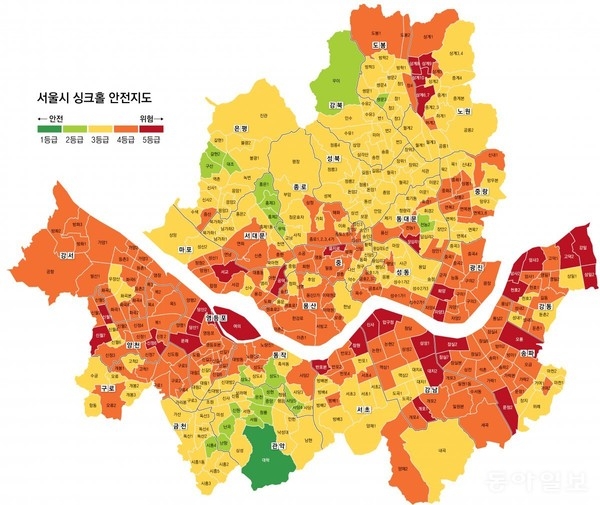
Prevention efforts lag
Experts have likewise emphasized preventive action. But measures taken by local governments have fallen short of what officials say is needed, partly because of limited financial support from the central government.
Nearly 40 percent of ground subsidence cases in Seoul have been linked to damaged sewer pipes, prompting the city government to replace aging infrastructure. About 55 percent of Seoul's sewer network, or 5,029 kilometers, is at least 30 years old, including 3,303 kilometers that are at least 50 years old.
The city replaces about 100 kilometers of aging sewer pipes annually. However, its request for 49.8 billion won ($35.8 million) in central government funding to accelerate next year's replacement work was rejected, leaving the project without national subsidies, according to local media reports.
Concerns have also grown over underground cavities — empty spaces beneath the ground that can develop into larger-scale subsidence.
According to data released earlier this month by Rep. Jung Hee-yong of the People Power Party, only 65.3 percent of 1,111 underground cavities detected nationwide between 2022 and June this year had been repaired. In Seoul, 10 cavities were detected during the period, all of which had been filled.
But concerns remain that larger cavities requiring extensive excavation could impose costs beyond what individual local governments can immediately handle, potentially leaving risks unaddressed.
"Given that underground cavities could lead to large-scale ground subsidence accidents, the central government's response has been somewhat insufficient," Jung said. "Institutional improvements are needed so that the central and local governments can actively work together on repairs."
forestjs@heraldcorp.com



![[Breaking] North Korea fires projectile toward East Sea](https://wimg.heraldcorp.com/news/cms/2026/09/20/news-p.v1.20260920.395191315d5544b490b498a0ed1f0ea3_R.png?type=h&h=120)