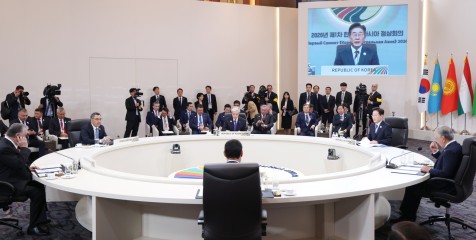
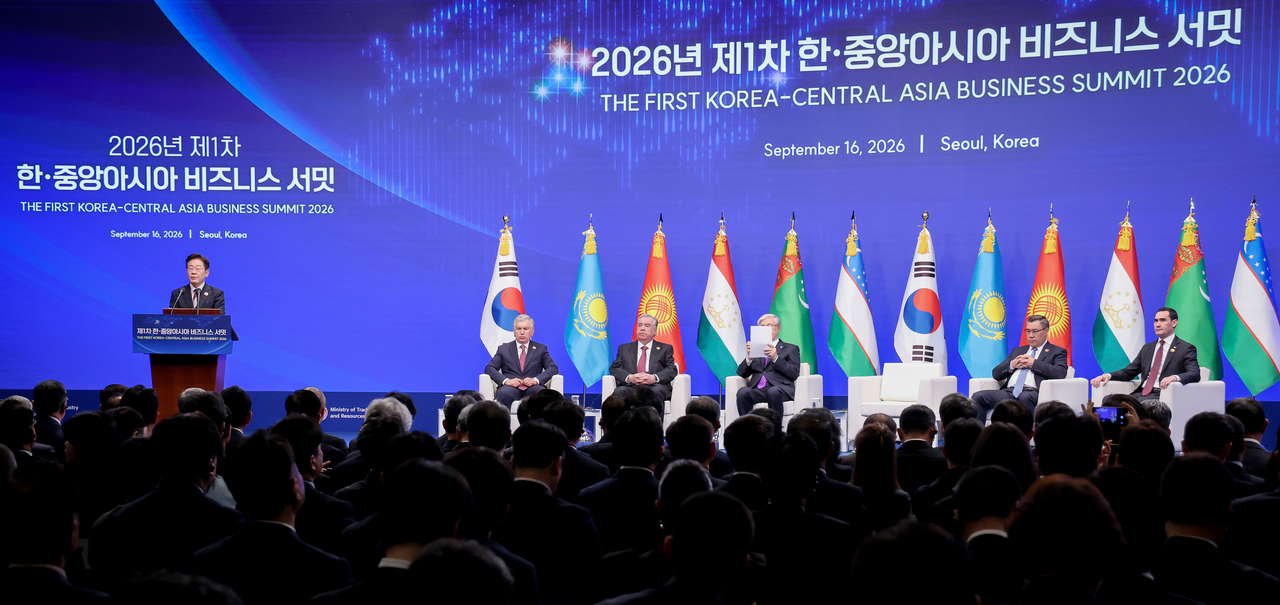
President Lee Jae Myung called Wednesday for South Korea and five Central Asian nations to forge a “new Silk Road,” seeking to harness their complementary strengths to build a broader economic partnership spanning trade, industry and infrastructure.
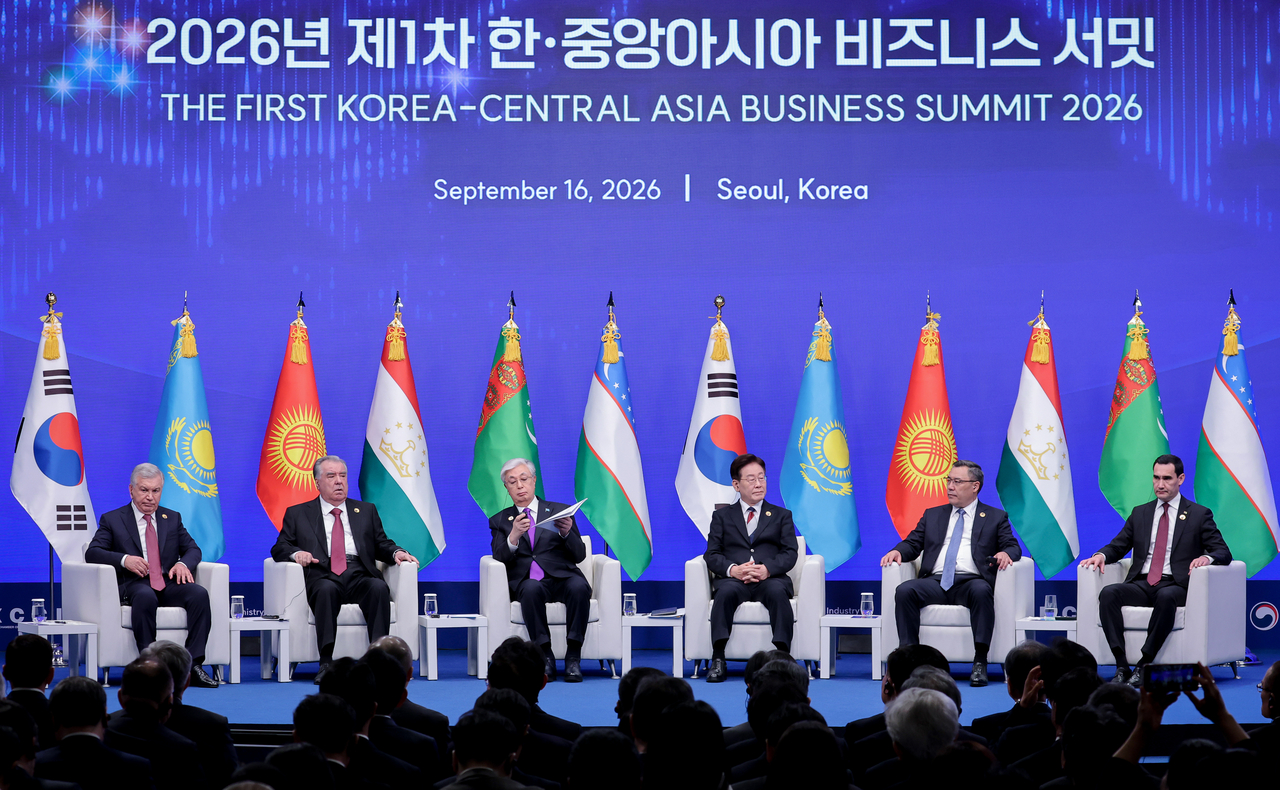
Speaking at the Korea-Central Asia Business Summit in Seoul, Lee drew on more than a millennium of exchanges between Korea and Central Asia to argue for taking their relationship into a new phase.
The business gathering followed the inaugural Korea-Central Asia summit, where the six countries adopted the Seoul Declaration, a longer-term framework for regional cooperation.
Kazakhstan President Kassym-Jomart Tokayev, Kyrgyzstan President Sadyr Japarov, Tajikistan President Emomali Rahmon, Turkmenistan President Serdar Berdimuhamedov and Uzbekistan President Shavkat Mirziyoyev also addressed the business summit.
Lee invoked the ancient Silk Road as a symbol of the countries' historic connections, saying the next step was to translate them into deeper cooperation in trade, critical minerals and infrastructure.
“If we walk together, I am certain that the road of 1,500 years ago will reopen as a new and beautiful Silk Road,” Lee said. “If the five countries gathered here today and we in the Republic of Korea pool our wisdom and join hands, there is nothing we cannot achieve together,” he added.
Lee stressed the practical value of closer cooperation, saying “we will also be able to overcome the many difficulties we are facing together today, swiftly and with ease.”
His proposal centered on three areas: expanding trade and investment beyond their traditional sectors; building an integrated partnership linking Central Asia’s critical minerals with Korea’s advanced manufacturing; and jointly developing the transport, energy and urban infrastructure needed to support the region’s rapid growth.
On trade, Lee called for moving beyond a relationship largely centered on Korean exports of automobiles and auto parts and imports of Central Asian energy and raw materials.
“We must increase the range of goods we exchange and expand the areas of investment,” Lee said. “We must now move beyond these items and decisively broaden the scope of trade into new industries such as consumer goods, biotechnology and digital sectors.”
Seoul, he said, would send trade delegations to the region and help Central Asian products gain greater access to the Korean market. It would also accelerate the introduction of digital customs systems to lower non-tariff barriers and streamline clearance procedures.
The government plans to establish “Korea Desks” in all five Central Asian countries to serve as on-the-ground channels for resolving difficulties faced by Korean businesses.
A second pillar of Lee’s proposal was the need to “build a framework for cooperation encompassing critical minerals and advanced manufacturing.”
“Against the backdrop of a reshaping of global supply chains, Central Asia is emerging as a treasure trove of critical minerals essential to electric vehicles, batteries and semiconductor production,” Lee said.
Lee underlined that combining Central Asia’s abundant reserves of lithium, uranium and other minerals with South Korea’s manufacturing strengths in batteries and semiconductors could allow the two sides to “lead the global market.”
Lee also called for cooperation to move beyond the simple trade of raw materials.
The partnership should extend across the entire value chain, from exploration and refining to high-value-added materials processing and finished products, stressing the need to “strengthen full-cycle cooperation in critical minerals,” according to Lee.
Infrastructure formed the third pillar of Lee’s vision. “We will be a steadfast partner in building the infrastructure of the future together,” Lee said.
Lee pointed to Central Asia’s population of roughly 84 million, average age of 27, fertility rate of 3.1 births per woman and annual economic growth of around 5 percent.
Lee underlined that the region’s rapid expansion was fueling plans to modernize large-scale infrastructure, including urban development, high-speed railways, industrial plants and power grids.
“I can say with confidence that our Republic of Korea companies, with their extensive construction experience and proven technology, are the optimal partners for Central Asia’s infrastructure innovation,” Lee said.
“We should work together to build transport and energy arteries across this vast continent, along with dense logistics networks, and unlock Eurasia’s potential,” he said.
Lee also pledged Seoul’s continued support for the region’s development ambitions, saying, “The Republic of Korea will stand firmly behind your bold endeavors so that they can expeditiously translate into tangible results.”
dagyumji@heraldcorp.com