

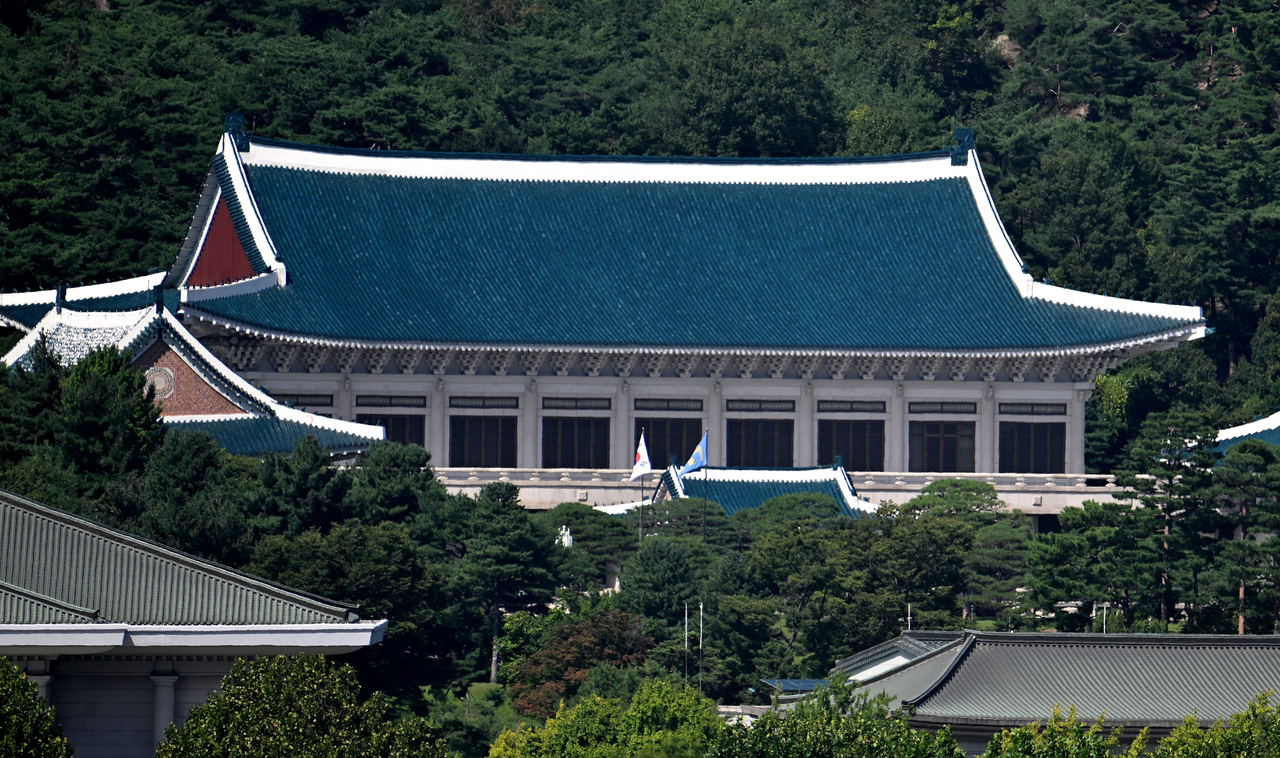
South Korea and the United States are close to finalizing a comprehensive agreement on relocating US military facilities at several air bases, including Gwangju, national security adviser Wi Sung-lac said Friday.
The agreement could help pave the way for the relocation of US military facilities at Gwangju Air Base, a key issue in plans to develop a semiconductor manufacturing cluster in the southwestern Honam region, one of three "megaprojects" pursued by the Lee Jae Myung administration.
Wi stressed that Washington was neither opposing nor obstructing the relocation.
"There is no situation in which the US is refusing to leave, deliberately holding up the process or seeking to extract concessions in return for relocating," Wi said during a press briefing at the Chunchugwan press center at Cheong Wa Dae in Seoul.
His remarks came amid concerns that the US military presence at Gwangju Air Base could complicate or delay plans to build a second semiconductor manufacturing hub. The issue was raised Thursday during the National Assembly's audit of Cheong Wa Dae offices, including the National Security Office.
Wi explained that the two countries had been negotiating a comprehensive agreement establishing the principles and procedures for relocating US military facilities at five collocated operating bases: Gwangju, Daegu, Cheongju, Gimhae and Suwon.
"The US wants the Gwangju facilities to be covered by the comprehensive agreement, and we share that position," Wi said.
"Discussions had been stalled over several outstanding issues, but we have made considerable progress recently and are now close to finalizing the agreement," he added.
Wi further explained, "once concluded, the agreement will establish a framework for relocating US military facilities at Gwangju as well as other bases."
The framework is intended to establish common standards for replacement facilities, arrangements for the temporary deployment of US forces during relocation and principles governing the sharing of relocation costs.
The negotiations date back to October 2020, when the two countries established a special subcommittee on military air base relocation under the Status of Forces Agreement or SOFA Joint Committee, prompted by plans to relocate the Daegu military airport. Full-scale working-level consultations began in February 2021.
Wi emphasized that with the agreement nearing completion, the key remaining challenge was preparing replacement facilities to accommodate US military operations.
"The remaining question is how the replacement facilities will be prepared," he said. "The US will relocate once alternative facilities are available. If those facilities are delayed, the relocation could also be delayed, but that is something we have to take care of."
Accelerating the relocation schedule would therefore require Seoul to move faster in constructing replacement facilities and securing the necessary funding.
"If we decide to bring forward the relocation timeline, we will have to prepare the replacement facilities more quickly," Wi said. "It is primarily a matter of our budget and our own preparations."
At the third megaproject review meeting in late September, President Lee Jae Myung ordered officials to accelerate plans to vacate Gwangju Air Base, calling for the existing mid-2028 target to be brought forward as much as possible to speed up development of the semiconductor cluster.
Lee had initially instructed the Defense Ministry at the second megaproject review meeting in mid-August to temporarily relocate military functions at Gwangju Air Base to other airfields by mid-2028.
Gwangju Air Base, however, remains strategically important to the South Korea-US alliance. As one of five designated collocated operating bases, it can accommodate US air assets during contingencies, while portions of the installation are reserved for US military use under the bilateral Status of Forces Agreement.
The US 7th Air Force previously underscored its significant military interests at the base, stressing the need to maintain military requirements and combined defense readiness throughout the relocation process.
Nevertheless, Wi sought to play down concerns that the US military presence could become a major obstacle to the project.
"I don't think this should be viewed as such a serious problem," he said.
dagyumji@heraldcorp.com



