

As dementia increases risks of going missing, falling victim to financial exploitation, South Korea’s rapidly aging society struggles to keep pace
How a society dies can reveal how it lives. From childbirth to suicide and cancer, this series examines what mortality trends tell us about South Korea today. This is the third installment of Behind the Numbers, exploring dementia’s shadow over the final days of life. — Ed.
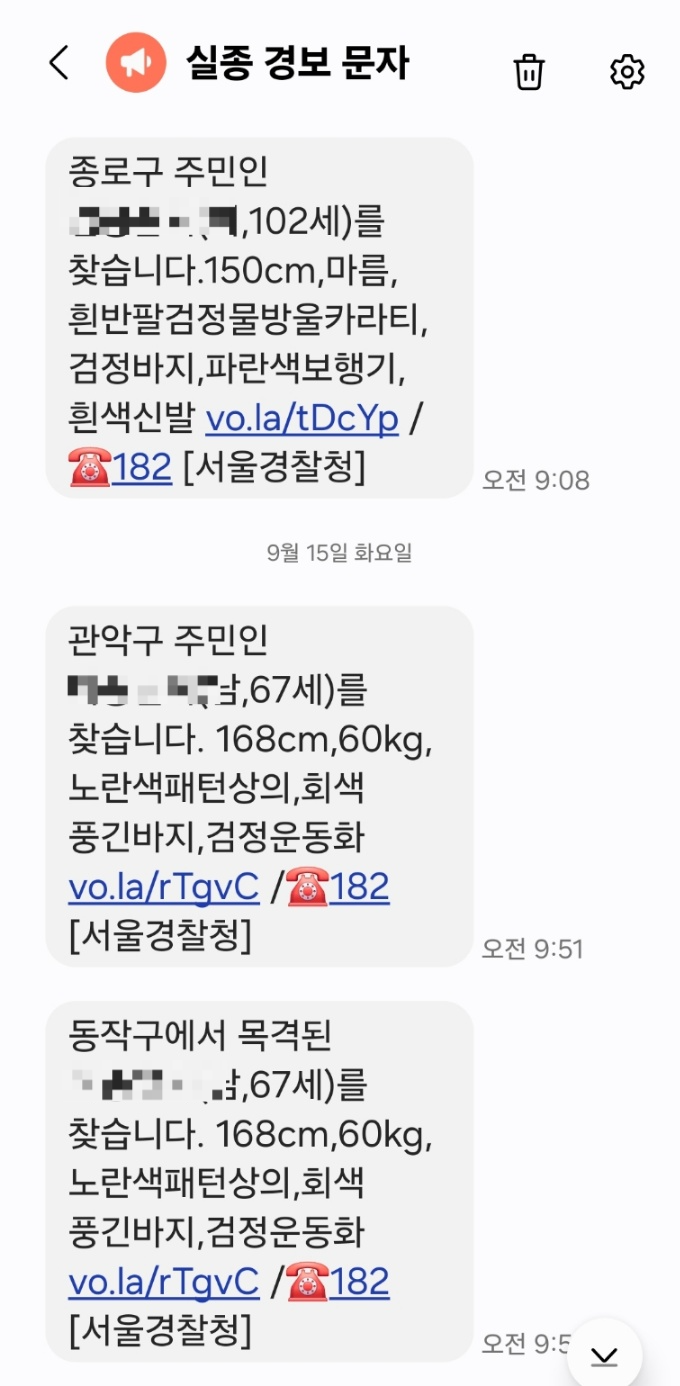
Hardly a day passes without a missing person alert popping up on South Koreans' phones.
The police-run system sends emergency-style alerts with details about missing individuals, including their age, gender, last known location and clothing, seeking the public's help in finding them.
More than 65 percent of the alerts sent from the system's launch in 2021 through July last year were for older adults with dementia, according to National Police Agency data.
On average, they were found in three hours and 48 minutes, but not all cases ended safely.
Between March 2016 and June 2023, a total of 761 people with dementia died after getting lost or wandering away, data showed.
The figures expose a darker side of South Korea's longevity. People here are living longer than in many other countries, but the population is also aging rapidly, with fewer younger people to support a growing number of older adults.
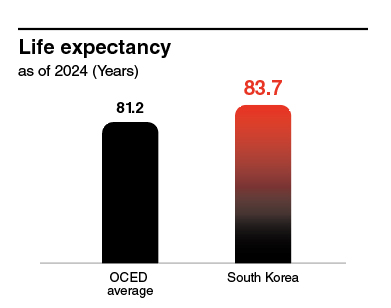
Life expectancy reached a record 83.7 years in 2024, 2.5 years above the Organization for Economic Cooperation and Development average of 81.2 years.
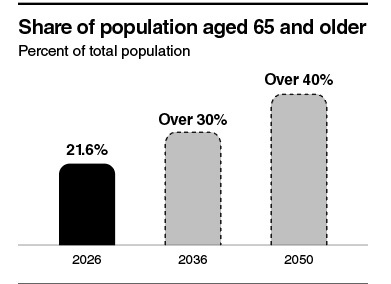
More than 1 in 5 South Koreans are now aged 65 or older, with their share projected to exceed 30 percent by 2036 and 40 percent by 2050, according to the Ministry of Data and Statistics.
Dementia deaths surge 72% over past decade
Not surprisingly, longer lives are coinciding with a growing toll from dementia.
Dementia deaths in South Korea have climbed 72 percent over the past decade, to a rate of 32 deaths per 100,000 people in 2025, according to cause-of-death statistics released Sept. 22. A total of 16,321 people died from dementia last year, up 9 percent from 2024.
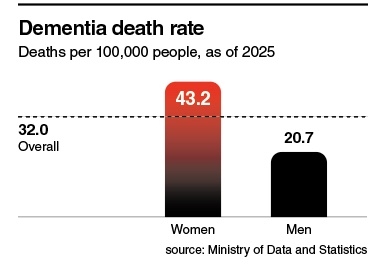
Women were particularly affected, with a dementia death rate of 43.2 per 100,000 people, more than double the 20.7 recorded among men.
But dementia’s toll extends far beyond the death count. For patients and their families, the disease can mean years of suffering, uncertainty and emotional strain before the end of life.
The challenge was foreseeable decades ago, as smaller nuclear families replaced extended households that had traditionally cared for elderly and ailing relatives.
Recognizing that dementia care was becoming a public health issue rather than solely a private family responsibility, the government began expanding public support nearly two decades ago.
South Korea launched its first national dementia management initiative in 2008 and enacted the Dementia Management Act in 2011.
A major political push arrived in 2017 under President Moon Jae-in, whose mother had dementia and died while he was in office. The policy expanded dementia care centers nationwide, strengthened community-based support and introduced measures to help prevent patients from going missing, including GPS tracking devices.
More patients, less funding
Yet policy efforts have struggled to keep pace with the growing challenge. In recent years, the government’s commitment to dementia care appears to have waned, at least in budgetary terms.
The number of people living with dementia, estimated at around 704,000 in 2017, has now surpassed 1 million, with projections pointing to 1.21 million by 2030 and 2.26 million by 2050.
But the annual operating budget for dementia relief centers nationwide fell 12.6 percent over four years, from 172.3 billion won in 2021 to 150.6 billion won in 2025, Health Ministry data shows.
Over the same period, staffing at the centers increased by just 5.9 percent, from 4,752 to 5,032 employees.
The state-run centers provide community-based services, including early dementia screening, cognitive rehabilitation and support for patients and their families.
The government's overall dementia care budget, which includes funding for public nursing hospitals and guardianship services, has also fallen from previous levels.
Funding for the program rose from 204.7 billion won in 2021 to 207.7 billion won in 2022, before falling to 178.2 billion won in 2025. Although the budget increased 3.7 percent on-year to approximately 184.9 billion won in 2026, it remained about 11 percent below its 2022 level.
The Korean Dementia Association urged the government to preserve the specialized role of dementia relief centers rather than scale back their services.
"Dementia relief centers are one of the few examples of public infrastructure functioning nationwide. Their services should be strengthened, particularly in rural and medically underserved areas," the association said in a statement.
"Clear guidelines are needed to prevent center staff from being overburdened with unrelated administrative duties, along with service models tailored to regional needs."
Crimes targeting people with dementia
With dementia affecting a growing number of older South Koreans, fears are rising that their accumulated wealth could become an increasingly attractive target for fraudsters.
According to a comprehensive survey released on Oct. 6 by the Presidential Committee on Aging Society and Population Policy, an estimated 760,000 of South Korea's 1.24 million older adults with dementia, or 61 percent, held assets totaling 154 trillion won ($114 billion) as of 2023.
As of the end of 2025, assets held by people with dementia were estimated at 172 trillion won, equivalent to about 6.9 percent of South Korea’s gross domestic product.
By 2050, when the number of people with dementia is projected to reach 2.26 million, their combined assets are expected to rise to 488 trillion won.
By 2050, the committee projected, the number of older adults with dementia could reach 2.26 million, with their collective wealth approaching 500 trillion won.
Yet many struggle to manage or safeguard their assets as their cognitive abilities decline, making them particularly vulnerable to financial exploitation.
In June last year, members of a fraud ring were sentenced to up to three years and six months in prison for swindling 975 million won from a dementia patient in their 90s.
The perpetrators had lured the victim with promises of high investment returns before siphoning off money obtained through a loan secured against the victim's apartment.
In another case, police arrested members of a solar energy fraud ring in 2022 on suspicion of swindling a total of 17.5 billion won from older adults in rural areas, including Haenam, Jeonam-Gwangju. Among the victims were four people in their 80s with dementia.
The government responded to these risks by rolling out a dementia asset management service in April.
Under the program, individuals can enter into trust agreements with the National Pension Service either after being diagnosed with dementia or in advance of a potential diagnosis. The agency then manages their assets and covers living expenses, medical bills and long-term care costs on their behalf, helping protect them from financial exploitation.
The initiative, included in the government's fifth national dementia management plan for 2026-2030, is expected to become a full-fledged program in 2028. Yet its reach remains limited. As of early July, just four trust agreements had been signed, according to the Health Ministry.
"Protecting people with dementia requires more than simply managing their assets. We need a system that can identify financial abuse early, track crimes targeting this vulnerable population and intervene before victims lose their life savings," said Jeon Yong-ho, a professor of social welfare at Incheon National University.
cjh@heraldcorp.com



