
Overall user base grows 35% as businesses integrate AI deeper into operations
OpenAI Korea is entering its second year after explosive growth in corporate adoption, with the number of ChatGPT Enterprise users in the country surging 28-fold over the past year.
Korea’s overall ChatGPT user base also expanded 35 percent during the period, the company said Wednesday at a press briefing marking the first anniversary of its local office.
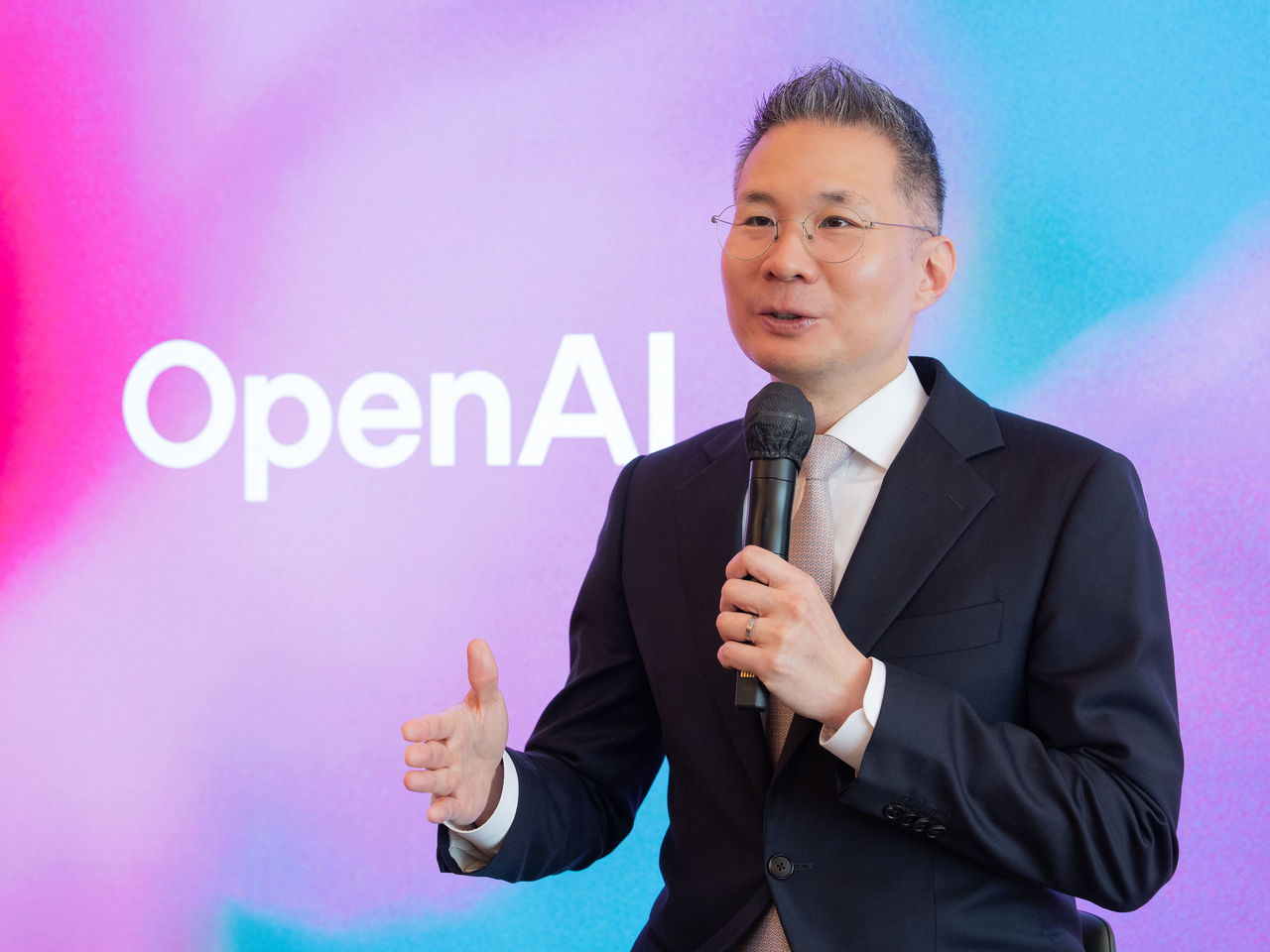
“When we opened our Korea office a year ago, we said OpenAI would become a partner in Korea’s AI transition,” said Kim Kyoung-hoon, general manager of OpenAI Korea. “Looking back, I believe we have made meaningful progress toward that goal.”
Kim attributed the rapid expansion to Korea’s early embrace of AI, highly skilled developer community and vibrant startup ecosystem.
Even before the local office opened, some Korean companies had contacted OpenAI’s headquarters directly to adopt ChatGPT Enterprise, Kim said. Establishing a team in Korea helped accelerate adoption by making it easier to engage with local businesses.
The way companies use AI is also evolving. Businesses are moving beyond stand-alone chatbots and integrating the technology into their operations, products and services.
“In the past, companies mainly used AI as chatbots that provided information,” Kim said. “Now, we are seeing companies work with AI to create new products and services.”
OpenAI cited Samsung Electronics and Seoul National University as prominent examples of large-scale adoption.
Samsung has deployed ChatGPT across its global workforce for research and development, marketing, overseas sales and production management. At Seoul National University, nearly 50,000 students and faculty members use ChatGPT and Codex, OpenAI’s coding assistant, for research and administrative work.
With adoption accelerating, OpenAI Korea is turning its attention to the computing infrastructure needed to support further growth.
The company already offers data residency in Korea for enterprise, education and application programming interface customers. It is also preparing to process AI inference workloads within the country, Kim said.
“Inference requires advanced graphics processing units and cloud systems that can support them,” he said. “We are continuing discussions with several Korean partners capable of providing that infrastructure.”
OpenAI is also pursuing AI infrastructure cooperation with Samsung Group and SK Group under memorandums of understanding signed in October. The talks include the Stargate project and involve multiple affiliates, including SK Telecom and SK hynix.
Kim cautioned that the project remains in an early stage and that specific plans have not been finalized.
“Building a data center involves more considerations than we initially expected,” he said, noting that the rapid evolution of AI has altered infrastructure requirements since discussions began.
Korea’s semiconductor industry will also be central to OpenAI’s longer-term strategy, Kim said.
“Better semiconductors that enable faster and deeper computation are important,” he said. “Collaboration with Korean companies, especially those in the semiconductor supply chain, is a very important priority for us.”
After a first year centered on expanding adoption, OpenAI Korea’s next phase will focus on deepening corporate use and building the domestic computing infrastructure needed to sustain that growth.
yeeun@heraldcorp.com