
South Korea’s labor minister said Tuesday that a strike planned by Samsung Electronics unions over their demand for a fixed share of the company’s operating profit would have been illegal under new government guidelines.
The labor activist-turned-minister’s comments came after the Ministry of Employment and Labor issued implementation guidelines on Thursday for the revised Trade Union and Labor Relations Adjustment Act.
While the revised law broadened the scope of labor disputes to cover changes in working conditions arising from certain management decisions, the guidelines say demands for a fixed share of a company’s profits as performance bonuses fall outside the scope of mandatory bargaining.
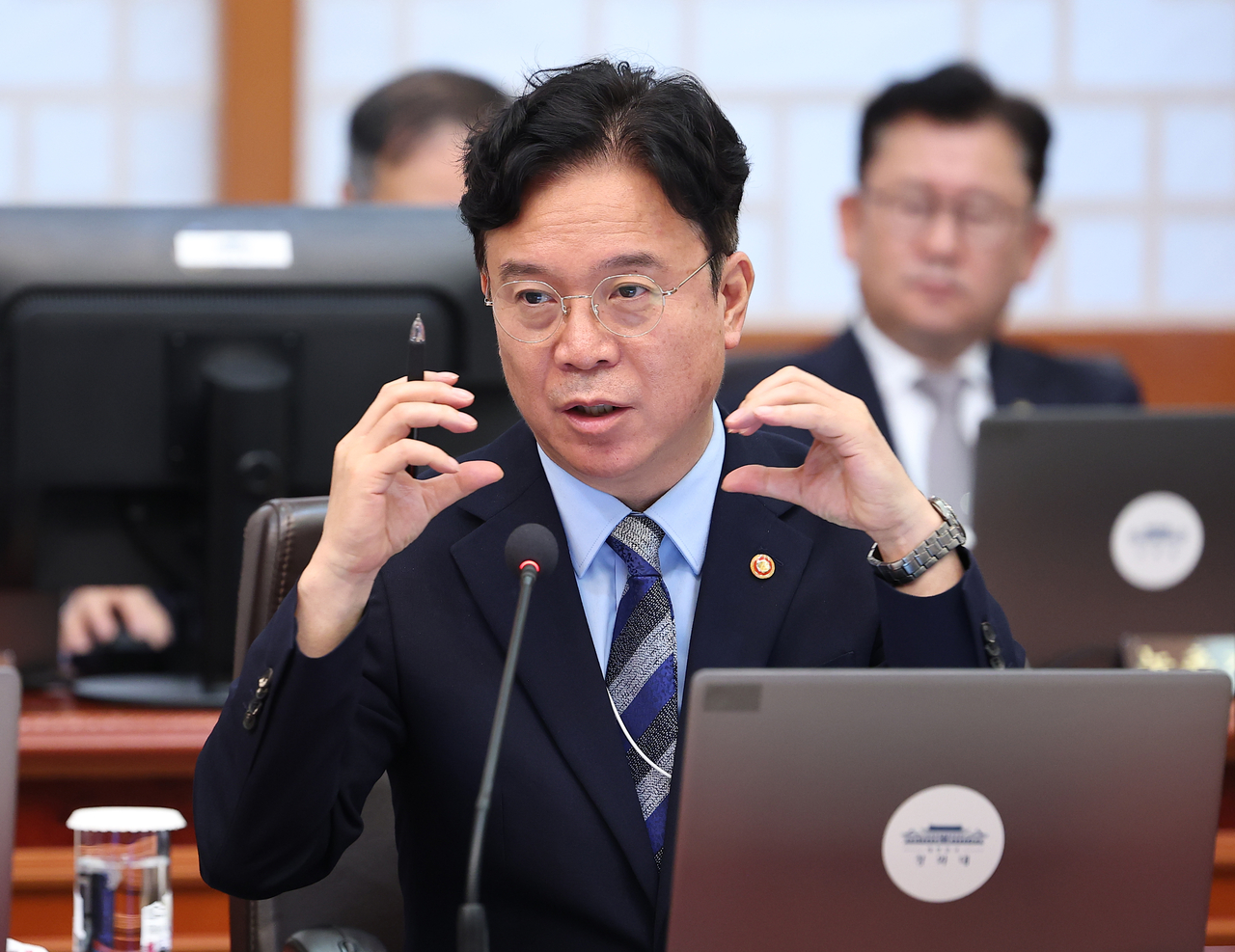
“The guidelines were intended to restrict demands for a certain percentage of operating profit to be set aside as bonuses even before taxes are paid,” Kim said on an SBS radio program.
He added that such demands could be misunderstood by foreign investors, leading to reduced investment and weakened corporate competitiveness.
Asked whether Samsung Electronics’ planned strike earlier this year would have been considered illegal if the guidelines had been issued before the dispute, Kim answered in the affirmative, reiterating his criticism of demands for a predetermined share of operating profit as performance bonuses.
Three unions at Samsung Electronics, including the Samsung Electronics Super Corporate Union, voted in March to authorize a general strike, with 93.1 percent of participating members approving the action. The company and the unions reached a last-minute agreement on May 20.
The unions had initially demanded that 20 percent of the company’s operating profit be used to fund performance bonuses, among other demands.
Under the agreement, semiconductor workers will receive an additional bonus funded by 10.5 percent of the company’s business performance, rather than a predetermined share of its operating profit.
The definition of “business performance” is to be determined through further negotiations in future years. For this year, it refers specifically to operating profit.
The agreement also abolished the previous cap on bonuses, which had been set at 50 percent of annual salary.
The Samsung dispute drew attention across other industries, where similar demands for profit-linked incentives emerged as a major issue in wage negotiations, eventually prompting the ministry to issue the guidelines.
The guidelines state that management decisions themselves are not subject to mandatory bargaining, although labor and management may discuss them voluntarily. Issues involving employment or working conditions may become subject to mandatory bargaining if changes are objectively expected as a result of those decisions.
The guidelines do not apply retroactively to Samsung’s concluded negotiations.
The ministry said the guidelines are intended to support industrial growth by providing businesses with greater predictability.
Labor groups, however, criticized the guidelines immediately after their release, saying they effectively narrow the scope of labor disputes, and called for their abolition.
“The guidelines seek to narrow the scope of labor disputes by specifying, by type, which management decisions can be subject to labor disputes,” the Korean Confederation of Trade Unions said in a statement. “This will only further narrow the scope of the revised labor law through administrative guidelines and amplify confusion in workplaces.”
Meanwhile, business groups expressed concern that the guidelines could lack enforceability because they constitute administrative guidance rather than legally binding rules.
“We hope the guidelines will continue to be supplemented to minimize confusion in workplaces during their implementation and that more explicit and stable legal standards, such as those established through enforcement decrees, will be put in place soon,” an official from the Federation of Korean Industries said.
forestjs@heraldcorp.com