Currency’s sharp rebound squeezes export earnings, chips away at overseas investment returns

The South Korean won’s rapid rebound to its strongest level in nearly two years is proving a double-edged sword: easing import costs while threatening the earnings of the semiconductor giants powering the country’s growth.
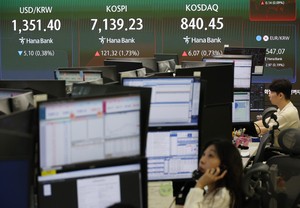
The won strengthened to 1,334.7 per dollar in onshore Seoul trading Monday, its strongest level since Oct. 4, 2024. It has gained more than 200 won against the dollar in just over two months after weakening to 1,599.2 on July 1. The currency was trading at 1,346.08 per dollar around noon.
The rally offers relief to households and businesses by making imported energy and raw materials cheaper. But for Korea’s export-heavy economy, a stronger won reduces the local-currency value of overseas revenue — putting chipmakers and investors in US stocks on the other side of the trade.
Red-light for exporters?
Concerns are growing that the country's leading chipmakers Samsung Electronics and SK hynix could come under pressure from the stronger won.
Nomura Securities noted that domestic memory chip-makers receive most of their payments in dollars but incur a significant portion of their costs — about 20 percent of sales — in won. This means a 10 percent appreciation of the won could lead to a roughly 12 percent decline in operating profit, creating a near-term earnings burden.
Reflecting the impact of currency fluctuations, Citigroup lowered its third-quarter operating profit estimate for Samsung Electronics by 10 percent to 10.41 trillion won ($ 7.7 billion) from 11.55 trillion won, citing the cut reflects a "5 trillion won negative impact from unfavorable FX," along with an additional 5 trillion won from bonus provisions.
For SK hynix, the banking group brought down its forecast by 3 percent to 7.4 trillion won from 7.67 trillion won.
Mirae Asset Securities also lowered its operating profit forecasts for Samsung Electronics and SK hynix for this year and next year, citing the won's appreciation.
"The currency's fluctuations could raise concerns over a decline in corporate earnings when translated into won terms. A weaker won over the remaining trading days could also weigh on export earnings, creating an additional drag on corporate profits," Kim Kyou-jin, an analyst at NH Investment & Securities, said.
With corporate dollar holdings at record levels amid strong exports, further won appreciation could heighten the risk of forex losses.
The dollar deposits held by companies at the country's five major banks — KB Kookmin, Shinhan, Hana, Woori and NH NongHyup — totaled $63.3 billion as of Thursday, the highest level since May 2021, when comparable data for all five banks was first recorded.
US stocks: A two-sided bet
For Korean investors betting on US equities, a stronger won can reduce investment returns when dollar-denominated assets are converted back into the local currency.
For example, if the won-dollar exchange rate falls from 1,550 won to 1,400 won, the won value of a dollar-denominated asset would decline by roughly 10 percent even if its dollar price remains unchanged. This means Korean investors could see their returns significantly eroded by currency movements even when US stocks continue to rise.
On the other hand, with Korean investors' appetite for US stocks remaining strong, the strengthening of the won could spur renewed demand for dollar conversion.
Investment data also show that Korean investors' net purchases of US stocks have been picking up again.
According to the Korea Securities Depository, local investors were net sellers of US stocks in April and May, offloading $468.92 million and $937.96 million in shares, respectively, but turned to net buyers in June, purchasing $632.96 million worth of US stocks.
Net purchases then surged to $4.64 billion in July and remained strong at $1.96 billion in August.
Market analysts expect the won to strengthen further, although the pace of appreciation is likely to slow.
"Taking domestic and external conditions into account, we expect the won to strengthen further, with the floor through the end of the year potentially reaching the low 1,300-won range at the minimum, although the pace of appreciation is likely to moderate," Moon Da-woon, an analyst at Korea Investment & Securities, said.
silverstar@heraldcorp.com