
The professional network with 5.8m members in Korea urges businesses to turn audience reach into stronger sales prospects
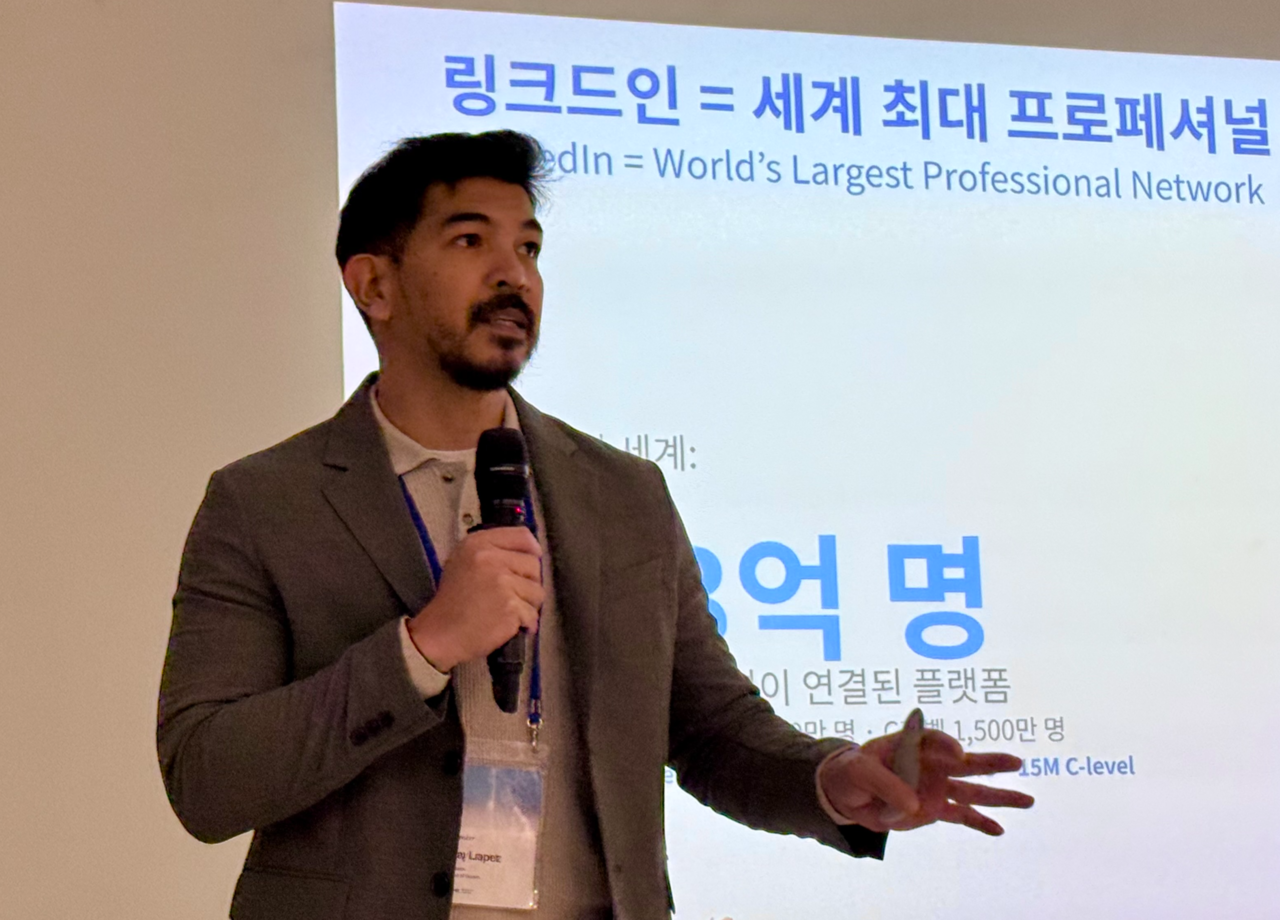
LinkedIn is courting Korean companies seeking overseas customers, urging marketers and sales teams to use its professional network to identify potential buyers and build relationships before purchasing decisions are made.
At LinkedIn's Korea Summit 2026 on Thursday, executives outlined how businesses could combine targeted advertising, professional content and sales outreach to connect with decision-makers abroad and link marketing spending more closely to revenue.
“What’s important here is not the size,” said Ray Lopez, LinkedIn’s head of growth for Korea and midmarket Asia. “It’s actually about the quality of the audience.”
Lopez highlighted the ability to identify professionals by job title, function and influence within a company as a way to help suppliers reach people involved in purchasing decisions.
LinkedIn’s Korean network is growing. The platform has 5.8 million members in the country, and has added about 100,000 a month over the past 18 months, the company said.
For advertisers, the harder task is turning that access into business.
LinkedIn Senior Account Director Choi Min-hee said companies often define their customers too broadly. Targeting an industry or a senior job title is only a starting point. Marketers need to examine which companies and functions respond, then ask sales teams which contacts led to worthwhile conversations and why.
He questioned the practice of demanding more leads when existing ones fail to convert, saying, “Is simply pushing up the numbers really a way to solve the problem?”

Companies also need to offer something worth sharing contact details for. Strategic research may appeal to executives, while managers and practitioners may be more interested in practical tools that help solve an immediate problem.
Choi recommended publishing regularly through company pages, employees and executives, then putting advertising spending behind content that draws a relevant audience.
The aim is to become familiar to potential customers before they start looking for a supplier.
“Only 5 percent of B2B buyers are in market today,” Lopez said, referring to the principle that only a small share of potential customers are actively considering a purchase at any given time.
That leaves marketers working to a different clock from the people judging their budgets. Lopez put the average B2B sales cycle at 211 days, while noting that 66 percent of B2B marketers face pressure to demonstrate returns at least monthly.
Jhun Yu-bin, LinkedIn’s senior client solutions manager, described a global air cargo company whose LinkedIn advertising was generating inquiries that often failed to meet its sales team’s needs.
Only 20 percent came from freight forwarders, which directly book cargo space. Most came from shippers, which could influence the choice of airline but were less likely to generate an immediate booking.
The underlying problem, Jhun said, was that marketing and sales had not agreed on which customers to prioritize or what made an inquiry worth pursuing.
The teams decided to establish common targeting criteria, drawing on sales’ list of priority companies and LinkedIn reports showing which businesses had engaged with their advertising. They then adjusted the campaigns to reflect how close prospective customers were to purchasing.
The company used simpler LinkedIn forms to collect initial inquiries, then followed up with ads and more detailed questions to gauge purchasing interest. Its sales team received only the contacts ready to discuss a purchase, Jhun said.
“People at that stage don’t want to ‘learn more,’” Jhun said. “They want a quote.”
The initial form completion rate rose from 1.07 percent to 4.01 percent, while the cost of attracting each early-stage contact fell 80 percent, she said.
Jhun emphasized that contacts qualified for sales cost 4.7 times as much as early-stage contacts during the same period.
She urged marketers to explain that distinction internally and connect LinkedIn campaign data with their own customer records to track progress from inquiry to sales opportunity and revenue.
Kim Woo-jin, co-founder and chief executive of Business Canvas, which also joined the event, pitched its Athena offering to companies seeking help turning LinkedIn connections and business data into sales opportunities. The service uses AI to identify potential customers, find decision-makers and help arrange meetings, he said.
herim@heraldcorp.com