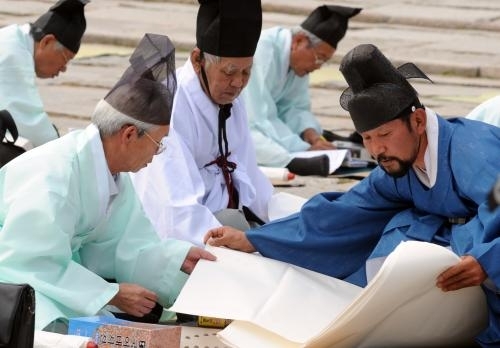
For men born into Joseon's elite, passing the gwageo, or civil service examination, was more than a matter of career ambition. It was one of the few paths to government service — and the salaries, status and power that came with it.
The exam was also crucial to maintaining a family's standing. From an early age, boys in yangban households, the aristocratic class of Joseon, were expected to study for it, while their families devoted considerable time and effort to helping them succeed. (Girls were not allowed to take the test until 1894, when the law was abolished.)
But the road to a government post was long and unforgiving.
Candidates first had to pass the sogwa, which served as a preliminary qualification for the exam. Its two rounds selected about 1,400 candidates nationwide in the first round and 200 in the second. Those who passed could enter Sungkyunkwan, the kingdom's highest educational institution, where they typically studied for about a year before becoming eligible for the daegwa, or main examination.
The daegwa was no less competitive. After several rounds of testing, just 33 candidates were selected. The exams were generally held every three years, though special examinations were sometimes organized to mark significant royal occasions. In 1800, for example, a special exam drew around 110,000 candidates, with only 10 passing.
Those who passed the exam averaged 36.4 years old — not so young by the standards of the time. Many had begun studying at around age 5, spending three decades or more preparing for a chance at government service.
Even after making it through the competition, the finalists faced one last test: an examination in front of the king himself.
The king personally set the questions, known as chaekmun, asking candidates to write essays on pressing political, social, diplomatic and military issues — or, at times, questions that were far more unexpected.
Although the final essay did not determine whether a candidate passed, it decided his ranking. That ranking could shape his entire career. The top candidate could be appointed to a senior government post immediately, potentially advancing roughly seven years ahead of his peers.
So what did Joseon kings want to know from the men who hoped to govern their kingdom?
Some questions were practical, others philosophical, and a few might feel surprisingly familiar today.
The following are questions set by Joseon kings.
How should the government recruit talented people? (King Sejong, 1447)
What can be done to improve people's livelihoods? (King Danjong, 1453)
How should the government decide which officials to dismiss? (King Sejo, 1456)
If the law is already strict and clear, why do people continue to commit crimes? (King Seongjong, 1492)
Alcohol has long been a source of social problems. Some people neglect their duties or lose their sense of propriety through drinking. How can these problems be addressed? (King Jungjong, 1513)
What makes a good diplomat? (King Jungjong, 1526)
What must a king do to keep his country from falling into ruin? (King Myeongjong, 1542)
What should the purpose of education be, and how should it be pursued? (King Myeongjong, 1558)
After a devastating war, rebuilding the lives of survivors is an urgent priority. What other measures should the government take? (Gwanghaegun, 1611)
Why do people feel melancholy on the last night of the year? Discuss. (Gwanghaegun, 1616)
hwangdh@heraldcorp.com