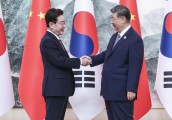
Lee meets Trump, Xi and Putin to convey Seoul’s position on Korean Peninsula security ahead of their three-way summit.
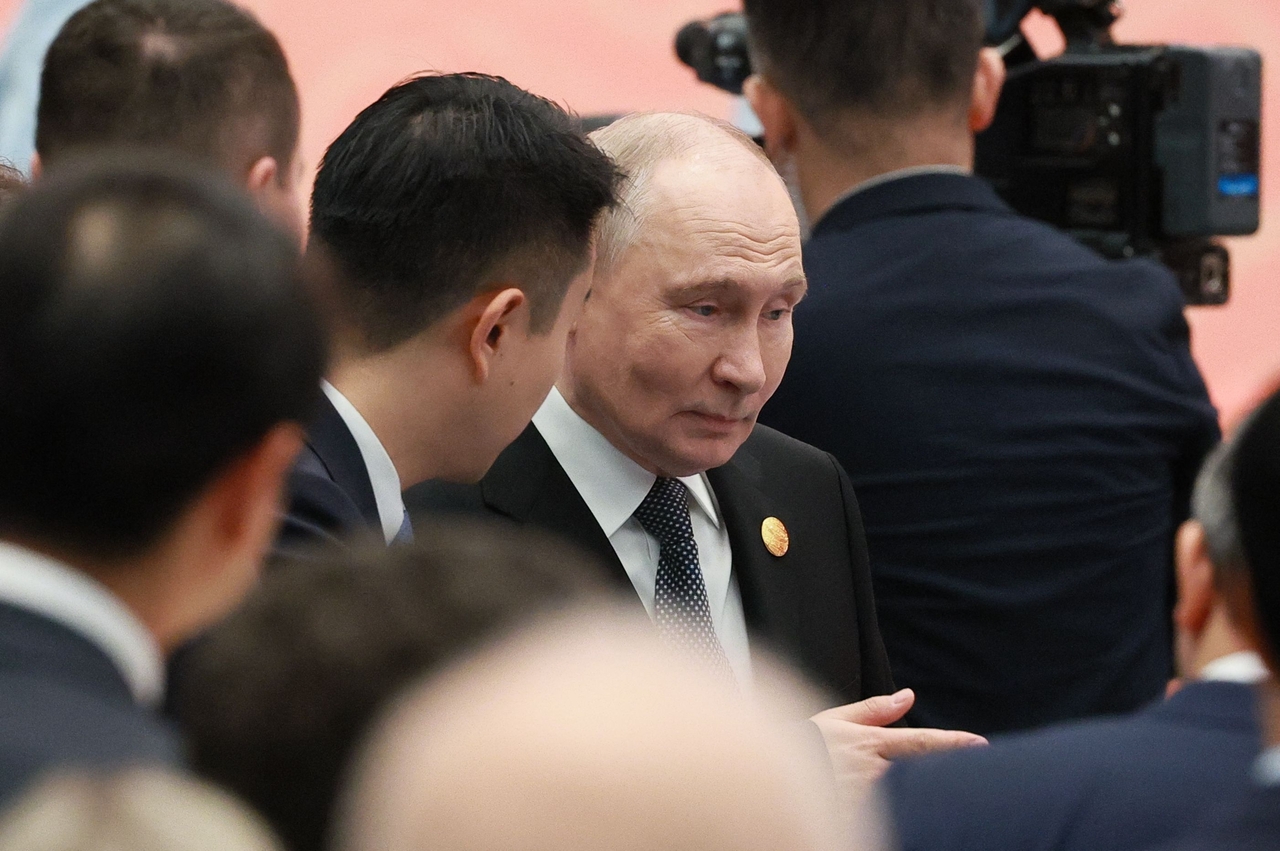
SHENZHEN, China —South Korean President Lee Jae Myung and Russian President Vladimir Putin agreed to seek avenues for cooperation despite strained bilateral ties and shared the need to ease tensions on the Korean Peninsula, according to Seoul's presidential office.
Lee and Putin spoke for about 10 minutes Wednesday after crossing paths at a banquet hosted by Chinese President Xi Jinping for leaders attending the Asia-Pacific Economic Cooperation summit in Shenzhen, marking their first face-to-face encounter since Lee took office in June 2025.
"The two leaders naturally crossed paths toward the end of the banquet and as they were leaving," a senior South Korean presidential official told reporters Thursday on condition of anonymity.
The brief exchange covered bilateral relations, tensions on the Korean Peninsula and practical issues affecting people's livelihoods.
"Although South Korea-Russia relations face difficulties due to various circumstances, there was broad agreement that we should nevertheless seek opportunities for cooperation in areas where there are no obstacles and work to manage our relations well," the official said.
"There was also agreement on the need to prevent the situation on the Korean Peninsula from deteriorating and to ease tensions," the official added.
The discussion also touched on "issues concerning North and South Korea, including North Korea's nuclear program," though they "were not discussed at length," the official said.
The two leaders also discussed "practical bilateral issues related to people's livelihoods," the official said, declining to elaborate.
Relations between Seoul and Moscow have deteriorated sharply since Russia's full-scale invasion of Ukraine in 2022, which prompted South Korea to join international sanctions against Moscow. Tensions have deepened further over Russia's expanding military cooperation with North Korea, including Pyongyang's deployment of troops to support Moscow's war effort beginning in 2024.
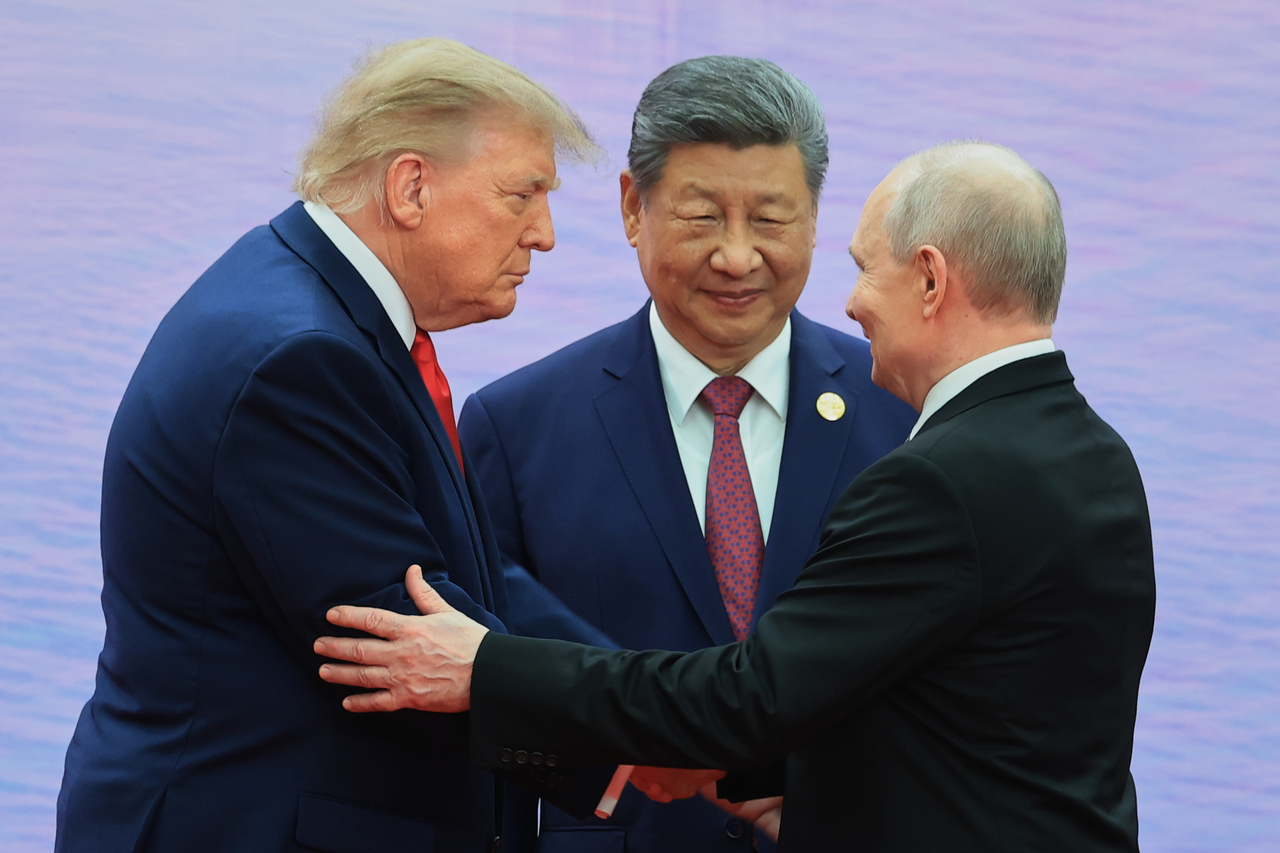
The encounter came just a day before an unprecedented trilateral summit involving U.S. President Donald Trump, Xi and Putin, raising concerns in Seoul that the three powers could discuss the future of the Korean Peninsula without South Korea at the table.
Seoul makes its case to three powers
Against that backdrop, Lee used a series of diplomatic encounters this week to convey Seoul's position directly to the leaders of all three countries, according to the official.
Lee spoke with Trump on Tuesday evening at a welcome dinner hosted by Philippine President Ferdinand Marcos Jr. during the ASEAN-related summits in Manila. The two spoke again Wednesday at the APEC welcome banquet in Shenzhen, where Trump was seated to Xi's right and directly across from Lee.
They discussed upcoming diplomatic engagements, including the G20 summit in Miami, and areas of cooperation between the allies, according to Seoul's presidential office.
Lee also held a one-on-one summit with Xi earlier Wednesday on the sidelines of APEC before his brief encounter with Putin at the banquet.
"On each of those occasions, we conveyed our position on issues concerning the Korean Peninsula," the official said.
"It is not certain how the Korean Peninsula issue will be addressed in the discussions among the leaders of the US, China and Russia, but we can say that we have had opportunities to appropriately convey our position," the official said.
The official added that the Korean Peninsula could come up during the trilateral summit but was unlikely to be a major topic.
Trump said Monday that "denuclearization" and the wars in Ukraine and Iran would be among the issues discussed.
The prospect of the three leaders meeting without South Korea has revived comparisons to the 1945 Yalta Conference, when the leaders of the United States, Britain and the Soviet Union met to shape the postwar order, fueling concerns in Seoul about major powers making decisions affecting the Korean Peninsula without South Korea's participation.
The official acknowledged such concerns but played down the prospect of a second Yalta, arguing that Washington, Beijing and Moscow lack the common purpose that brought the wartime allies together eight decades ago.
"First of all, China, which is hosting the meeting, is a country that, in a sense, considers itself a victim of the decisions made at Yalta," the official said.
"The thinking of China, the US and Russia is not all the same, so those three countries are not in the same position as the major powers that gathered at Yalta in the past," the official said.
Unlike the wartime allies, which were united in their fight against Germany despite differing visions for the postwar world, the three powers today do not share the same degree of common purpose, the official said.
"There is not that degree of common ground today," the official added.
Meanwhile, Seoul said it had detected no concrete signs of preparations for a possible meeting between Trump and North Korean leader Kim Jong Un, despite speculation about a resumption of high-level diplomacy between Washington and Pyongyang.
"We can say that how U.S.-North Korea dialogue will unfold remains unknown, and nothing is certain at this point," the official said.
Contacts with China had yielded no new information about a possible Trump-Kim meeting, the official said, suggesting Beijing had roughly the same understanding of the situation as Seoul.
"There are no new developments at this point," the official said.
dagyumji@heraldcorp.com