Lee calls peninsula peace a “vital national interest,” while Xi voices support for US-N. Korea dialogue
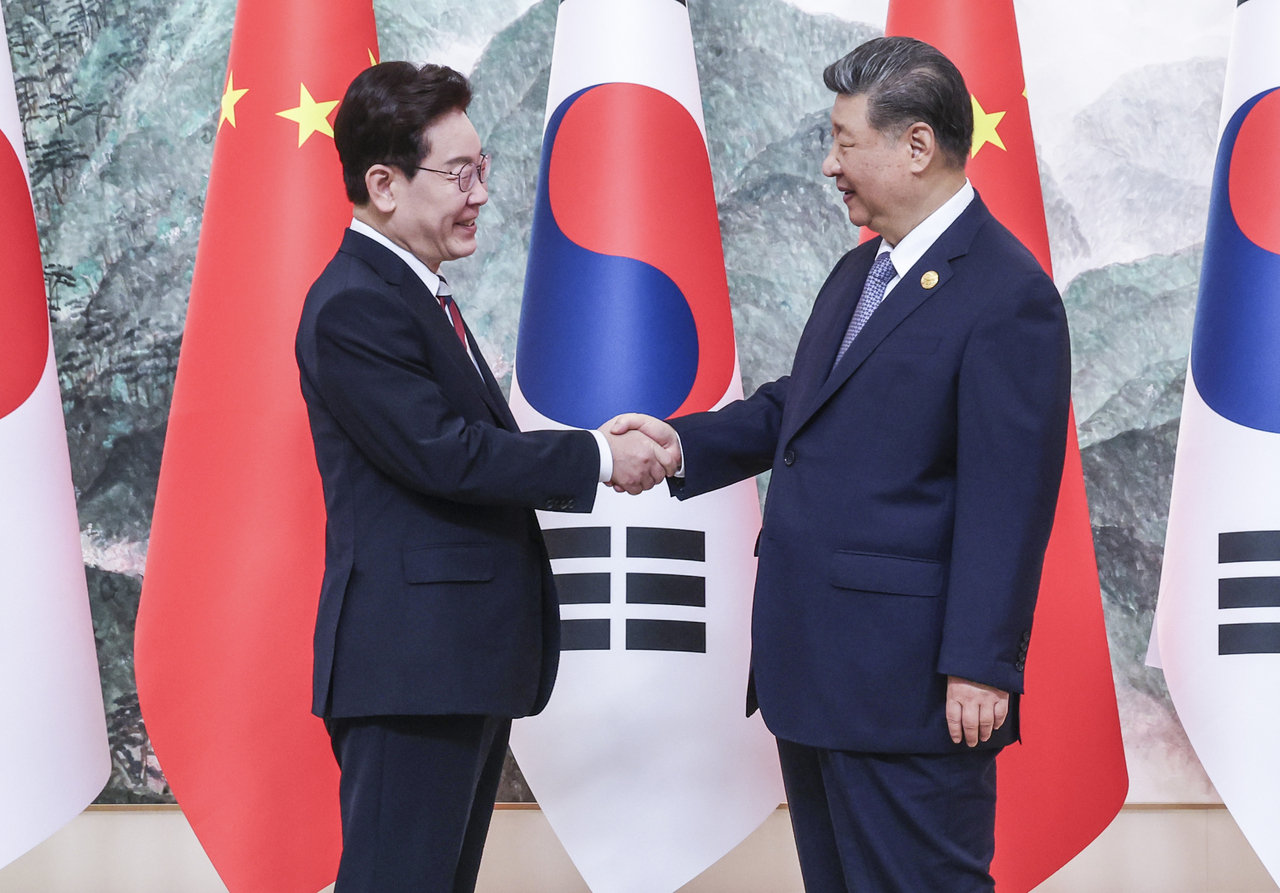
SHENZHEN, China — The leaders of South Korea and China agreed Wednesday to expand cultural exchanges as the two countries reached a breakthrough in long-running free trade talks to open each other's services and investment markets, including in entertainment and tourism.
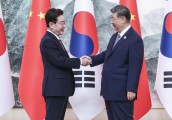
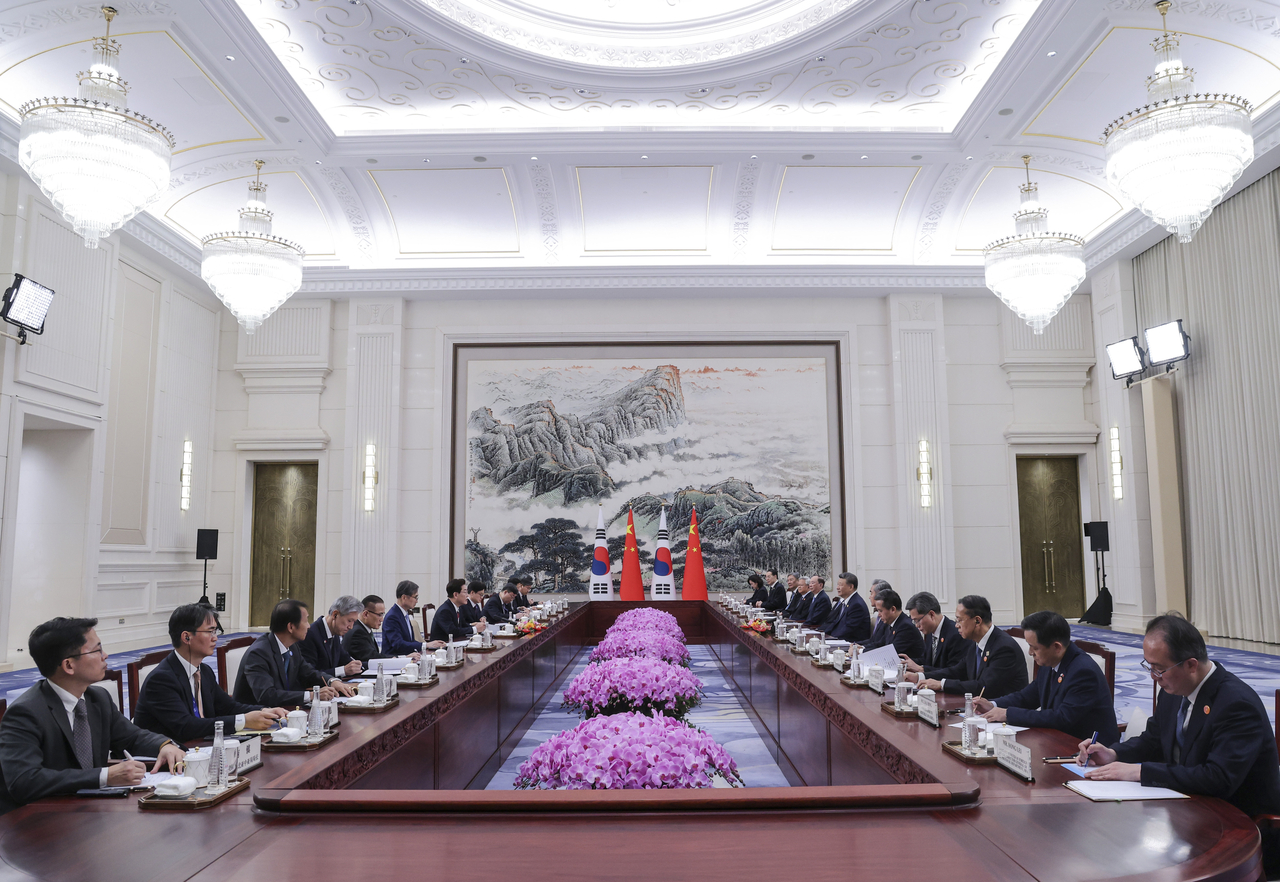
The announcements came as President Lee Jae Myung and Chinese President Xi Jinping held a roughly 35-minute summit at Kylin Villa in Shenzhen, on the sidelines of the Asia-Pacific Economic Cooperation summit.
During the closed-door talks, Lee and Xi agreed to use the breakthrough as a basis for expanding mutually beneficial economic cooperation, National Security Adviser Wi Sung-lac said in a written briefing following the summit.
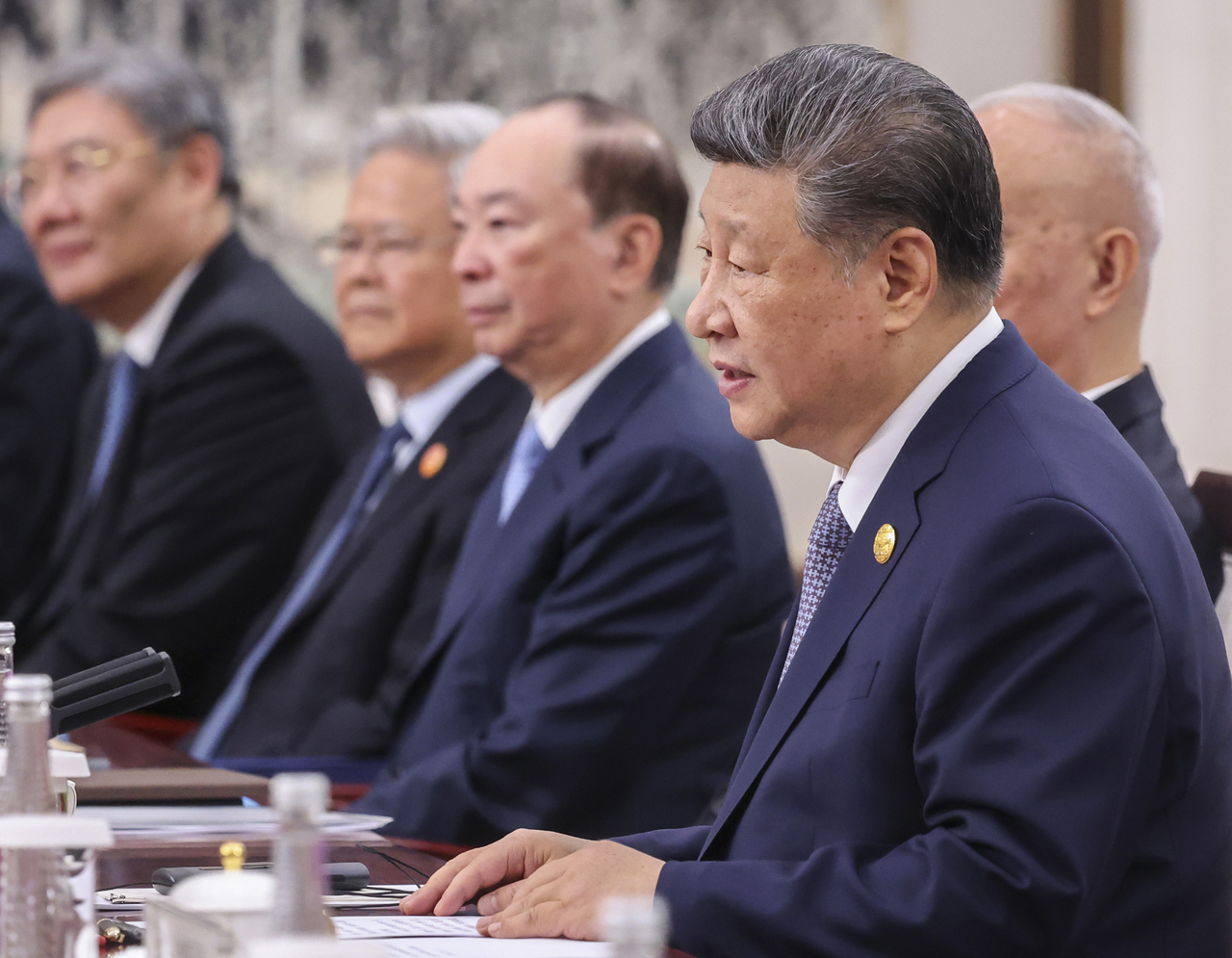
Lee called on the two governments to encourage businesses to expand into each other's markets, while Xi emphasized the importance of strengthening economic cooperation alongside political trust.
"President Xi said the two countries should expand mutually beneficial economic cooperation while consolidating political trust, using the conclusion of FTA negotiations on services and investment as an opportunity," Wi said.
The two countries declared negotiations on services and investment under their bilateral free trade agreement effectively concluded, with some technical provisions still to be finalized before the agreement can be formally signed and brought into force.
The agreement would ease barriers facing South Korean businesses operating in China across industries including film, gaming, tourism, retail, construction, legal services and finance, while strengthening protections for investors and their technology.
It could also provide an opening for easing long-standing Chinese restrictions on the import of South Korean cultural products, widely known in South Korea as the "Hallyu ban."
The breakthrough followed more than eight years of negotiations that began in March 2018 and stalled for more than four years amid disagreements over market access. The talks gained momentum after Lee and Xi agreed in January to seek meaningful progress by the end of this year.
Beyond trade, the leaders discussed ways to move past the restoration of bilateral relations toward a "more mature strategic partnership," with cultural exchanges emerging as another priority, according to Wi.
Cultural exchanges, from film productions to pandas
Lee proposed bringing a pair of giant pandas to South Korea as a gesture of friendship and gradually expanding cultural and creative-industry exchanges, "taking into account regional differences within China and sensitivities across sectors."
"President Xi expressed agreement with the proposal and called for the gradual promotion of positive and beneficial cultural exchanges," Wi said. “In particular, the two leaders agreed to cooperate on initiatives including joint film productions.”
Lee also called for “continuing the measures both countries have implemented to facilitate entry and exit,” noting that people-to-people exchanges between South Korea and China are expected to surpass 10 million this year and stressing the need to restore exchanges to the 2016 level of 13 million.
Xi, in response, stressed the "importance of sustaining the momentum toward restoring friendly sentiments between the peoples of the two countries as a way to strengthen the foundation for the development of bilateral relations," according to Wi.
With next year marking the 35th anniversary of diplomatic relations between Seoul and Beijing, Xi welcomed Lee's proposals and pledged to encourage Chinese government agencies to support bilateral cooperation projects.
Xi says he supports Trump-Kim dialogue
The summit also turned to tensions on the Korean Peninsula, with Lee seeking Beijing's support for efforts to reduce tensions with North Korea and establish peaceful coexistence.
"President Lee emphasized that the Korean Peninsula issue is a matter of vital national interest for South Korea and that his government has been actively working to ease inter-Korean tensions and achieve peaceful coexistence," Wi said.
Lee also "requested that China play a constructive role in addressing issues concerning the Korean Peninsula," Wi said.
"In response, President Xi recognized our government's efforts and said China would continue to play a constructive role in resolving issues concerning the Korean Peninsula," Wi said.
"President Xi also explained recent developments in China-North Korea relations and expressed support for various efforts to ease tensions on the Korean Peninsula, including dialogue between North Korea and the United States," Wi added.
The discussion came amid renewed speculation about a possible diplomatic opening with Pyongyang, as US President Donald Trump has repeatedly expressed interest in meeting North Korean leader Kim Jong-un during his visit to China.
The possibility of renewed US-North Korea engagement drew further attention Wednesday when Secretary of State Marco Rubio said Trump was "serious" about pursuing dialogue with Kim, although no meeting had been scheduled.
Lee's meeting with Xi also came a day before an unprecedented trilateral summit involving Trump, Xi and Russian President Vladimir Putin, adding diplomatic significance to Seoul's efforts to secure Beijing's cooperation on Korean Peninsula issues.
In his opening remarks, Lee underscored the importance of peace and stability on the Korean Peninsula as a foundation for advancing the strategic partnership between Seoul and Beijing.
"Peace and stability on the Korean Peninsula are in the common interests of both countries. I hope we can work together to usher in an era of peaceful coexistence on the Korean Peninsula," Lee said.
On maritime security, Lee called on China to work with South Korea toward a "fundamental resolution of disputes in the West Sea," according to Wi.
The issue concerns structures China has unilaterally installed in the Provisional Measures Zone, an area of overlapping exclusive economic zone claims governed by a bilateral fisheries agreement.
Lee calls for 'revival of APEC spirit' amid crisis
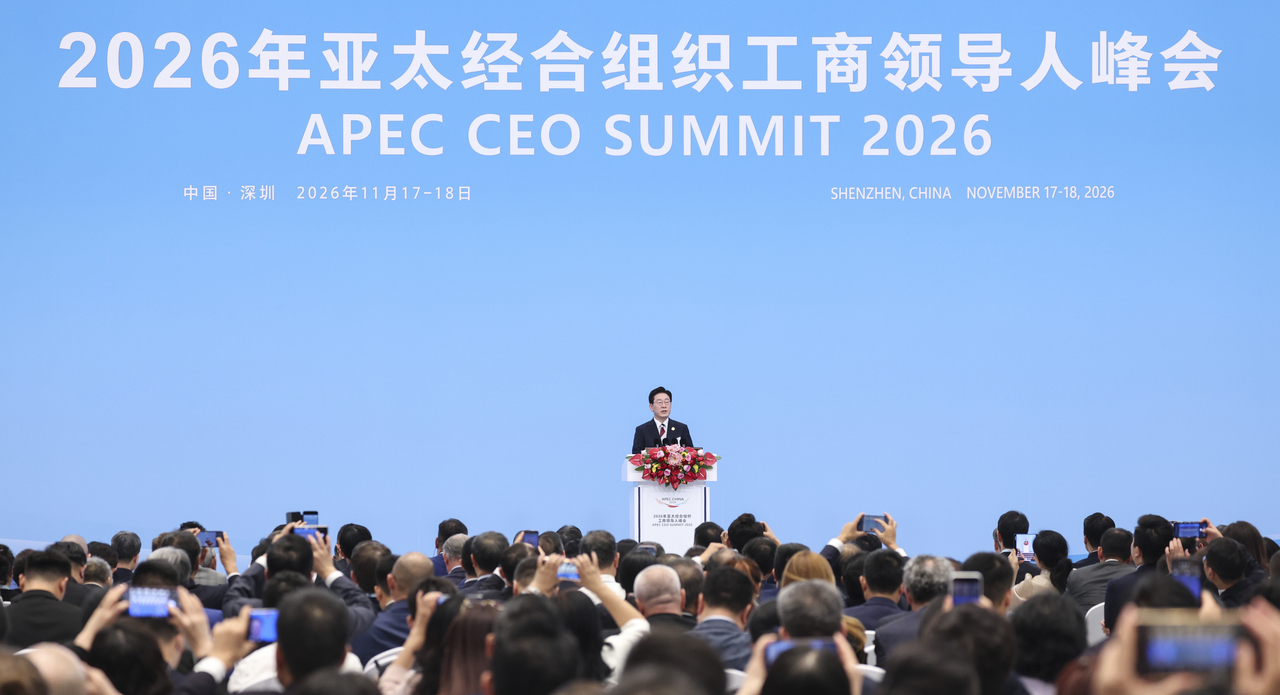
Beyond his bilateral talks with Xi, Lee took his message of economic cooperation to the broader Asia-Pacific stage at the APEC CEO Summit in Shenzhen, calling for collective action to address supply chain vulnerabilities amid growing geopolitical uncertainty.
Lee emphasized that even the most advanced artificial intelligence technologies depend on cutting-edge semiconductors and reliable energy supplies, while semiconductor production itself requires materials, equipment, technology and skilled workers from multiple countries.
Lee said that the interconnected nature of these industries had made economic and security instability in any one country a shared challenge for the region.
"Recent geopolitical crises and the resulting supply chain disruptions have actually shown just how deeply interconnected economies, industrial structures and people’s lives are across the Asia-Pacific region," Lee said.
"The international community must work together to establish systems for the early identification of supply chain risks and ensure a stable supply of critical minerals and energy," he added.
Lee also warned that APEC, which had helped reshape the global free trade system, was facing mounting challenges and a critical turning point.
"Economic fragmentation is deepening due to protectionism, while geopolitical tensions and global economic uncertainty are steadily increasing," he said.
Lee pointed to the AI-driven technological revolution, climate change and demographic shifts as forces fundamentally reshaping industries and demanding new engines of growth.
"The deeper the crisis, the clearer the answer becomes," Lee said. "We must revive the founding spirit of APEC that we once envisioned."
dagyumji@heraldcorp.com