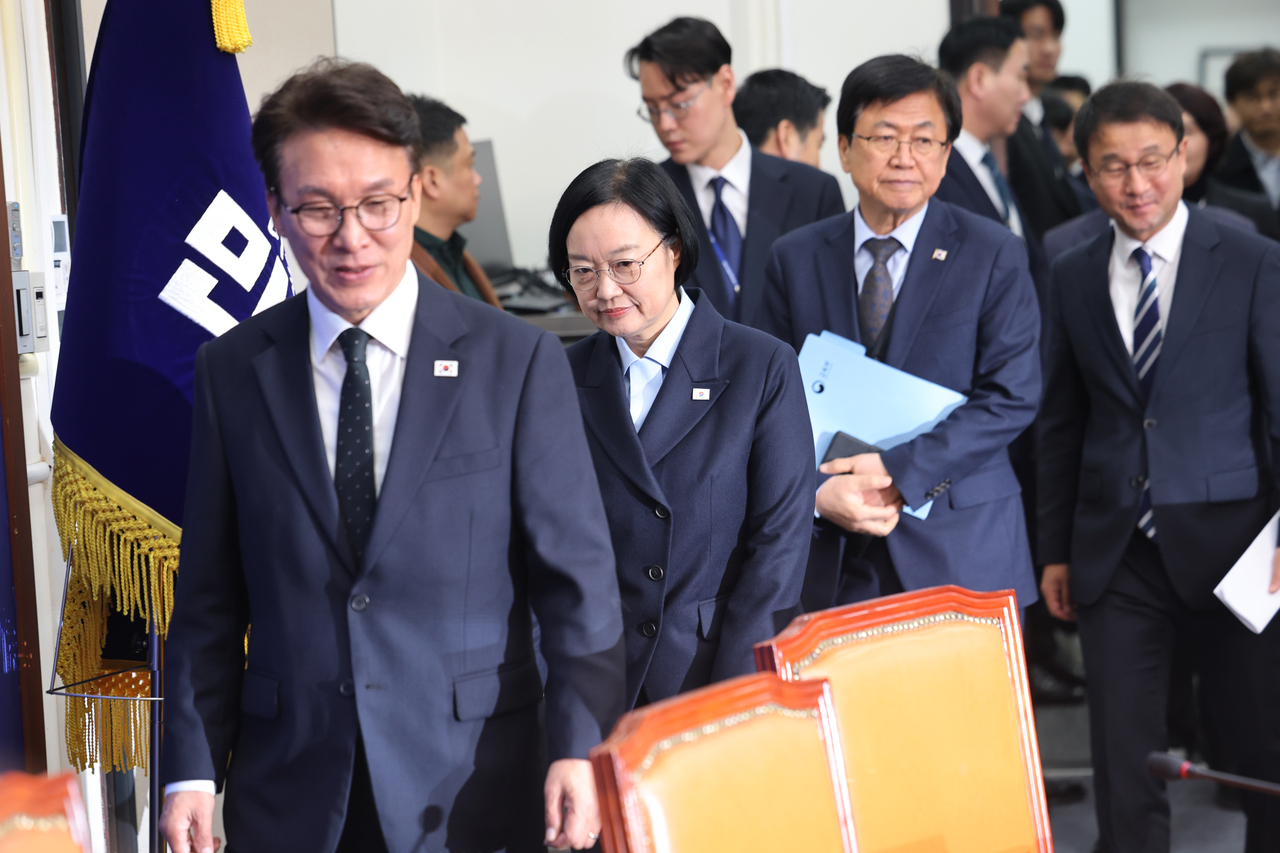
South Korea's ruling bloc convened a last-minute meeting at the National Assembly on Wednesday as the government and the ruling party agreed on a set of improvised measures to fight artificial intelligence-assisted cheating a day before the university entrance exam Thursday.
The ruling Democratic Party of Korea and the government discussed measures announced Tuesday, after a recent case raised doubts about the government's ability to ensure fairness in the nationwide exam.
The ruling bloc was considering introducing bills aimed at mandating AI companies to disclose generated responses in cases the government identifies as suspected cheating related to this year's exam, said Lim Ki-keun, minister of the Office for Government Policy Coordination, in the meeting.
Four global AI tech companies were willing to cooperate with the move, according to the Democratic Party's Rep. Park Sung-joon.
Lim said these firms had "a shared, fundamental understanding that AI must not be used to facilitate illegal activities." Lim and Park declined to name the four companies.
Moreover, the government and the party will each launch task forces to further discuss measures to ensure fairness in all state exams.
These are in addition to Tuesday's measures to deploy at least 8,400 more proctors, send emergency text alerts that cannot be turned off, restrict access to public Wi-Fi near test venues and allow proctors to use devices such as metal detectors, among others.
The ruling bloc also said it would ensure that its new measures could be legitimately in effect by allowing relevant rules to be revised in a way that are "applied retroactively" according to Park, so that laws that passed after Thursday's exam could serve to discourage test takers from cheating.
For example, there are no existing legal grounds to ban this year's cheaters from retaking tests for the next 10 years as announced Tuesday. The current rule stipulates a 1-year ban for test takers.
Regarding President Lee Jae Myung's proposal to award those who tipped off a cheater with 100 million won ($75,000), the ruling party was actively reviewing such awards, according to its lawmaker Park.
Right-wing politicians, however, slammed the government for suggesting outdated measures that are inadequate to combat AI-assisted cheating that existed for years.
Rep. Jang Dong-hyeok, chair of the main opposition People Power Party, criticized the president's proposal of the 100 million won reward and his claims that a few minutes' delay in checking on potential cheaters would be tolerable.
"A commotion could last for 20-30 minutes, not 2-3 minutes. In that time, all test takers will suffer disadvantages," wrote Jang on Wednesday. Jang has called for a delay if the administration lacks clear measures to alleviate test takers' concerns.
Right-wing Seoul mayor Oh Se-hoon said on his Facebook on Wednesday the Lee administration has "lost the ability to detect and manage crises,” adding that the administration's response measures indicate they remain "stuck in the analog era."
Asked about the questions over the ruling bloc's decision to come up with last-minute measures for crackdown instead of delaying the meeting, Park highlighted the significance of informing the public about the direction of the liberal government.
Park also said the main opposition People Power Party does not deserve to criticize the ruling bloc by saying it has failed to "address public anxieties and propose alternatives."
"The biggest problem is that the opposition party does not seem to act like an opposition party at all," Park said.
consnow@heraldcorp.com