MANILA, Philippines — President Lee Jae Myung drew on unrest in the Middle East to stress the importance of keeping vital waterways open, telling a summit of major powers that freedom of navigation and overflight in the South China Sea is essential to regional security and prosperity.
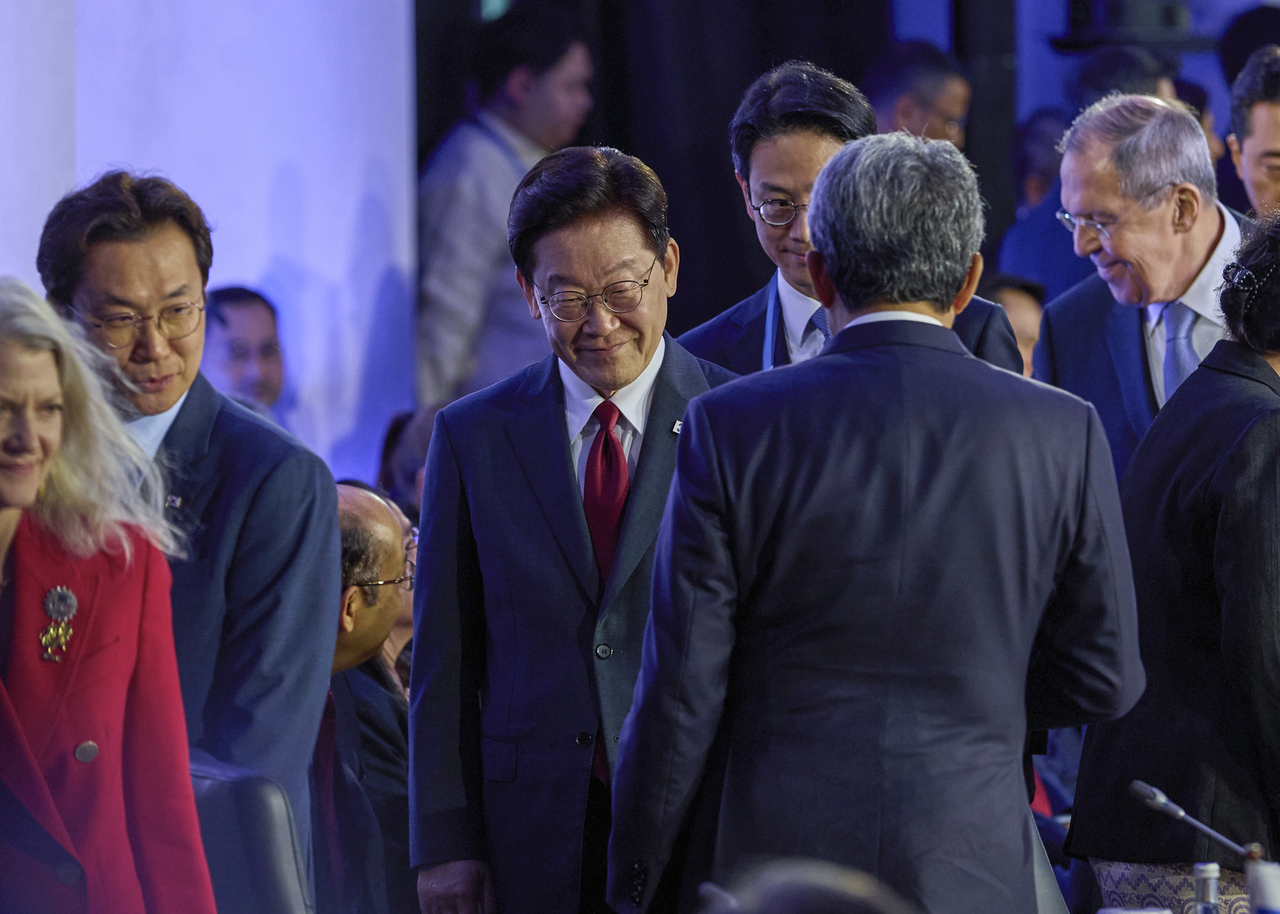
Lee delivered the message during a closed-door session of the 21st East Asia Summit on Tuesday in Manila, the Philippines, which brings together the Association of Southeast Asian Nations' 11 members and eight partners, including South Korea, China, the United States and Russia. It was his first appearance at the forum since taking office.
"Lee emphasized that recent developments in the Middle East have reminded us that free and safe passage is a matter of security for us all and the foundation of prosperity," according to a written statement by presidential spokesperson Kim Seong-wan.
Lee did not explicitly mention Iran or the Strait of Hormuz, but his remarks came amid disruptions to shipping through the strategic waterway, a crucial route for Persian Gulf oil exports to Asian markets. Attacks on vessels have disrupted traffic, exposing the vulnerability of energy supply routes on which economies such as South Korea depend.
The South China Sea is another vital artery for global trade, carrying energy supplies, raw materials and manufactured goods across Asia and beyond.
During the summit, Lee further stressed "the importance of safeguarding freedom of navigation and overflight under international law in international waterways, particularly the South China Sea," according to Kim.
Lee welcomed ASEAN and China's efforts to conclude a long-delayed Code of Conduct aimed at managing tensions in the disputed waters.
"Lee also said the code of conduct should be consistent with international law, respect the legitimate rights and interests of all parties concerned, and contribute to regional trust and stability," Kim said.
The remarks came two days after ASEAN and China failed to finalize the code during the Philippines' chairmanship of the regional bloc.
Philippine Foreign Secretary Theresa Lazaro said Sunday that negotiators had provisionally agreed on about 80 percent of the draft's paragraphs. However, significant differences remained, including over its geographic scope and whether it would be legally binding.
Negotiations on the code, which builds on a nonbinding 2002 declaration calling for restraint in the contested waters, have dragged on for more than two decades. The proposed code seeks to establish clearer rules for managing incidents and reducing the risk of confrontation rather than settling competing territorial claims.
China claims much of the South China Sea, overlapping with claims by the Philippines, Vietnam, Malaysia and Brunei. Beijing rejects a 2016 international arbitration ruling that found no legal basis for its sweeping claims to historic rights over resources in the waters.
Against a backdrop of growing geopolitical competition, Lee urged East Asia Summit members to pursue practical cooperation despite their differences.
"Amid intensifying geopolitical competition and deepening global uncertainty, Lee emphasized that the value of the EAS lies in acknowledging differences while identifying issues on which countries can find common ground and deliver tangible results," Kim said.
Against that backdrop, Lee identified three priorities for cooperation: combating online scams, upholding international rules in waterways and providing humanitarian assistance to Myanmar.
On online fraud, Lee pledged that South Korea would launch the Korea-ASEAN Response and Enforcement against Scam-Related Crime project next year to "help strengthen regional capabilities to combat transnational crime, not just through words but through action," Kim said.
The initiative, known as KARE, will strengthen cooperation between South Korea's National Police Agency and ASEANAPOL, a network of Southeast Asian police forces, through intelligence sharing and coordinated investigations.
The roughly $1.2 million project is scheduled to run through 2029, with substantive activities expected to begin in 2027. It also aims to prevent criminal syndicates from moving operations across borders to evade law enforcement.
On Myanmar, Lee "emphasized the importance of expanding humanitarian efforts and reaffirmed his support for ASEAN's efforts to achieve a peaceful resolution of the Myanmar issue," Kim said.
Lee also pledged continued humanitarian assistance for the people of Myanmar.
Turning to the Korean Peninsula, Lee outlined his administration's three-part blueprint for peaceful coexistence and called for active engagement and cooperation from key regional countries to help resume inter-Korean dialogue and ultimately establish lasting peace on the peninsula.
dagyumji@heraldcorp.com