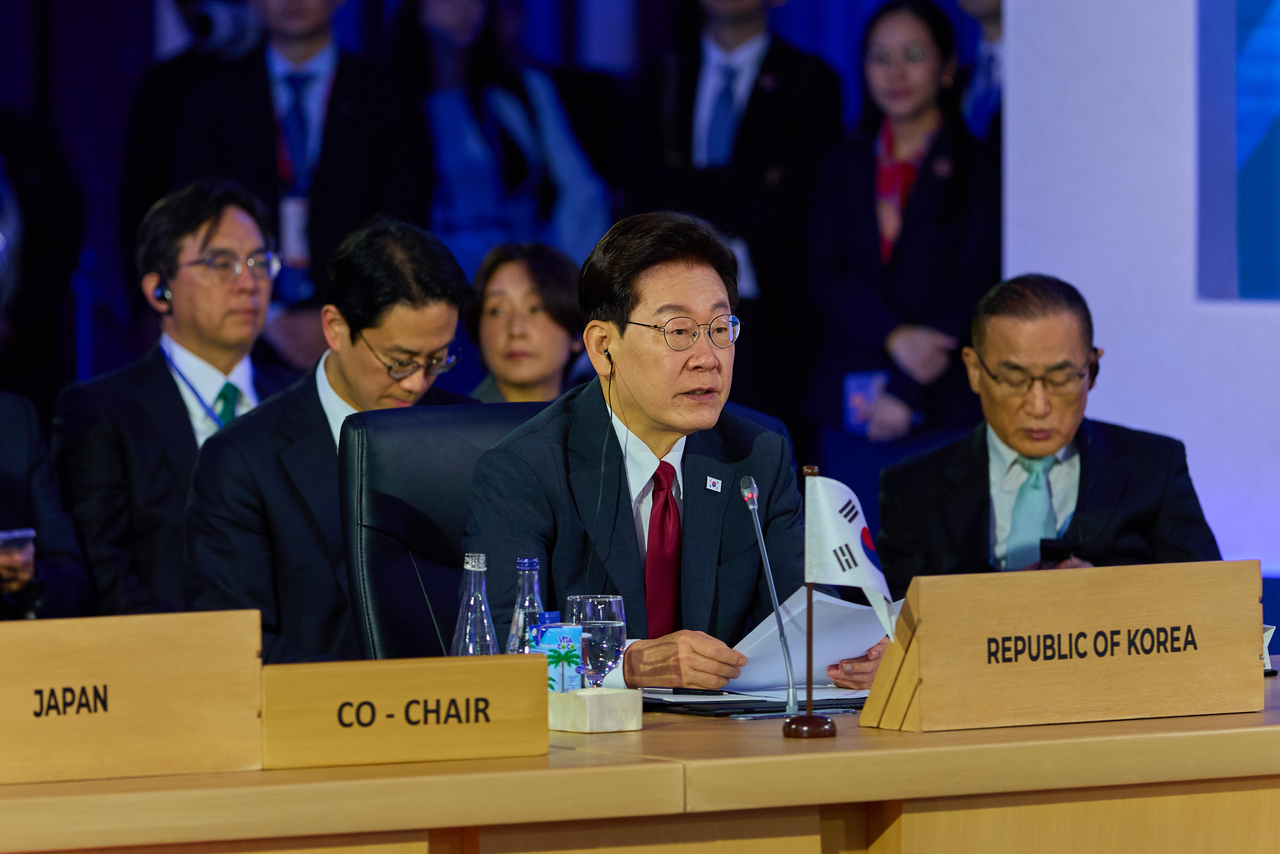
MANILA, Philippines — President Lee Jae Myung on Tuesday presented the historic cooperation among South Korea, China and Japan as a model for navigating today's crises, pointing to how the three neighbors found common economic ground despite their differences.
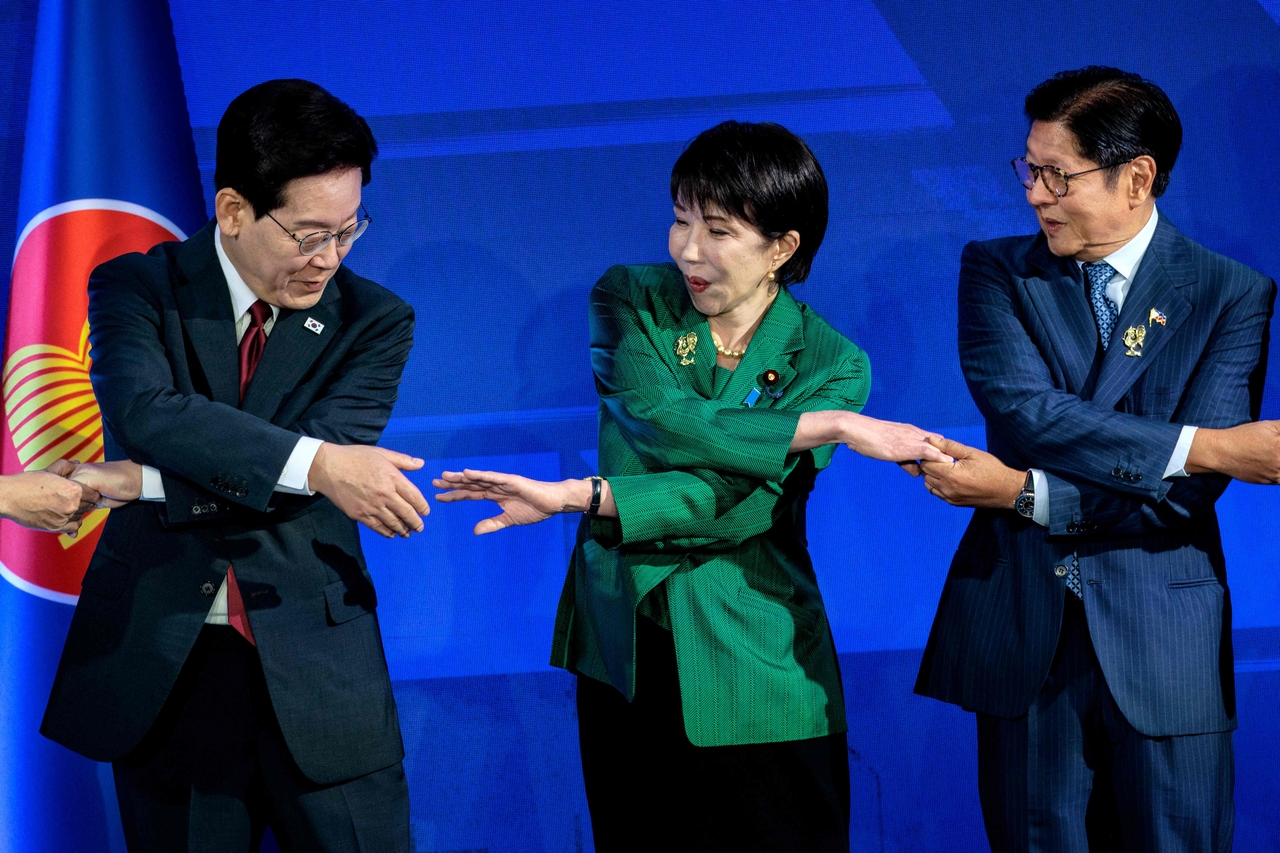
Lee made the remarks at the ASEAN Plus Three summit in Manila, the Philippines, attended by Japanese Prime Minister Sanae Takaichi and China's Agriculture and Rural Affairs Minister Zhang Zhu, alongside leaders of the Southeast Asian bloc.
"Trilateral cooperation among Korea, China and Japan also began right here in Manila," Lee said, recalling a landmark meeting in 1999 that laid the foundation for cooperation among the three Northeast Asian neighbors.
That year, then South Korean President Kim Dae-jung, Chinese Premier Zhu Rongji and Japanese Prime Minister Keizo Obuchi met over breakfast on the sidelines of the ASEAN Plus Three summit, marking the first gathering of the three countries' leaders and paving the way for a separate trilateral summit mechanism.
"Despite their many differences, the three leaders made the visionary decision to open a new chapter of cooperation based on shared economic interests.," Lee said. "In this age of polycrises, I believe their decision offers a model we should learn from and follow."
Lee's remarks came against a backdrop of renewed tensions between China and Japan, underscoring the challenges of sustaining trilateral cooperation among the Northeast Asian neighbors.
South Korea, China and Japan last held a standalone summit in Seoul in May 2024, when their leaders agreed to deepen cooperation and maintain regular high-level exchanges.
Efforts to convene another summit have faced difficulties amid deteriorating relations between Beijing and Tokyo, particularly over Taiwan and other regional security issues.
Against this backdrop of growing geopolitical uncertainty, Lee also emphasized the broader role of ASEAN Plus Three in helping the region weather crises that increasingly transcend national borders.
"The international and economic environment we face today is far more complex and uncertain than when ASEAN Plus Three was launched," Lee said.
"At a time when conflicts and shocks in a single region can swiftly threaten the daily lives of people everywhere, ASEAN Plus Three — which has repeatedly demonstrated its strength in times of crisis — has a more vital role than ever."
ASEAN Plus Three emerged in 1997 amid the Asian financial crisis as a framework bringing together Southeast Asian nations and the three Northeast Asian economies. Over the years, it has expanded cooperation in areas ranging from financial stability to food security and crisis preparedness.
Lee credited the framework with helping the region navigate successive challenges, including global food price crises and the COVID-19 pandemic, saying its history showed how countries with different backgrounds and development experiences could overcome common challenges through cooperation.
With the grouping set to mark its 30th anniversary next year, Lee called on Southeast Asian nations and their three Northeast Asian partners to look beyond past achievements and lay the groundwork for the next 30 years of cooperation.
"We must jointly enhance our capacity to respond to polycrises, build our resilience and lay the groundwork for sustainable future growth," he said.
Lee pledged South Korea's continued contribution to the grouping's future, noting that Seoul had twice taken the lead in exploring its medium- to long-term development through the East Asia Vision Group.
"The Republic of Korea will fulfill its responsibility and play its part in helping ASEAN Plus Three map out the next 30 years," he said.
Cushioning global crises
Philippine President Ferdinand Marcos Jr., who chaired the summit, also stressed the urgency of regional cooperation as the Middle East conflict involving Iran continues to disrupt energy supplies and raise concerns over food security across Asia.
"A disruption thousands of miles away can reach households across East and Southeast Asia through the price of rice, the cost of energy or the loss of a day's income," Marcos said. "Our peoples feel the effects of the global economy in palpable and immediate ways."
His message was that regional cooperation must deliver results people can feel — from keeping trade routes open and food and energy supplies flowing to ensuring businesses can continue operating despite disruptions.
"The benefits of regional cooperation, in turn, should be just as tangible and reach our peoples with the same urgency," he said.
Marcos pointed to the Chiang Mai Initiative, a regional financial safety net, and the ASEAN Plus Three Emergency Rice Reserve as examples of how the grouping has sought to turn regional commitments into practical safeguards against economic and supply shocks.
The arrangements are designed to help participating countries weather financial instability and food shortages, providing a foundation for collective action as conflicts, supply disruptions and natural disasters put mounting pressure on regional economies.
"Acting together, we can give our peoples greater security today and greater confidence for tomorrow," he said.
dagyumji@heraldcorp.com