
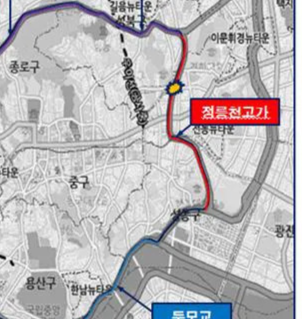
The safety of a Seoul overpass has come under scrutiny after another severed tendon was found inside the structure shortly after a safety inspection found no significant defects, a lawmaker said Monday.
Seoul plans to replace 35 tendons by June 2027, including those previously identified as damaged but not yet replaced, acknowledging limitations in its inspection methods.
Tendons are steel cables that help a bridge withstand the weight of passing vehicles.
According to Rep. Hwang Hee of the Democratic Party of Korea, a tendon inside Jeongneungcheon Overpass in northeastern Seoul was found severed shortly after the city completed a safety inspection in March 2026.
The inspection, conducted from February 2025, found no significant defects and gave the structure a Grade B rating, which indicates a satisfactory condition.
This was not the first time a tendon had been found severed at the overpass. A tendon broke in 2024, about six months after an earlier safety assessment conducted from May 2023 to March 2024.
A subsequent survey, conducted from September 2024 to August 2025, identified 25 corroded or damaged tendons, including one that was severed. None of the 25 have been replaced, Hwang said.
Hwang said national guidelines classify corrosion accompanied by cable damage and a loss of cross-sectional area as a major structural defect. Seoul assigned the affected tendons its own C3 classification.
The city said C3 measures the degree of corrosion and should not be directly compared with the overpass’s overall safety rating.
In 2016, the city suspended traffic on the overpass for about a month to replace 32 damaged tendons.
The six-lane overpass serves as a major route through northeastern Seoul, carrying more than 100,000 vehicles a day. Hwang criticized the city for not taking precautionary measures such as restricting traffic, installing warning signs or notifying nearby residents after the damage was found.
“All tendons in the overpass should be reassessed in accordance with national guidelines, and the results and a detailed replacement plan should be made public to Seoul citizens,” Hwang said.
Seoul said its safety assessments in 2023 and 2025 did not involve drilling into the structure to inspect its interior, so inspectors could not directly examine the tendons inside the concrete.
The city plans to replace all 25 tendons identified as damaged in the 2024-25 survey, along with 10 additional tendons near a previous break, bringing the total to 35 by June 2027.
The city also said a 2017 study commissioned from the Korean Concrete Institute concluded that the overpass could remain open while up to four broken tendons were being replaced.
forestjs@heraldcorp.com