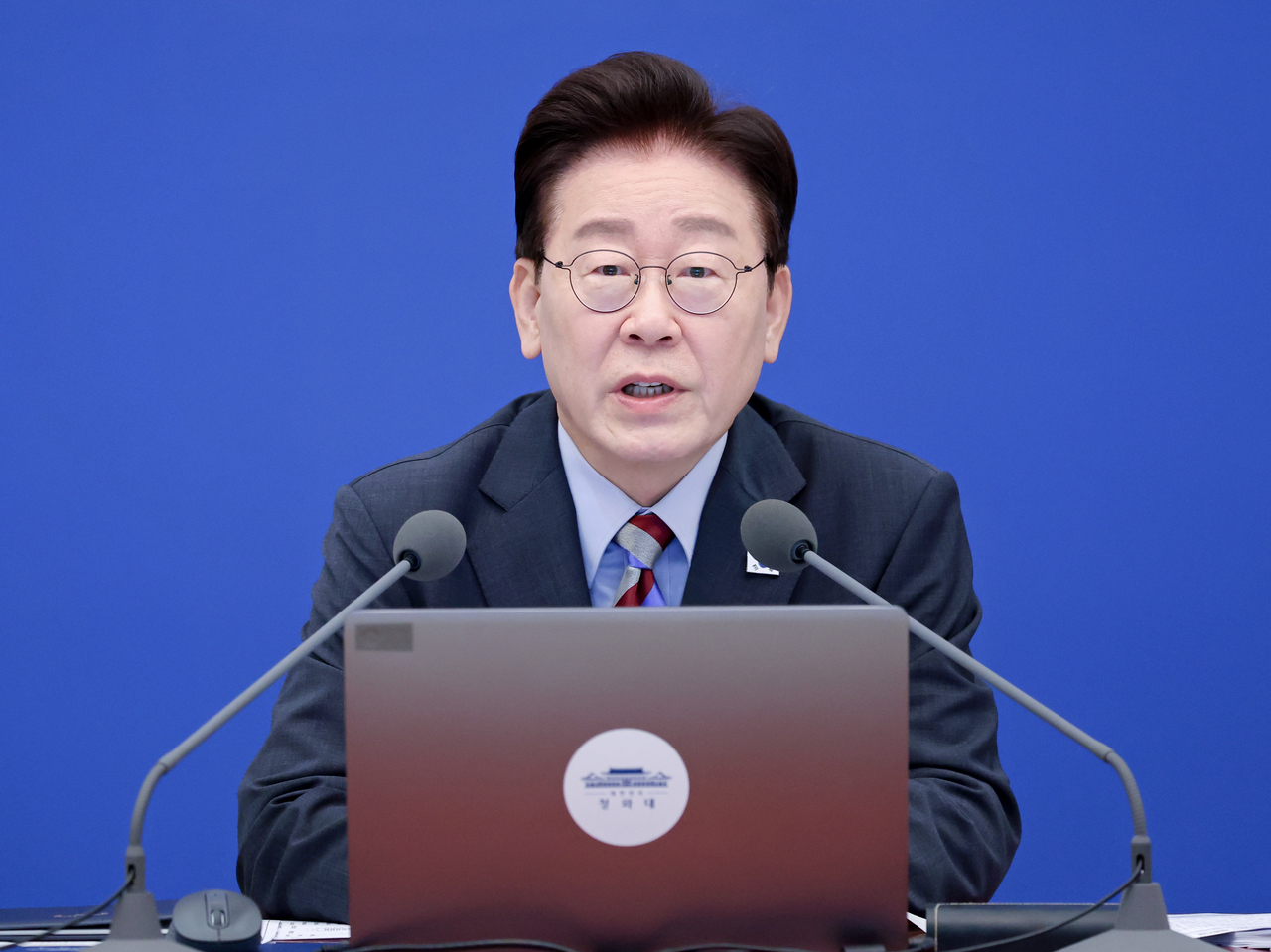
President Lee Jae Myung said Tuesday that police who manipulate cases should face penalties that could cost them their jobs as they take charge of investigations and gain the power to close cases.
The warning came days before prosecutors are stripped of their investigative powers and limited to indictments, a fundamental restructuring of South Korea’s criminal justice system 72 years after the Criminal Procedure Act was enacted in 1954.
Under the revised system taking effect Friday, police will assume responsibility for investigating the bulk of ordinary criminal and livelihood-related investigations, while the newly created Serious Crimes Investigation Agency will handle major crimes.
Speaking at a Cabinet meeting, Lee said the public remained concerned that police could mishandle cases or fail to adequately protect victims as their investigative authority expands.
Lee pointed to recent cases involving allegations that police officers or their family members had destroyed evidence, covered up wrongdoings or otherwise mishandled investigations.
“We need to minimize such cases, for the sake of the police themselves, the human rights of the public and the protection of victims,” Lee said.
For instance, in the case of Jang Yoon-gi, who was charged with sex offenses and the murder of a high school student in Gwangju, two police officers were indicted on charges of leaking investigative information to his father, a serving police officer, and helping conceal or destroy evidence.
In Jeju, a police officer falsely reported having contacted a missing woman and closed the case without confirming her whereabouts. The woman was later found dead, and the case was one of 27 missing-person cases found to have been improperly terminated by the officer.
Lee reiterated that “both disciplinary measures and criminal penalties should be strengthened” for when cases are manipulated, echoing his recent calls for greater police accountability as investigative powers expand.
“If evidence is concealed or fabricated, or if cases are manipulated once police have the authority to make final decisions on investigations — this is just my personal view — disciplinary action should basically go as far as removing them from the police force altogether or dismissing them,” Lee said. “Minor disciplinary action simply does not make sense in such cases.”
Lee underlined that “it is not appropriate to keep the level of disciplinary action or accountability at the same level as in the past.”
Lee further stressed that “strengthening the internal inspection function and enhancing its independence also appear to be very important.”
“It has now become difficult, in practice, to exercise external oversight over the investigative process. That means the responsibility is also becoming much greater.”
Lee said police reform had become a matter of broad public concern, citing “considerable concern about the side effects that could result from the fundamental transformation.”
Prime Minister Han Seong-sook explained that a police reform committee was being formed under the Prime Minister’s Office, with plans to launch it around late September or early October.
Speaking at the Cabinet meeting, Lee also called for stronger independent defense capabilities, highlighting the significance of the transfer of the domestically developed KF-21 fighter jet to the South Korean Air Force earlier this month.
“We need to go a step further and continue developing and deploying cutting-edge weapons systems capable of firmly defending our skies, land, seas and even space with our own technology and capabilities,” Lee said.
“Above all, we need to accelerate the construction of nuclear-powered submarines, a key element of self-reliant defense, as well as the advancement of missile technologies, including hypersonic missiles.”
Lee added that South Korea should continue efforts “to create genuine peace in which there is no need to fight, beyond simply having the ability to win a fight.”
At the meeting, the Cabinet also approved a special bill governing the acquisition, operation and safety management of nuclear-powered submarines.
Lee also addressed last week’s explosions in the Demilitarized Zone that injured three South Korean soldiers, calling for a swift and thorough investigation in close coordination with the United Nations Command.
Lee added that “necessary measures should then be taken based on the findings.”
His remarks came after the Joint Chiefs of Staff said Monday that the two Sept. 21 explosions were “highly likely to have been caused by North Korean (land) mines,” based on a preliminary assessment of its on-site investigation, which remains ongoing.
dagyumji@heraldcorp.com

![[Exclusive] Enhypen to return with new album in November, agency confirms](https://wimg.heraldcorp.com/news/cms/2026/09/29/news-p.v1.20260929.41760e88b0f048fcb5fa3e0dd9b75524_R.jpg?type=h&h=120)