JCS warns of countermeasures, but details await final findings
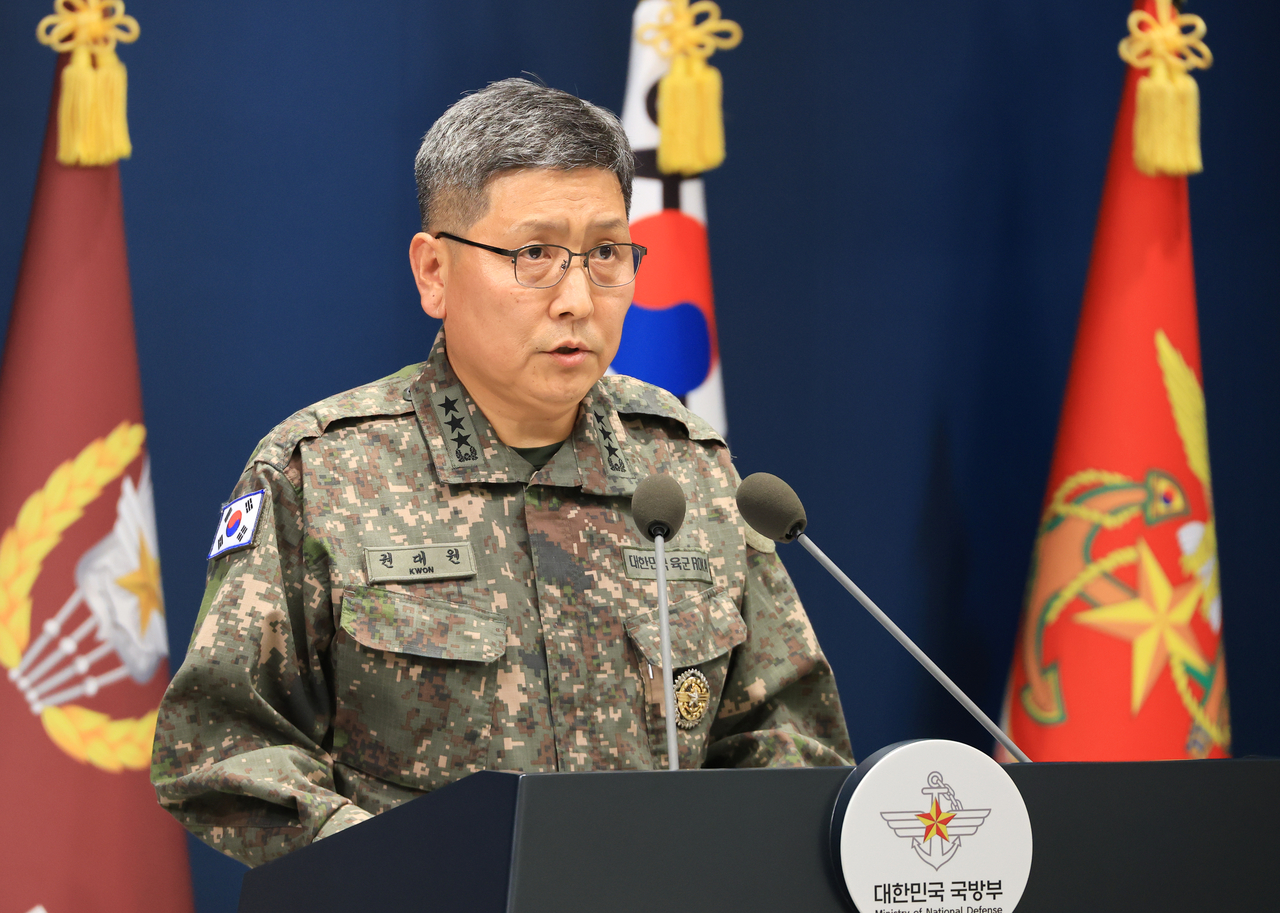
South Korea's Joint Chiefs of Staff said Monday that the explosions that injured three military personnel inside the Demilitarized Zone last week are highly likely to have been caused by North Korean mines. The JCS also said that the military will take appropriate and corresponding measures if the findings are confirmed.
The JCS said its assessment was based on several circumstances that ruled out South Korean mines and pointed instead to North Korean ones.
"Considering the findings so far and the results of the on-site investigation, we assess that there is a very high possibility that the explosions were caused by North Korean mines," Army Lt. Gen. Kwon Dae-won, vice chairman of the JCS, said.
The remarks came during a briefing Monday evening on the military's findings into the Sept. 21 explosions in the western section of the DMZ.
Two personnel suffered serious injuries and one sustained minor injuries in the explosions. The seriously injured personnel were a reconnaissance battalion commander and a military engineer.
In explaining the assessment, the JCS said there were no records of South Korean mines having been laid at the while signs that North Korean troops had laid mines in the nearby area were detected in September 2025.
According to the JCS, the National Forensic Service's preliminary analysis found traces of TNT and brown-colored foreign material on protective equipment recovered from the scene, but no metal fragments. The military said the absence of such fragments indicated that the explosions were not caused by South Korean anti-personnel mines.
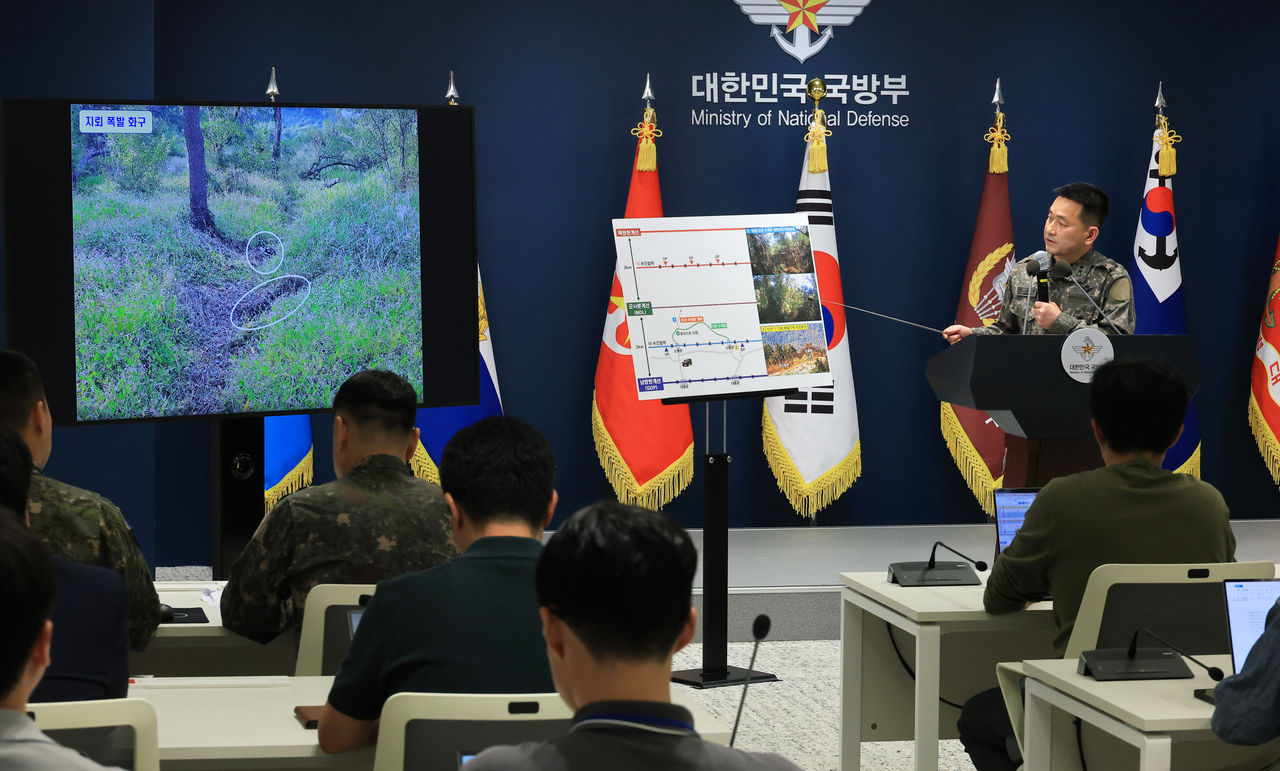
The JCS also cited testimony from personnel involved in the operation that a brown, rectangular object resembling North Korean anti-personnel mine was spotted about 1 meter from the first blast site.
The shape of the blast craters and flames, the extent of the injuries and accounts from personnel at the scene further supported the assessment, the military said.
Regarding questions over whether greater use of unmanned equipment could have reduced the risk to personnel, a JCS official said the military had deployed all available assets, including robots, drones and quadruped robots, during mine-detection operations.
The official said, however, that personnel still had to enter parts of the area because of the mountainous terrain and other operational constraints, adding that the military had taken what it considered the best available safety measures under the circumstances.
According to the JCS, the blasts occurred about 10 meters south of the Military Demarcation Line, which divides the two Koreas, and roughly the same distance from an area where signs of North Korean mine-laying activity had been detected.
All 18 personnel involved in the operation were taken to the Armed Forces Capital Hospital following the explosions. Fifteen have since been discharged, while the two seriously injured personnel and one with minor injuries remain hospitalized.
Seoul warns Pyongyang of responsibility
The JCS also said North Korea would bear responsibility if the final investigation confirms that the mines were laid by Pyongyang.
"If the final investigation concludes that our troops were injured by mines laid by North Korea, it means our service members were injured by North Korean mines while legitimately conducting operations south of the Military Demarcation Line," Kwon said.
"All responsibility lies with North Korea, and our military will take appropriate and corresponding measures," he added.
The military has yet to determine whether the suspected North Korean mines were deliberately planted south of the MDL or had been displaced from elsewhere. The mine-like object reported near the first blast site has also yet to be recovered.
The JCS said a final determination would be made after further investigation with the United Nations Command.
As for possible countermeasures, the JCS did not specify what action it could take, saying corresponding measures would be decided based on the final findings.
The Defense Ministry, meanwhile, said it would keep all policy options open in considering a response.
Earlier in the day, Defense Minister Kang Shin-chul also said "appropriate and corresponding" measures would be necessary if the mine is confirmed to have been laid by North Korea.
If confirmed, the incident would mark the first case of South Korean military personnel being injured by North Korean mines in the DMZ since August 2015, when two South Korean soldiers were seriously wounded by wooden-box mines.
A South Korean and UNC investigation at the time concluded that North Korean troops had crossed the MDL and deliberately planted the mines. Seoul subsequently resumed loudspeaker broadcasts toward North Korea.
flylikekite@heraldcorp.com