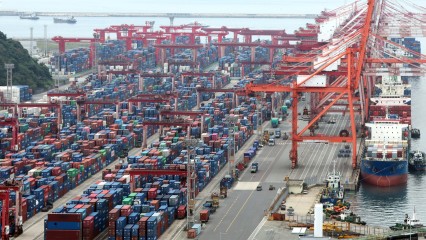


South Korea's economy expanded in nominal terms at its fastest annual pace in nearly 47 years in the second quarter, as a semiconductor-led export boom widened the country's terms of trade, Bank of Korea data showed Tuesday.
Nominal gross domestic product rose 26.4 percent in the April-June period from a year earlier, the sharpest increase since the third quarter of 1979. Output for the quarter reached 834.9 trillion won ($622 billion), up 9.2 percent from the first quarter.
The country's real GDP, the inflation-adjusted measure, grew 0.6 percent from the previous quarter and 3.7 percent from a year earlier. Semiconductors and machinery led a 1.3 percent rise in exports from the previous quarter, while stronger spending on appliances and services lifted private consumption 0.4 percent.
Export prices jumped 56.6 percent from a year earlier as chipmakers commanded higher prices amid a global semiconductor supply crunch, pushing nominal GDP growth well above the pace of real GDP.
Real gross national income, a broader measure of purchasing power, far outpaced the 0.6 percent growth in real GDP, rising 3.1 percent from the previous quarter and 15.6 percent from a year earlier. Real trade gains rose to 58.5 trillion won in the second quarter from 38.7 trillion won in the first quarter, underpinning the rise in real GNI.
Corporations captured much of that windfall. Total operating surplus jumped 18.5 percent from the previous quarter, the fastest pace since the Bank of Korea began compiling the data in 2010.
The income gains outpaced spending, driving the gross saving rate to 45.6 percent, up 3.9 percentage points from the previous quarter. Gross national disposable income rose 8.9 percent, while final consumption expenditure grew just 1.6 percent.
The central bank lifted its 2026 growth forecast last month to 3.3 percent from 2.6 percent, pointing to the rebound in chip demand. If realized, that would give Korea its strongest annual expansion since 2021, when the economy grew 4.7 percent.
minmin@heraldcorp.com