

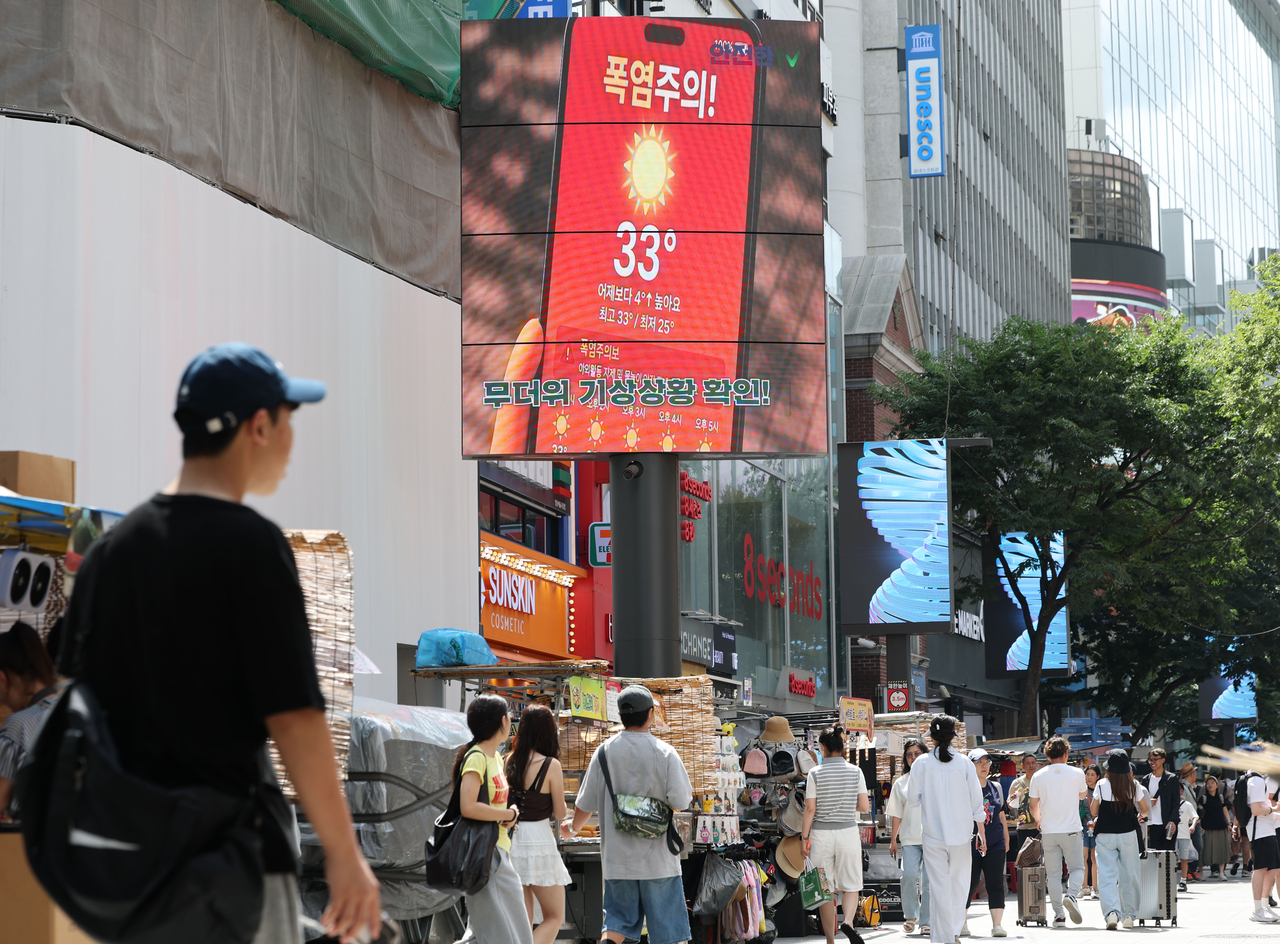
South Korea can expect high day and nighttime temperatures until early next month, with Monday's temperature projected to reach 39 degrees Celsius in some regions.
The Korea Meteorological Administration issued a heat wave emergency warning for several southeastern regions, including Gyeongsan, Pohang, Gyeongju, Goryeong and Cheongdo in North Gyeongsang Province; Yangsan, Gimhae, Miryang, Euiryeong, Haman, Changnyeong, and Hapcheon in South Gyeongsang Province and Daegu.
The heat wave emergency warning is the highest of the new three-tiered system implemented this year, issued when the temperature is expected to reach 39 degrees Celsius or higher after remaining above 35 C for two consecutive days. It is also issued when the apparent temperature is forecast to be at least 39 C.
Temperatures in Gyeongju reached 39.1 degrees as of 3 p.m., the highest recorded in the country that day. Unofficial temperature measurements using the automatic weather station showed slightly higher figures in Sinam-dong, Daegu, at 39.2 degrees.
Seoul recommended that residents restrict outside work between 2 p.m. and 5 p.m. if a heat wave warning is issued, and provided 100,000 bottles of ice water at 30 rest areas for delivery workers.
High temperatures to persist for over a week
High temperatures are expected to persist across the country for the time being, according to the weather authorities.
The KMA projected morning temperatures of between 24-26 C. Daytime temperatures are expected to range between 32-39 C until Aug. 6.
"Tropical nights and the heat wave will continue at least until early next month," the KMA said in its forecast.
Tropical nights occur when the overnight low between 6 p.m. and 9 a.m. remains at or above 25 C.
The peninsula can expect some rain in Seoul, Incheon, Gyeonggi Province, Gangwon Province, northern North Gyeongsang Province and some parts of North and South Chungcheong Provinces.
However, the rainfall will only have a temporary effect on bringing temperatures down, the KMA said.
Thunderstorms are expected in some parts of the East Sea and the West Sea until Tuesday, along with heavy fog.
minsikyoon@heraldcorp.com
![[World Class] Dongguk looks to Buddhism, Hallyu and AI to shape global identity](https://wimg.heraldcorp.com/news/cms/2026/10/25/news-p.v1.20261001.4f5f085cfb5d48e7a6af0848b0d5089c_R.jpg?type=h&h=120)