Architects from France, South Korea discuss history and future of public space, why empowering young architects is important
Why, in a country celebrated for the global reach of its music, cinema and technology, does architecture seem to lag behind?
“Look at the qualitative level of Korea’s dance, music, film, graphic arts, science and technology, it is remarkable,” French architect Dominique Perrault said. “Why is architecture not at that same level?”
“Perhaps it is because there is not enough affection for the nation and its heritage.”
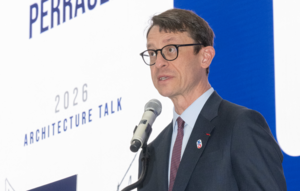
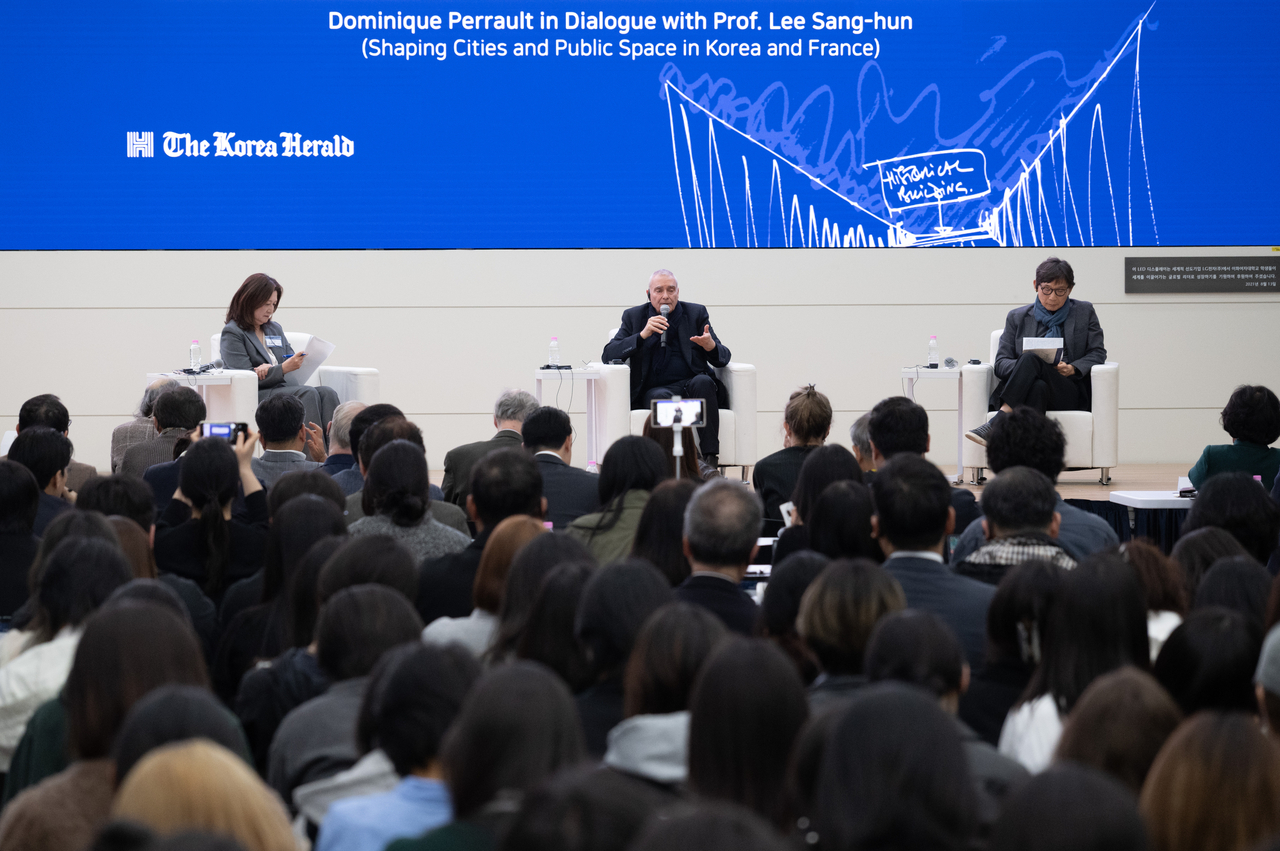
The question came during the 2026 Korea Herald Architecture Talk, where the world-renowned architect spoke in conversation with Lee Sang-hun, emeritus professor of architecture at Konkuk University.
The session, titled “Shaping Cities and Public Space in Korea and France,” unfolded as both a critique and an invitation for a cross-continental reflection on how public architecture mediates memory, identity and public life. The dialogue was moderated by Kim Hoo-ran, editor-at-large at The Korea Herald.
Perrault argued that Korea’s fixation on the “modern” often comes at the expense of continuity. “There is a tendency in Korea to think that if something is not modern, it is not good,” he said. “Modernity becomes synonymous with demolition and rebuilding — as if without erasure, nothing can be contemporary.”
What is lost in that cycle, he suggested, is not only buildings but meaning. Heritage, in his telling, is not a static archive but a living framework.
He urged a shift in mindset: to “tag” places, to recognize where one comes from and where one is going. Such tagging, he said, accumulates into something larger: a nation with emotional depth and cultural storytelling. “Heritage then becomes the foundation of modern creation. And it is precisely this heritage that serves as the basis for contemporary creation."
From that “fertile layer,” as he described it, new forms of public space might emerge — not imitations of European plazas, but distinctly Korean spatial inventions. “You can do things here that European cities cannot,” Perrault said. “There is an opportunity to create entirely new concepts of public space.”
Professor Lee added, “Architecture does not fall from the sky. It is deeply rooted in tradition and locality. But we have not sufficiently accumulated or translated those layers into present-day practice.”
He also pointed to historically structural limitations within Korea’s architectural ecosystem. “There has been no long-standing social consensus around the norms or aesthetics of public architecture. That is our greatest difficulty.”
Unlike in many European countries, where public architecture has evolved through sustained debate and institutional support, Korea’s architectural culture, he argued, has yet to fully consolidate its traditions into contemporary practice. The result is a fragile sense of trust — both in architecture as a discipline and in architects as cultural agents.
The conversation also turned to public commissions. Both said public projects should serve as a springboard for young architects.
Perrault described himself as “a child of public procurement.” He recalled that in the 1970s in France, it was nearly impossible for an outsider — someone without money or connections — to win major commissions.
That changed under President Valery Giscard d’Estaing, who redefined architecture as a matter of public interest. The shift led to a system of open competitions, requiring municipalities and public institutions to commission projects through transparent processes.
“I do not think France is better than Korea,” Perrault cautioned. “It is not inherently easier for architects there. What matters is political, cultural and institutional movement.”
Such frameworks, he argued, are essential for fairness and cultivation.
“Young architects, in particular, need access and opportunity. Without experience, there is no reference. Without reference, there is no future opportunity.”
Lee acknowledged that Korea has expanded access to competitions in recent years, but underscored a deeper problem: the gap between winning a design and realizing it. Projects, he said, often become entangled in layers of bureaucracy from government agencies, contractors and shifting regulations that dilute the architect’s original intent.
“Even if a design wins, the process of execution is extremely difficult,” Lee said. “There are many players involved, and the design is often altered along the way. Architects struggle to maintain their vision.”
The consequences, he added, are not merely procedural but psychological. Architects become “exhausted and diminished,” and public projects rarely serve as the kind of springboard that propelled figures like Perrault.
Underlying these issues, Lee suggested, is a broader cultural skepticism. “There is a lack of trust in Korean architects. And that reflects a lack of recognition of architecture as a cultural value.”
This skepticism, in turn, fuels a reliance on internationally acclaimed figures that can sideline local voices and inhibit the growth of a robust domestic culture.
For Perrault, the question ultimately returns to the nature of public space itself. A publicly funded project, he emphasized, does not automatically become a public place.
“A space becomes public when people occupy it, when they inscribe history into it. Without history, it is just a place.”