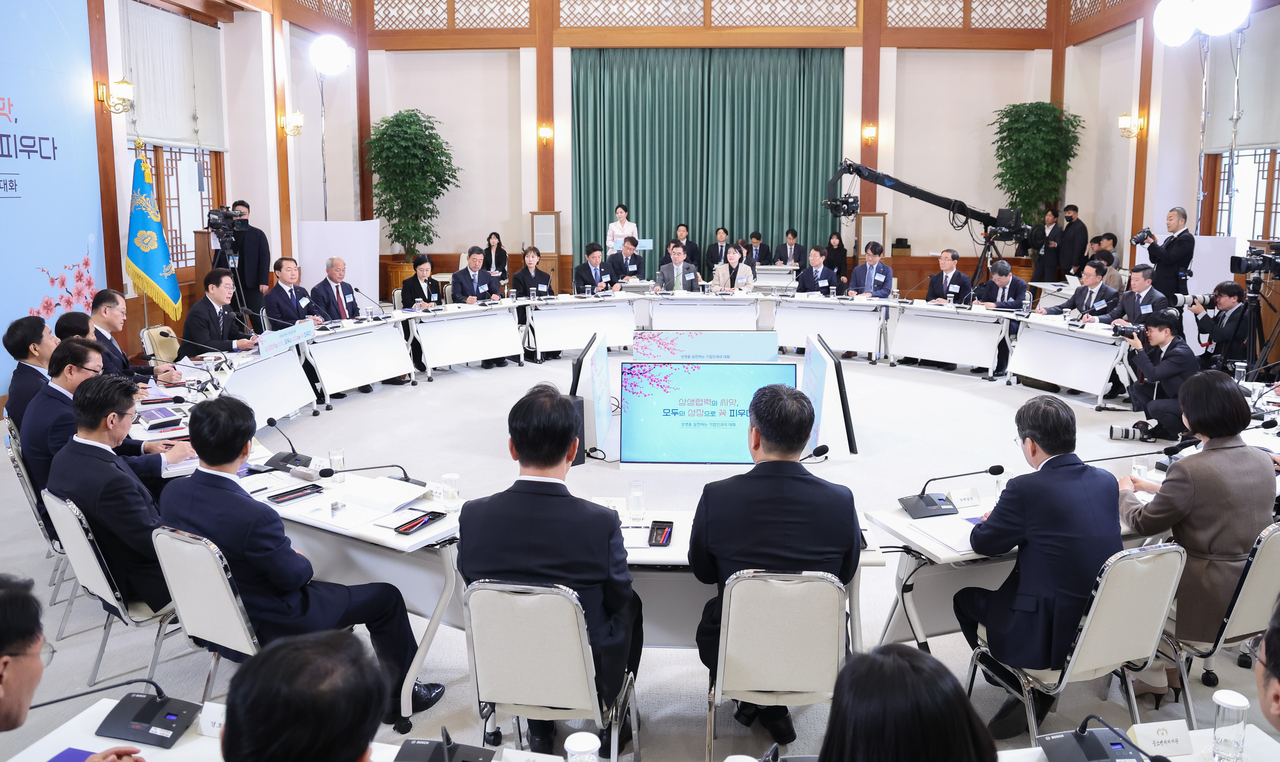
President Lee Jae Myung said Tuesday that cooperation between large corporations and small businesses should be treated as an investment and even a national “survival strategy."
Speaking at a roundtable at Cheong Wa Dae with representatives from 10 large companies and their SME partners, Lee said some approaches that powered South Korea’s industrial rise had become outdated.
Held under the slogan “seeds of shared cooperation, blossoming into growth for all,” the meeting aimed to encourage companies that have demonstrated exemplary win-win partnerships and spread successful models of collaboration between large and small businesses.
Lee underscored the need for a "major shift toward growth for all, in which opportunities and fruits of growth are shared evenly, for the sustained growth of the Republic of Korea,” referring to South Korea by its official name.
“I believe that only by creating a fair and circulating ecosystem can we transition to a society where creativity and innovation function, and where sustained growth and development are possible,” Lee said.
“That is why mutually beneficial cooperation between large corporations and small businesses is not an act of charity, but an investment. And, to put it more bluntly, it may even be a survival strategy,” Lee added.
Lee contended that concentrating limited resources and opportunities in a few key sectors — in the hope that the gains would later spread through the broader economy — had once been an effective development strategy but no longer suits South Korea’s current economic structure.
“During our industrialization process, we benefited considerably from that approach. But while it once served as a stepping stone for growth and development, the prevailing assessment today is that it has become an obstacle,” Lee said. “Strategies that were popular in the past, such as vertical integration and aggressive cost-cutting, no longer fit a modern economy driven by high-value knowledge and advanced industries.”
Lee specifically expressed gratitude toward Hanwha Ocean’s efforts to promote shared growth with subcontractors, including the resolution of long-running wage-seizure disputes and the provision of equal-rate performance bonuses for partner-company workers.
“I believe this is a model case of efforts to address the dual wage structure between large corporations and SMEs,” Lee said.
During the meeting, executives from large companies and SMEs presented real-world cases of mutually beneficial cooperation and discussed ways to expand a shared-growth ecosystem.
Participating large companies included Samsung Electronics, SK Supex Council, Hyundai Motor Company, Hanwha Ocean, Naver, Korea Aerospace Industries, LG Electronics, CJ ENM, Shinhan Financial Group and Pulmuone Foods.
The cases spanned sectors from profit-sharing programs and defense-industry cooperation to smart-factory support, regional development and supply-chain initiatives tied to environmental, social and governance standards. They also included open innovation with startups, online platform partnerships for small merchants, joint overseas expansion, financial support and efforts to improve job quality at supplier companies.
One example was Hanwha Ocean’s profit-sharing program with supplier Daewon Industry. The shipbuilder applies the same bonus payment rate to employees at partner companies as it does to its own workers and provides welfare support such as tuition assistance for skilled supplier employees.
Korea Aerospace Industries also presented its partnership with supplier Mirae Aerospace, in which the defense contractor provided emergency financing and low-interest loans for equipment investment to smaller partners with weaker credit profiles.
Samsung Electronics has been dispatching manufacturing experts to smaller firms to support smart-factory upgrades, including process innovation and automation. It cited its work with Hongseong Industry, which used the support to build a production-management system and improve its manufacturing processes, reducing inventory costs, shortening delivery times and boosting productivity.
Hyundai Motor highlighted its partnership with Poongkang as an example of supply-chain cooperation on environmental, social and governance issues, saying it has helped the company adopt carbon-reduction equipment and strengthen its environmental management through training and consulting.
Among the corporate participants were Hanwha Ocean CEO Kim Hee-cheul, Samsung Electronics President Park Seung-hee, SK Supex Council Social Value Committee President Jee Dong-seob, Hyundai Motor Company President Jung Jun-cheul, LG Electronics President Park Hyoung-sei, Naver CEO Choi Soo-yeon, Korea Aerospace Industries Acting CEO Cha Jae-byun, CJ ENM CEO Yoon Sang-hyun and Shinhan Financial Group Chair Jin Ok-dong.
Senior government officials attending the meeting included Deputy Prime Minister and Finance Minister Koo Yun-cheol, SMEs and Startups Minister Han Seong-sook, and Defense Minister Ahn Gyu-back.
The Ministry of SMEs and Startups also unveiled a strategy to broaden what the government calls a cooperative ecosystem between large corporations and small and medium-sized enterprises.
dagyumji@heraldcorp.com


