Higher percentage of foreign workers involved in fatal industrial accidents compared to Korean counterparts
The majority of foreign workers in South Korea have not been participating in safety drills at industrial sites, despite them accounting for roughly 1 out of 10 deaths via industrial accidents here, government data showed Sunday.
The government conducts specialized training drills for occupational safety and basic skills for living here — including culture and language — for E-9 visa holders, and Ministry of Employment and Labor data showed that just 718 people had participated in such drills as of July. This is 11.9 percent of some 6,000 who the program has targeted to train, comprising E-9 visa holders with under six months of work experience in the country.
The E-9 visa is issued for those staying as nonprofessional employees in South Korea, most of whom are manual workers, including in the fields of manufacturing, construction, forestry and mining. These are also fields in which workers are subject to higher risks of occupational hazards.
According to Sunday's report compiled by Rep. Kim Ju-young of the ruling Democratic Party of Korea, only 1,264 (31.6 percent) of the 4,000 foreign workers slated to receive the specialized training course participated in last year's drills.
The data for this year so far showed that no one from the construction, service and housework industry had taken part in the state drills, while 670 workers in manufacturing had participated. The vast majority of the workers who participated in last year's training course were also from the manufacturing sector — 1,152 — with zero participants from the construction and service industry.
Kim's report also showed that a total of 287 people died in the first half of 2025 in industrial accidents, with foreign workers accounting for 38, or 13.2 percent.
Separate data from the Korea Workers' Compensation & Welfare Service showed last week that 8.2 percent of deaths from industrial accidents in 2024 were of foreigners, which is high considering that foreign workers accounted for 3.4 percent of all employees.
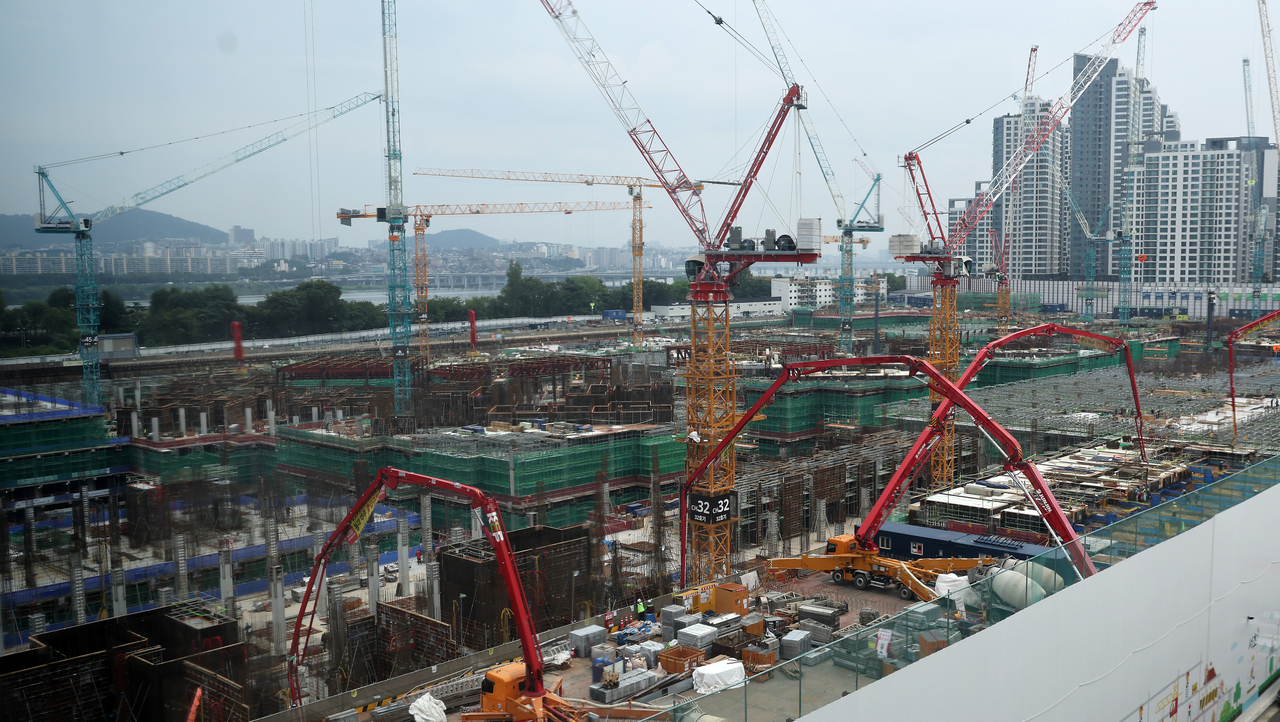
121 deaths in 2024 in civilian construction projects, 74 in state projects
Among different industries, the construction sector accounts for around half of all deaths, with private sector projects showing higher a fatality rate, figures from the Korea Authority of Land & Infrastructure Safety showed.
A total of 6,180 accidents occurred at construction sites last year, with 50.1 percent of them occurring at sites commissioned by private companies.
Casualties in these accidents were similar between civilian and government projects, at 3,124 to 3,121, respectively, but the fatality rate was much higher in civilian-led projects. Accidents at civilian projects resulted in 121 deaths, compared to 74 for state projects.
About 4.1 percent of the civilian construction projects had accidents last year, compared to 3.5 percent of state construction sites.
Some 80.6 percent of accidents at construction sites were deemed to be caused by a failure to follow safety protocols, directly responsible for 129 deaths and 4,906 injuries across both state and civilian sectors.
While the accident rate was marginally lower for government projects and there were fewer deaths, the data showed that significant risk of industrial accidents exists even in these cases. In February, a bridge under construction in the border between South Chungcheong Province and Gyeonggi Province collapsed, killing four and injuring six workers.
The project was commissioned by the state-run Korea Expressway Corp. and conducted by Hyundai Engineering Co. A government probe showed that the subcontractor was directly responsible for what had caused the collapse, but both the construction company and the state body were found to have failed to properly supervise the project.
minsikyoon@heraldcorp.com