President also says near-final deal on Korea’s US investment commitment is back under negotiation over proposed terms Seoul found difficult to accept
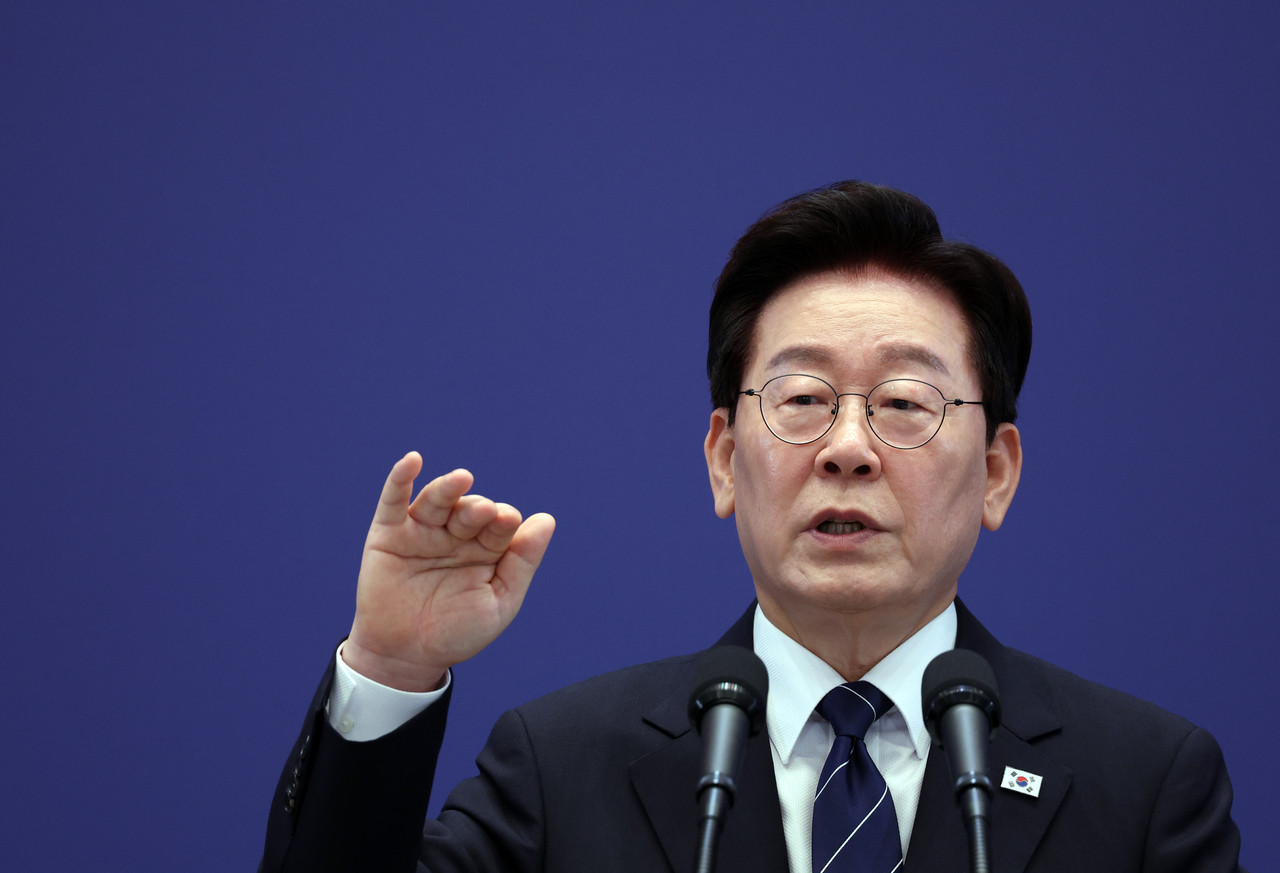
President Lee Jae Myung on Friday ruled out any deployment of South Korean troops or military assets that would involve Seoul in the conflict around the Strait of Hormuz, drawing a firm line around South Korea’s military role in the region.
At the same time, Lee stressed that Seoul still had a responsibility to protect Korean ships, oil routes and nationals, as the Korean government weighs expanding the role of a naval unit it has already deployed in the Middle East.
Lee said any decision would require balancing the risks to Korean vessels and crews against the potentially heavy economic cost of disruptions to vital energy supplies, with changing conditions repeatedly presenting new risks and difficult choices for the president to weigh.
“On the issue of troop deployment, I can say this: There will be no deployment that involves or intervenes in the war. I can state that clearly,” Lee said during a news conference at Cheong Wa Dae. “There will be no involvement in or intervention in the war. We will not send troops in such a form, nor will we dispatch military assets in such a form.”
Lee underlined that, “We have upheld that principle until now. That principle will remain unchanged going forward.”
Lee’s clear stance on the scope of South Korea’s military contribution across the Strait of Hormuz came amid growing controversy after local media reported in early this month that Seoul was considering deploying troops to the Strait of Hormuz.
The debate intensified as US President Donald Trump repeatedly claimed that Lee had declined his request for help with the war against Iran, publicly pressing the ally and saying Washington should “remember” countries unwilling to help the US.
At home, however, public opinion has tilted against such a deployment, with polls showing broad opposition to sending South Korean troops or military assets to the strait, particularly among supporters of Lee’s ruling Democratic Party of Korea.
Still, Lee said South Korea could not entirely stay on the sidelines when its own economic and security interests were at stake.
About 70 percent of South Korea’s crude oil imports pass through the Strait of Hormuz, where shipping has been severely disrupted by the war with Iran, which began with a joint US-Israeli attack on Feb. 28.
“It is also clear that, like other countries, we need to undertake the minimum activities necessary to protect our merchant ships and crude oil shipping routes, as well as the lives and safety of our citizens,” Lee said.
One option under consideration, he said, is expanding the role of the Cheonghae Unit, the Korean Navy’s anti-piracy force deployed to protect commercial shipping and Korean nationals along key sea lanes in the Middle East.
“The Cheonghae Unit is already deployed and is responding to threats to shipping routes and the safety of our citizens, including those posed by piracy,” Lee said. “It is also true that we are considering and deliberating over strengthening those activities.”
The Cheonghae Unit was first dispatched to the Gulf of Aden in 2009, and its operational area was later expanded to include the Gulf of Oman and the Strait of Hormuz as Seoul sought to protect Korean ships and nationals navigating the region.
Lee acknowledged, however, that the distinction between such protective operations and involvement in the conflict could become blurred.
“People are concerned because the boundary could become unclear and the two could become mixed together,” he said.
Lee pointed specifically to concerns that South Korean forces could end up “intervening in, becoming involved in or supporting the war,” that Seoul might “send combat troops” or “place our service members under foreign command and put them in harm’s way.”
“To make it clear once again, there will be no deployment to the war,” Lee said. “We have maintained the principle of noninvolvement and nonintervention in the war until now, and we will continue to uphold it.”
Lee acknowledges snag in US investment talks
On another front in the alliance, Lee admitted negotiations over South Korea’s $350 billion investment commitment to the US remained difficult, offering a glimpse into the disagreements that have delayed the rollout of the first investment project.
The government postponed a planned briefing on Thursday to National Assembly committees on the first project, a step that had been expected to precede its announcement and the signing of an investment agreement with Washington.
The delay came as Seoul and Washington continued to work through the terms of individual projects.
“The issue of investment in the US is a very complex and difficult task,” Lee said when asked when Seoul could announce its first project. “It is something that has truly complex implications for Korea-US relations.”
At the heart of the delay in finalizing the negotiations, Lee said, is “commercial reasonableness” — a principle Seoul fought to include in the strategic investment agreement signed with Washington in November 2025 and later enshrined in South Korean law.
“We only invest in projects that are commercially reasonable,” Lee said. “The law also requires us to assess how commercially reasonable they are.”
But Lee said that principle had become harder to translate into practice as Seoul and Washington moved from the broader agreement to selecting and structuring specific projects, raising questions over how South Korea would recover its investment, how profits would be shared and how losses would be handled.
Those issues have continued to complicate the working-level negotiations even as the two sides have moved close to an agreement.
"I was told we were close to an agreement, but from what I saw in the details, there were some parts that were difficult to agree with, so we are still discussing them,” Lee said.
“I have been giving this so much thought that it has kept me up at night. It carries enormous weight.”
Lee said Seoul would continue the negotiations with South Korea’s national interests as the overriding priority.
“National interests are extremely important. I do not think we should be swayed by any relationship, pressure or coercion. I am not saying that the US is doing that," Lee said.
“We are engaged in intense discussions and negotiations to structure the projects in a way that does not undermine the Republic of Korea’s national interests and benefits both Korea and the United States.”
dagyumji@heraldcorp.com