Iraq could more than double its current daily oil production by 2020, vastly boosting its economy and helping to bring stability to global energy markets, the International Energy Agency forecast on Tuesday.

The country’s crude oil output could grow to 6.1 million barrels per day in eight years’ time from about 3.0 mbpd currently, the IEA said as it unveiled its Iraq Energy Outlook report in London.

The Paris-based IEA added that Iraq stood to gain almost $5 trillion in revenue from exporting oil up to 2035, as long as the country invested more than $530 billion on raising its energy output.

“In our central scenario, Iraq’s oil production more than doubles to 6.1 mbpd by 2020 and reaches 8.3 mbpd in 2035,” said the IEA, which advises oil-consuming developed countries on energy policy.
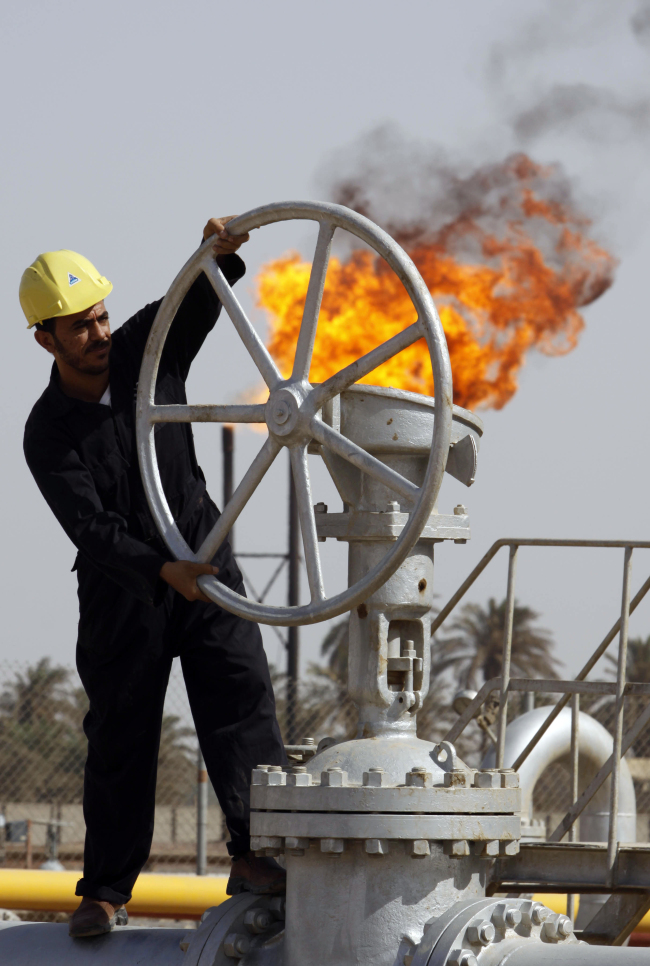
<YONHAP PHOTO-2000> FILE - In this file photo of Friday, July 17, 2009, an Iraqi worker operates valves at the Nahran Omar oil refinery near the city of Basra, 340 miles (550 kilometers) southeast of Baghdad, Iraq. The International Energy Agency predicted Tuesday Oct. 9, 2012 that Iraq will consolidate its position as a global oil power _ allowing it to rebuild the economy of a nation ravaged by war and decades of Saddam Hussein?s autocratic rule. The leading global energy monitor reported that Iraq?s annual revenues from energy exports could double to an average of $200 billion annually over the next 20 years. That optimistic scenario would make Iraq?s economy the same size as that of Saudi Arabia now by 2035. (AP Photo/Nabil al-Jurani, File)/2012-10-09 20:57:32/ <저작권자 ⓒ 1980-2012 ㈜연합뉴스. 무단 전재 재배포 금지.>
A worker operates valves at the Nahran Omar oil refinery near Basra, Iraq.   AP-Yonhap News
FILE - In this file photo of Friday, July 17, 2009, an Iraqi worker operates valves at the Nahran Omar oil refinery near the city of Basra, 340 miles (550 kilometers) southeast of Baghdad, Iraq. The International Energy Agency predicted Tuesday Oct. 9, 2012 that Iraq will consolidate its position as a global oil power _ allowing it to rebuild the economy of a nation ravaged by war and decades of Saddam Hussein?s autocratic rule. The leading global energy monitor reported that Iraq?s annual revenues from energy exports could double to an average of $200 billion annually over the next 20 years. That optimistic scenario would make Iraq?s economy the same size as that of Saudi Arabia now by 2035. (AP Photo/Nabil al-Jurani, File)/2012-10-09 20:57:32/ <저작권자 ⓒ 1980-2012 ㈜연합뉴스. 무단 전재 재배포 금지.> A worker operates valves at the Nahran Omar oil refinery near Basra, Iraq. AP-Yonhap News

A worker operates valves at the Nahran Omar oil refinery near Basra, Iraq. ( AP-Yonhap News)

“The largest increase in production comes from the concentration of super-giant fields in the south around Basra,” it added.

But reaching such a high level of output “will require rapid, coordinated progress all along the energy supply chain,” the agency stressed.

“Adequate rigs will need to be available at the right time. Early investment in a challenging project to bring up to eight mbpd of water inland from the Gulf to Iraq’s southern fields will be essential to support oil production and to reduce potential stress on scarce freshwater resources.” (AFP)


koreaherald@heraldcorp.com