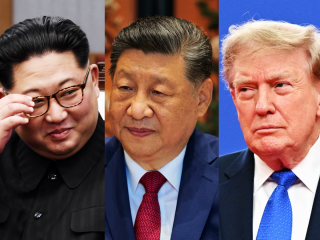
On Nov. 19, Korea became the fourth country to export $1 trillion in goods in a calendar year, joining the United States, China and Germany. In 1960, it exported $33 million, an extraordinary achievement for a nation and its people. Korea has every reason to be proud. Generations of Koreans worked to give their children a better life than the one they had known. Yet what caught my attention that day was a photograph from Shenzhen. Chinese President Xi Jinping sat between US President Donald Trump and Russian President Vladimir Putin. The Korean Peninsula reportedly came up. What had they said about us?
That is why talk of “a new Yalta” troubles many Koreans. At Yalta in February 1945, Franklin D. Roosevelt and Joseph Stalin discussed placing Korea under international trusteeship. Six months later, American officers proposed the 38th parallel as the boundary for accepting Japan’s surrender, and the Soviets agreed. Koreans who had devoted their lives to independence had no say in whether their country would be divided or where the line would run. Imagine a family waiting decades for word of a brother on the other side. Who would ever have to answer to that family for the decision that separated them?
In 1950, North Korea invaded the South. The war cost millions of lives. The 1953 armistice halted the fighting. Generations of young South Korean men have since fulfilled their obligation to serve. Many readers overseas glimpsed what that duty means when all seven members of BTS put their careers on hold to fulfill it. I spent more than three years as an Army officer along the Demilitarized Zone. Harder to convey is how it felt to stand guard there as a young man. Soldiers across the line spoke my language. To them, too, Korea was home.
Seoul did have a voice in Shenzhen. The evening before the three leaders met, President Lee Jae Myung spoke with Putin to ease tensions on the peninsula. It was the first meeting between a South Korean president and his Russian counterpart in seven years. Now, North Korea has sent troops and munitions to support Russia’s war in Ukraine and has signed a mutual military assistance pact with Moscow. Kim Jong-un has proved useful to Putin. If tensions rise on the peninsula, what restraint is Putin prepared to ask of Kim?
Americans fought alongside us when North Korea invaded. The Soviet Union armed North Korea, and China sent troops to fight on its side. It is a historical irony that China is now our largest trading partner. Washington, our treaty ally, would be among the first capitals Seoul would call in a crisis. The Korean people, especially politicians, must remember who fought on which side and still judge whom we can count on tomorrow.
In industrial negotiations, leverage is greatest before either side commits to something it cannot easily reverse. For example, when a foreign partner asks a Korean firm to build a shipyard, that is the moment to agree on how Korean suppliers can compete for future orders. Once the yard is built, bargaining power shifts. The same lesson applies if Washington reopens nuclear talks with Pyongyang. Before those talks begin, Seoul and Washington should agree on which proposals affecting South Korea’s security require prior consultation.
Suppose Washington secured a limit on North Korean missiles capable of reaching Los Angeles while leaving those aimed at Seoul untouched. What could a Korean president tell the people of Seoul about the threat still at their doorstep? Before the next summit, President Lee should meet with opposition leaders to agree on what Korea must seek in any such deal. He could then speak for Korea in Washington, backed by an agreement reached at home.
The American midterms give South Korean diplomats reason to look beyond the White House. Democrats will take control of both houses of Congress in January. Korean policymakers should speak regularly with lawmakers in both parties about what our two countries can accomplish together. Korean shipbuilders can help revive American shipyards. Cooperation on nuclear-powered submarines raises a different question about the allies’ long-term security in the Indo-Pacific. Both deserve sustained attention on Capitol Hill.
In "The Art of War," Sun Tzu prized winning without fighting. Beijing, too, has a stake in peace on the peninsula. Chinese manufacturers that depend on Korean suppliers to keep their factories running and expand production know what a crisis would cost them. Seoul can draw on that shared interest to press Beijing to ease tensions and uphold the trading rules both countries rely on.
Behind that trillion dollars are generations of Koreans who learned to build ships, make semiconductors, and earn the trust of customers who came back with a second order. That is the foundation of what I call the Korean Operating System. No Korean family should ever again pay the price for a decision made about us without our consent. When our future is at stake, we must speak for ourselves.
Man-Ki Kim
Man-Ki Kim is an adjunct professor at the KAIST Graduate School of Future Strategy, specializing in global public procurement, defense acquisition innovation and global strategic trends. He also serves as a senior adviser at Yoon & Yang. The views expressed here are the writer’s own. -- Ed.
khnews@heraldcorp.com