A pickpocket slips into the heart of Japan's colonial government in Korea, posing as an interpreter trainee. That's the premise of "100 Days of Deception," a tvN weekend espionage drama starring Kim You-jung and Park Jin-young, set in Gyeongseong, as Seoul was known under Japanese rule, in 1932.
Much of that world was filmed not in Seoul but at Sunshine Studio, part of the Sunshine Land complex in Nonsan, South Chungcheong Province. A 1930s railway station, a hidden residence used by independence fighters, a traditional medicine clinic and a crowded market lane were all shot on its grounds.
Kim plays a gifted thief who goes undercover inside the Japanese Government-General of Korea. Park plays a polished interpreter of Korean birth who lives as a Japanese man and guards secrets of his own. Neither fully trusts the other, and that tension sets the pace of the romance.
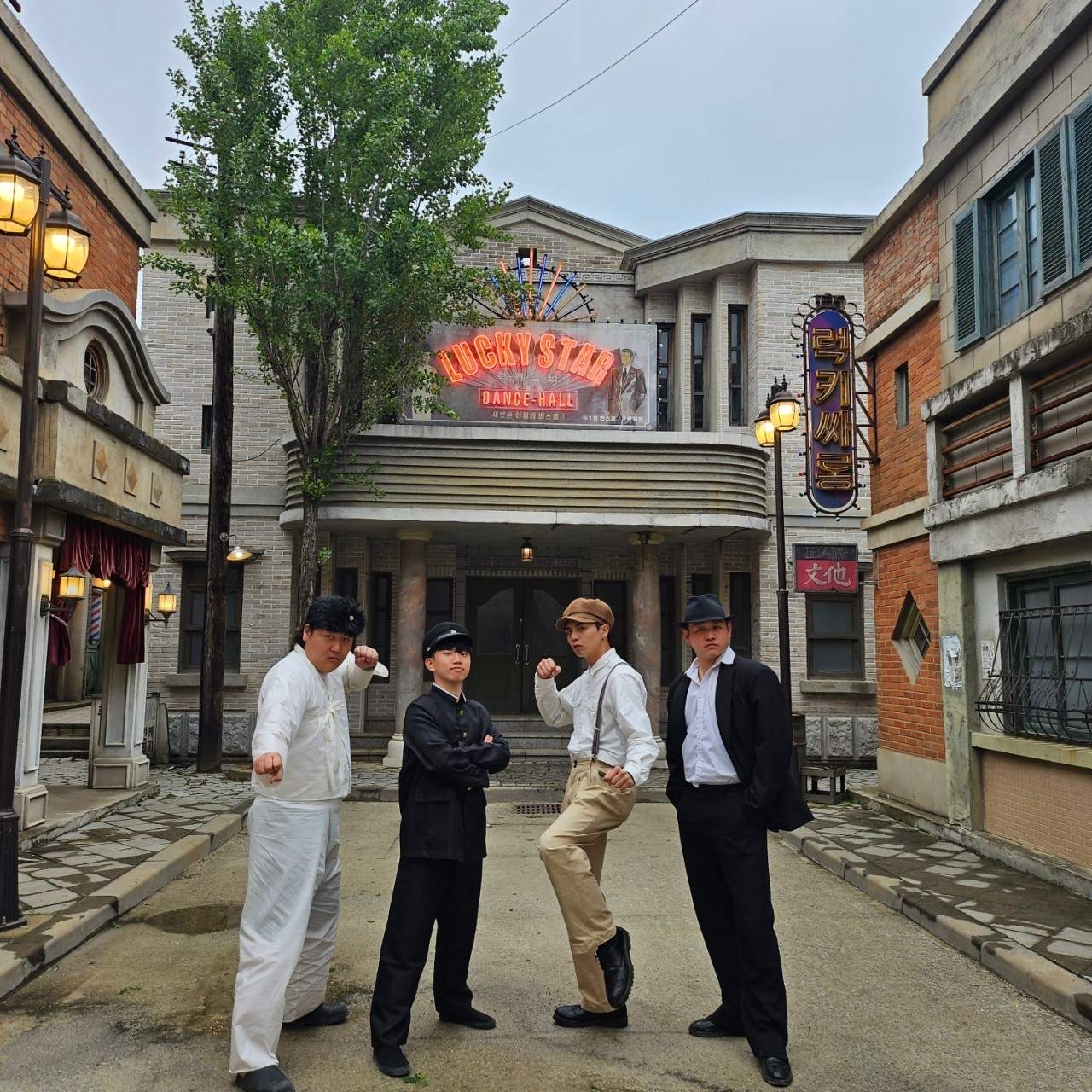
The streets may look familiar to drama fans. The studio was originally built for "Mr. Sunshine," the 2018 tvN hit starring Lee Byung-hun and Kim Tae-ri, which was set in the final years of the Korean Empire (1897–1910). New storefront signs, set dressing and wardrobe were enough to move the same lanes forward by roughly three decades.
Spanning nearly 20,000 square meters, the studio mixes Western-style buildings, Japanese-style homes and straw-roofed Korean houses. A tram runs down one of its main roads.
Its best-known landmark is the Glory Hotel, where Go Ae-shin and Eugene Choi crossed paths in "Mr. Sunshine." The ground floor now shows clips and props from that drama, and a cafe takes up the floor above.
Producers have returned to the lot repeatedly. Apple TV+'s "Pachinko" and tvN's fantasy series "Tale of the Nine Tailed 1938" also shot scenes there. Rather than demolishing the set after "Mr. Sunshine" wrapped, the city kept it standing and open to the public.
Today's visitors can wander among the old shopfronts or rent clothing from the early modern era for photos. Elsewhere in Sunshine Land are a survival game course, a military-themed experience hall and a separate studio built to resemble a 1950s streetscape.
The city now hopes to build on the new drama's attention. An expansion project will add a more detailed rendering of 1930s Gyeongseong Station, along with matching streets and props. Officials also plan an escape room and an audience-participation theater built around Dilkusha, the 1920s Seoul home of American journalist Albert W. Taylor.
The aim is to shift Sunshine Land from a place people pass through for photos to one where they spend the day, and ultimately to a K-content attraction with international reach, according to the city.
"We will develop Sunshine Land into a time-travel theme park where visitors can feel the romance and spirit of Gyeongseong from 100 years ago, offering tourists a distinctive experience," a city official said.
Sunshine Land is located at 102 Bonghwang-ro, Yeonmu-eup, Nonsan. Parts of the complex are under construction, and access to some areas may be limited.
yoohong@heraldcorp.com