Hanwha Ocean's turnaround offers potential blueprint as KAI trails defense rivals in growth, investment
The widening performance gap between Korea Aerospace Industries and its privately controlled defense rivals is fueling debate over whether a change in KAI's ownership structure could accelerate its growth, with Hanwha Ocean's turnaround offering a potential blueprint.
According to a recent report by Leaders Index, KAI's revenue grew just 30.8 percent between 2020 and 2025 to 3.7 trillion won ($2.76 billion), far behind the industry's leading players. Hanwha Aerospace's revenue surged 401.8 percent to 26.61 trillion won, while LIG Nex1 and Hyundai Rotem more than doubled their sales to 4.31 trillion won and 5.84 trillion won, respectively.
The gap was even wider in profitability. KAI's operating profit rose 92.9 percent over the five years, compared with an average 680 percent increase among its rivals. Hanwha Aerospace alone recorded a 1,166 percent jump.
Industry observers say the disparity raises questions about KAI's governance. Although publicly listed, the aircraft manufacturer remains heavily influenced by state-affiliated shareholders, with the Export-Import Bank of Korea and National Pension Service holding a combined 34.7 percent stake.
"State-run policy banks hold substantial stakes but face constraints in setting long-term strategies because of concerns over political backlash or excessive intervention," an industry source said. "This can create a governance vacuum that discourages bold investment decisions."
KAI has also experienced leadership instability, including an eight-month period without a chief executive.
The investment gap is particularly striking. Between 2020 and 2025, capital expenditure at Hanwha Aerospace and Hanwha Systems increased 401.9 percent and 278.3 percent, respectively, compared with just 8.4 percent at KAI.
"While KAI has played a pivotal role in developing Korea's defense industry, we need to examine whether its growth has stalled," said Hwang Yong-sik, a business professor at Sejong University.
"Given Korea's unique security environment, KAI has benefited from considerable protection. The question is whether its current ownership structure is limiting its potential."
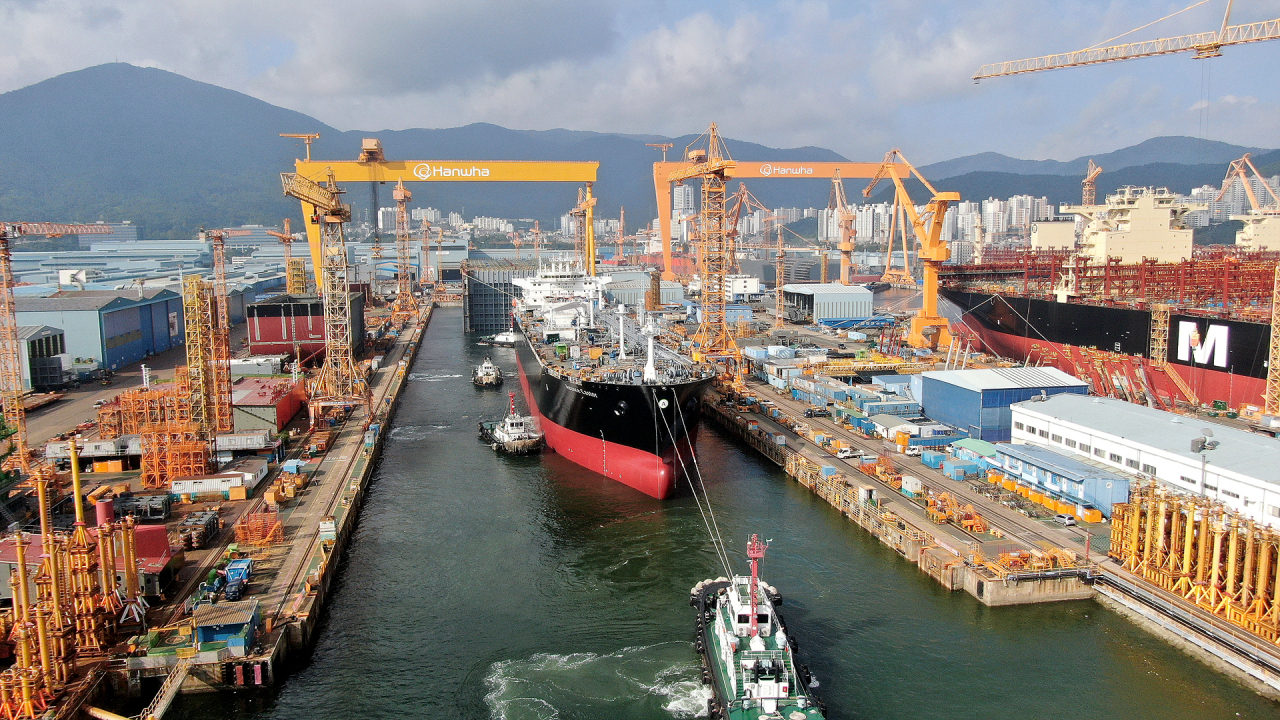
Supporters of a change in ownership point to Hanwha Ocean as a precedent.
Before Hanwha Group acquired the shipbuilder in 2023, the company, then known as Daewoo Shipbuilding & Marine Engineering, struggled under the ownership of state-run lenders Korea Development Bank and Korea Eximbank.
Between 2018 and 2023 as the shipbuilding market recovered, HD Korea Shipbuilding & Offshore Engineering and Samsung Heavy Industries posted revenue growth of 50 to 60 percent. DSME, by contrast, saw revenue fall 23.2 percent and recorded an operating loss of 1.6 trillion won in 2022.
Following Hanwha's acquisition, the shipbuilder sharply narrowed its losses in 2023 and returned to profitability in 2024. Operating profit exceeded 1 trillion won in 2025 and is projected to surpass 2 trillion won this year.
Hanwha's potential acquisition of KAI raises the prospect of a similar transformation, combining stronger corporate oversight and investment capacity with the aircraft-maker's technological expertise.
"More decisive private-sector ownership could help KAI overcome governance constraints and respond faster to intensifying global defense competition," the industry source said.
hyejin2@heraldcorp.com