Europe's rearmament and Japan's defense push raise stakes for Korea's next generation of defense champions
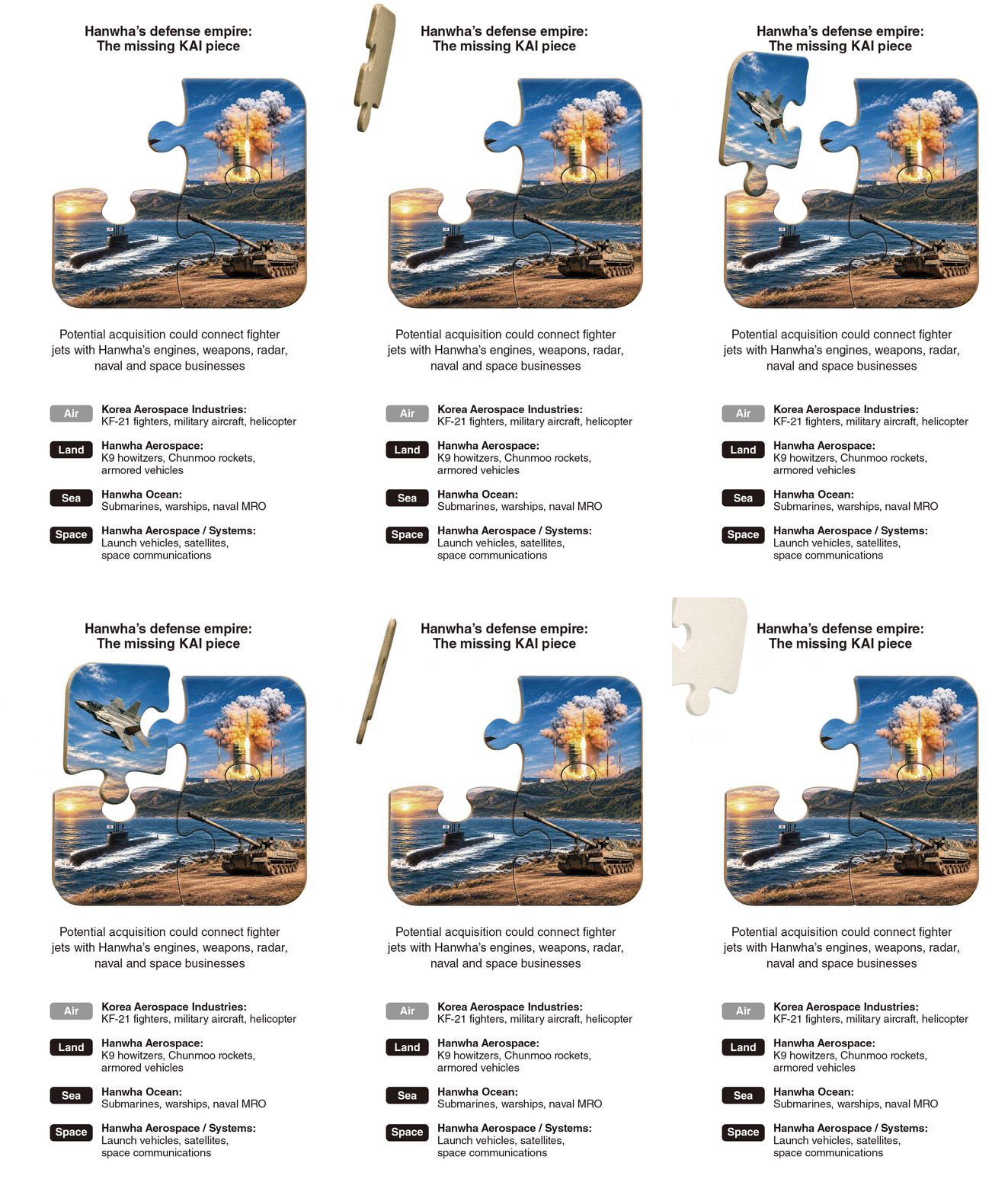
South Korea's defense industry faces a critical question as global arms makers consolidate to compete for increasingly complex, multibillion-dollar contracts: Can its fragmented aerospace and weapons businesses keep pace with larger international rivals?
Hanwha Group's potential acquisition of Korea Aerospace Industries is one potential answer, bringing aircraft manufacturing, engines, radar systems, missiles and space technologies under a single corporate umbrella.
Supporters argue the combination could strengthen not only Hanwha's global standing but also Korea's ability to compete for major defense contracts.
The proposed deal comes as defense contractors worldwide seek greater scale and technological integration to meet growing demand for advanced weapons systems, particularly in Europe, where military spending has accelerated amid the prolonged Russia-Ukraine war and concerns over US security commitments.
Hanwha has already strengthened its position in KAI. In August, the Fair Trade Commission cleared the acquisition of a combined 15.9 percent stake by Hanwha Aerospace, Hanwha Systems and Hanwha Ocean, making the group KAI's second-largest shareholder, after the state-run Export-Import Bank of Korea, which holds 26.4 percent.
Securing the bank’s stake would give Hanwha a combined 42.3 percent holding in KAI, potentially handing it effective control.
The potential merger would combine Hanwha's strengths in aircraft engines, guided weapons, radar and space technologies with KAI's aircraft design and manufacturing capabilities, including the KF-21 fighter jet and military helicopters.
"Hanwha's acquisition of KAI is more than a simple business merger," said Kim Dae-jong, a business professor at Sejong University. "It is a strategy that can elevate the global competitiveness of Korea's defense industry."
Kim said the integration of both firm's strengths could create a more comprehensive industrial ecosystem capable of competing with established global players.
Why scale matters
The case for consolidation draws on the experience of major international defense companies, particularly in the United States.
Following the Cold War, American defense contractors underwent sweeping restructuring as military spending priorities shifted and competition intensified.
One defining transaction was the 1995 merger of Lockheed Corp. and Martin Marietta, creating Lockheed Martin, which subsequently became the world's largest defense contractor.
The combination brought together capabilities spanning military aircraft, missiles, space systems and advanced electronics, helping the company compete for increasingly sophisticated defense programs.
According to the Stockholm International Peace Research Institute, the world's 100 largest arms-producing and military services companies generated combined arms revenue of $679 billion in 2024, with 39 US companies accounting for roughly 49 percent of the total.
Hwang Yong-sik, a business professor at Sejong University, pointed to the growth of global defense giants through mergers and acquisitions as an important precedent for Korea's industry.
For Korean defense companies, the challenge is not simply matching the size of American contractors but developing the ability to deliver integrated systems that combine multiple technologies and platforms.
A Hanwha-KAI combination could also reduce coordination barriers and strengthen Korea's capacity to develop and export complete defense systems rather than individual weapons or components.
The battle for Europe
The strategic importance of consolidation is growing as European countries expand defense budgets and seek to modernize their armed forces.
NATO members are placing greater emphasis on interoperability, requiring equipment, communications and weapons systems from different suppliers to operate together.
For Korean companies, this creates opportunities to supply advanced systems to European militaries, but also highlights the importance of coordinating complex technologies across platforms.
Industry observers say a more integrated Korean defense company could compete more effectively for large procurement programs.
"If Hanwha acquires KAI, it can create an end-to-end, vertically integrated defense ecosystem by combining KAI's airframes with Hanwha Aerospace's engines and Hanwha Systems' radar systems under one corporate umbrella," an industry source said.
"This structural alignment will likely provide Hanwha a clear edge in securing major European defense contracts."
However, European procurement is also shaped by domestic industrial policies, technology-sharing requirements and partnerships with local manufacturers. Greater corporate scale alone would not guarantee access to those contracts.
Japan's defense export push
The push for greater integration comes as Japan moves to strengthen its own defense export industry.
Tokyo has been easing restrictions on defense equipment exports while expanding international development partnerships, including the Global Combat Air Program with the United Kingdom and Italy.
The sixth-generation fighter initiative could help Japanese manufacturers deepen their involvement in international aerospace supply chains and advanced defense technologies.
Japan is also strengthening cooperation with the United States on missile production and other military systems.
These developments could intensify competition for Korean defense exporters, particularly in markets where buyers increasingly seek comprehensive technology packages and long-term industrial partnerships.
Japan's approach differs from a single-company consolidation model, relying heavily on government-backed cooperation among domestic manufacturers and international partners.
Nevertheless, the broader trend underscores the importance of industrial coordination as competition expands beyond individual weapons platforms.
Hanwha's SpaceX ambitions
For Hanwha Vice Chairman Kim Dong-kwan, acquiring KAI could accelerate the group's ambition to build an integrated aerospace and defense business extending from ground weapons to satellites and launch systems.
In July, Kim announced plans to invest 55 trillion won ($41 billion) by 2040 in an aerospace and defense cluster in South Gyeongsang Province.
The initiative could connect Hanwha's defense manufacturing operations in Changwon with KAI's aircraft production base in Sacheon, both in the province, strengthening regional supply chains and research collaboration.
Hanwha's longer-term vision also extends into space infrastructure, including satellite services and launch capabilities.
That ambition invites comparisons with SpaceX's integrated approach to launch vehicles and satellite networks, although Hanwha's defense businesses and KAI's aircraft operations represent a different industrial model.
A combined company could potentially link satellite-based surveillance with aircraft, radar and ground-based defense systems.
hyejin2@heraldcorp.com