South Korea’s central government and ruling party have agreed to consider providing around 2 trillion won ($1.5 billion) in financial support for urgent, essential firefighting investments, amid growing scrutiny of a funding system that leaves local governments bearing most of the costs.
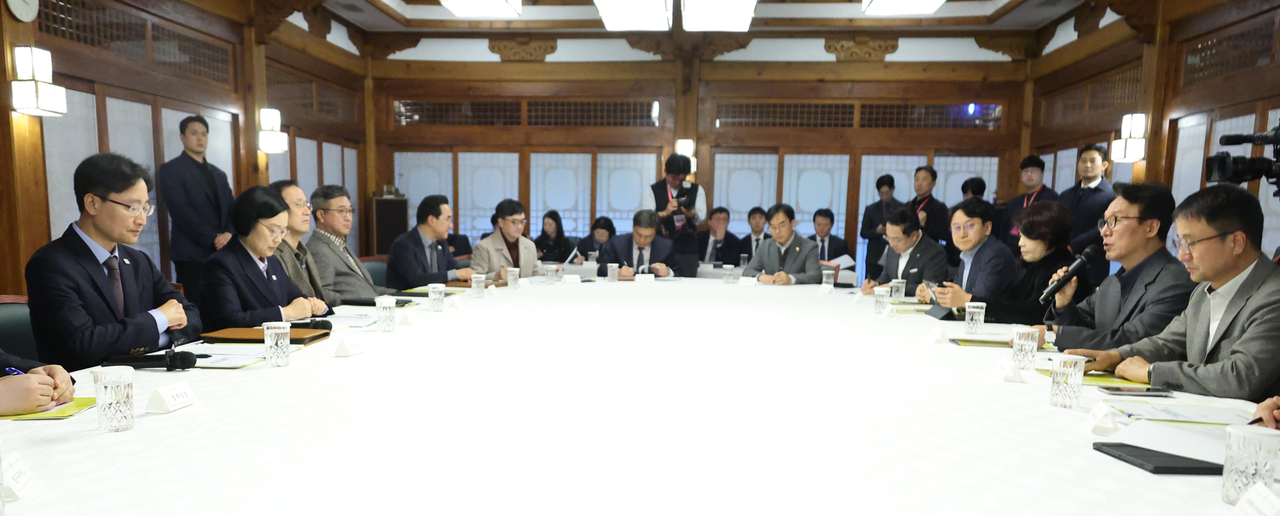
The ruling Democratic Party announced the plan on Sunday following a high-level meeting involving the party, government and presidential office at the prime minister’s official residence in Seoul.
“We agreed to review providing around 2 trillion won in financial support for urgent, essential firefighting investments to ease the financial burden on local governments,” Democratic Party senior spokesperson Rep. Park Sung-joon told reporters after the meeting.
Local governments continue to cover roughly 90 percent of firefighting costs despite firefighters having become national civil servants in 2020. Central government funding accounts for only around 10 percent of the firefighting budget.
Park said the government would also seek additional funding for firefighting equipment, training facilities and specialized medical services during the National Assembly’s deliberations on the 2027 budget.
He described the proposed package as “2 trillion won plus alpha and beta,” referring to the emergency financial support, additional spending on equipment and facilities, and the potential redirection of tobacco-related tax revenue to firefighting.
However, the government has yet to determine how the 2 trillion won would be financed or allocated.
Presidential Chief of Staff Lim Kwang-hyun said the government would consult the National Assembly on additional firefighting spending and the possible use of the Future Response Fund to address urgent funding needs.
“Firefighting is an essential public service directly linked to people’s lives,” Lim said, stressing the need for stable funding to ensure adequate protection regardless of where people live.
Lim also pledged to reactivate the government’s fiscal decentralization task force and discuss the possible use of tobacco-related local education tax revenue.
Under the existing system, a local education surtax is levied on tobacco consumption taxes, generating approximately 1.5 trillion won annually for local education funding.
The tax is scheduled to expire at the end of 2026. The government had previously proposed converting it into a local housing welfare tax in 2027, with the revenue earmarked for public housing programs.
But the ruling party is now pushing to redirect the entire revenue stream to firefighting instead, potentially raising the overall support package to more than 3.5 trillion won if the proposal is fully adopted.
The party proposed converting the expiring tax revenue into a dedicated firefighting component of the regional resource and facilities tax.
Park said Democratic Party policy chief Rep. Kwon Chil-seung strongly advocated allocating the entire 1.5 trillion won to firefighting, while government officials proposed dividing the revenue among competing spending priorities, including housing welfare.
“The party and the government had differing views on that point, and agreed to discuss it further,” Park said.
The government and ruling party also agreed to reactivate an interagency fiscal decentralization task force to work out the funding details and consider broader reforms, including the gradual transfer of national tax revenue to local governments and a redistribution of responsibilities between central and local authorities.
The funding debate has intensified following the death of firefighter Kim Jin-seok, who died in October from injuries sustained while battling a factory fire in Bucheon, west of Seoul.
His death also renewed controversy over remarks by Gyeonggi Governor Choo Mi-ae, who had described firefighting as a financial “straw” draining local resources during a parliamentary audit days earlier.
Choo subsequently apologized, saying her remarks were intended to highlight structural funding problems rather than disparage firefighters.
The government and ruling party plan to finalize the support measures during parliamentary deliberations on the 2027 budget, with the amount to be drawn from the Future Response Fund and the proposed tobacco tax revenue allocation still undecided.
“We agreed to finalize the specific level of support through close consultations between the party and the government during the National Assembly’s review of the 2027 budget,” Park said
dagyumji@heraldcorp.com