

GDP far exceeds BOK's 0.3% forecast, putting full-year growth of up to 4% within reach
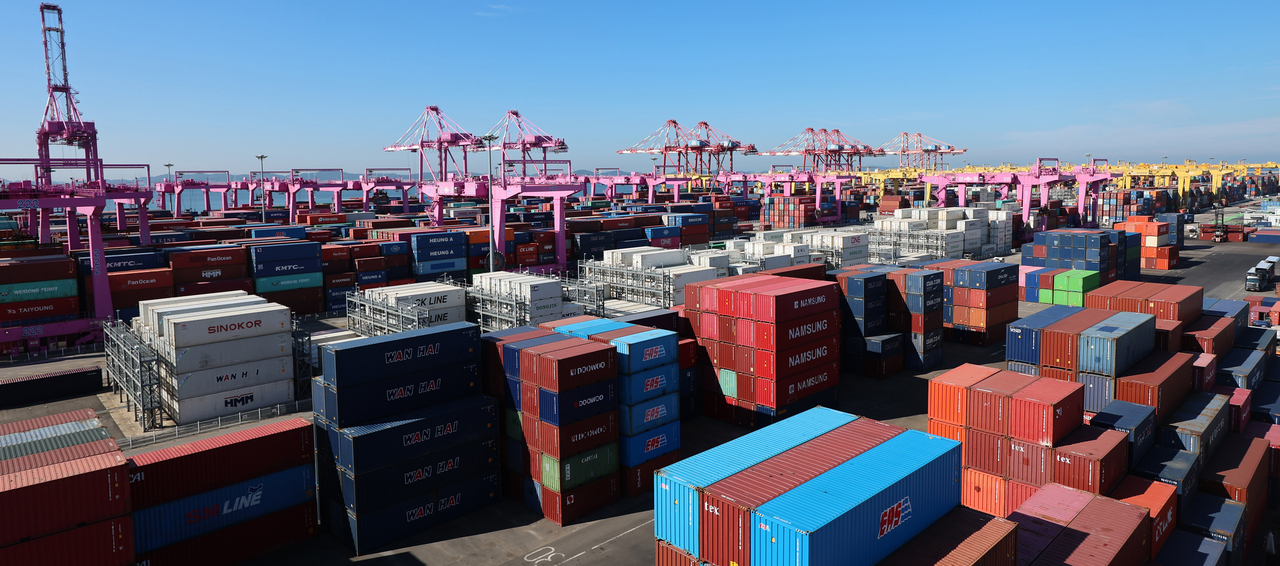
South Korea's economy grew more than three times faster than expected in the third quarter, powered by booming semiconductor exports and investment, raising the prospect of a significant upgrade to the country's annual growth outlook.
Real gross domestic product expanded 1 percent from the previous quarter, far exceeding the Bank of Korea's August forecast of 0.3 percent, preliminary data showed Tuesday. The unrounded growth rate was 0.97 percent.
The surprise expansion puts the economy on track to surpass the central bank's full-year growth forecast of 3.3 percent, with annual growth potentially reaching 4 percent if momentum strengthens further in the final quarter.
Lee Dong-won, head of the BOK's Economic Statistics Department, said the economy expanded 3.6 percent year-on-year over the first three quarters.
"If quarter-on-quarter growth in the fourth quarter were 0.0 percent, annual growth would come in at 3.6 percent. If fourth-quarter growth reached 1.4 percent or higher, annual growth could reach 4 percent," he said.
Semiconductors were the main engine of growth. Computers, electronics and optical equipment accounted for about 60 percent of the contribution to year-on-year growth, with chips alone responsible for an estimated half of that contribution.
The economy's quarterly growth accelerated from 0.6 percent in the second quarter, following a 1.8 percent expansion in the first quarter and a 0.1 percent contraction in the final quarter of 2025. Year-on-year growth eased slightly to 3.4 percent from 3.7 percent in the previous quarter.
Exports increased 2.3 percent quarter-on-quarter, led by semiconductors, machinery and electrical equipment. Imports rose 2.4 percent, driven by crude oil and semiconductor manufacturing equipment.
Facility investment jumped 4.1 percent, supported by increased spending on machinery, particularly chipmaking equipment. Investment in intellectual property products rose 2.3 percent on stronger research and development and software spending.
Construction investment increased 0.7 percent, mainly on civil engineering projects.
Despite the stronger-than-expected GDP performance, private consumption contracted 0.2 percent as spending on goods and services declined. Government consumption, meanwhile, rose 1.9 percent, supported by purchases of goods and increased health insurance benefits.
Domestic demand contributed 0.9 percentage point to third-quarter growth, while net exports added 0.1 percentage point.
Facility investment contributed 0.4 percentage point and government consumption added 0.3 percentage point, together accounting for most of the quarterly expansion. Construction investment contributed 0.1 percentage point, while private consumption subtracted 0.2 percentage point.
Lee attributed weak household spending partly to a stock market downturn and disruptions in automobile production.
"The stock market downturn since July reduced trading volumes, leading to a decline in financial services. A full-scale strike by automakers for the first time in 10 years also delayed vehicle deliveries," he said.
The BOK expects private consumption to recover gradually from the fourth quarter through early next year, supported by a rebound in passenger car purchases, cash dividends and performance bonuses from semiconductor companies, and increased government transfer payments.
Lee also cited the end of the stock market correction and stabilizing tensions in the Middle East as factors that could support consumption.
Government spending provided an additional boost to growth. Lee said authorities had conserved budget funds in the first half to prepare for a prolonged conflict in the Middle East, before stepping up spending on major construction projects and facility investment in the third quarter.
By industry, manufacturing expanded 2 percent, led by computers, electronics, optical equipment and machinery.
Electricity, gas and water supply grew 3.7 percent, while construction increased 2 percent on stronger civil engineering activity. Agriculture, forestry and fisheries expanded 5.9 percent, supported by crop production and fishing.
Services grew just 0.2 percent, with gains in business services, information and communications, and transportation.
The chip boom also delivered an unusually sharp increase in the economy's purchasing power.
Real gross domestic income surged 18.8 percent from a year earlier, accelerating from 15.7 percent in the second quarter. It was the fastest growth since the fourth quarter of 1977, when the figure reached 19 percent.
Real GDI measures the purchasing power of income generated through domestic production. The surge reflected improving terms of trade, particularly higher semiconductor prices.
The nearly 49-year high in income growth has not yet translated into stronger household spending.
"Corporate income has grown explosively since the first quarter," Lee said. "There is inevitably a time lag before this feeds through to government and household income."
ch0221@heraldcorp.com